Introduction
By Q2 2026, borax decahydrate remains a cornerstone inorganic chemical for industries ranging from detergents and ceramics to metallurgy and agriculture. At the same time, regulatory expectations for safe handling, labeling, and cross-border trade have tightened across major markets. Businesses that source and distribute borax decahydrate globally through platforms such as chemtradeasia.com, chemtradeasia.in, chemtradeasia.co.id, chemtradeasia.ae, and chemtradeasia.sg must now align with a complex framework of chemical control laws, hazard communication standards, and trade rules.
Regulators in the EU, North America, and Asia-Pacific have progressively refined their classification and risk management requirements for borates, including borax decahydrate, due to concerns about reproductive toxicity at high exposure levels. This has led to stricter classification under systems such as the EU CLP Regulation and closer scrutiny of occupational exposure, consumer uses, and environmental releases. At the same time, global value chains increasingly demand traceability, consistent product quality, and robust safety documentation.
This article provides a structured, in-depth overview of handling, labeling, and trade compliance for borax decahydrate in Q2 2026, with a focus on B2B distribution. It examines the evolving regulatory landscape, outlines product characteristics and applications, and details practical steps for safe handling, storage, labeling, and documentation. It also highlights how integrated supply platforms like the Tradeasia network support compliance across multiple jurisdictions.
Global Regulatory Landscape for Borax Decahydrate in Q2 2026
By mid‑2026, borax decahydrate is widely regulated under national and regional chemical control frameworks, but the degree and nature of restrictions vary. In the European Union, borax decahydrate (sodium tetraborate decahydrate) is classified as Reproductive Toxicity Category 1B under Regulation (EC) No 1272/2008 (CLP) when containing more than 8.5% boron. This classification triggers stringent labeling requirements, including hazard statements such as H360FD (“May damage fertility. May damage the unborn child.”) for qualifying mixtures. While borax decahydrate is registered under REACH, downstream users in the EU must ensure that their uses fall within the exposure scenarios described in the supplier’s extended Safety Data Sheet (eSDS).
In North America, borax decahydrate is subject to the Globally Harmonized System (GHS) implementation through OSHA’s Hazard Communication Standard (29 CFR 1910.1200) in the United States and the Hazardous Products Regulations in Canada. Classification can differ slightly from EU CLP, but borates are generally treated as hazardous substances requiring proper hazard communication, workplace controls, and training. Several U.S. states and Canadian provinces also maintain workplace exposure limits for borates, typically in the range of 2–5 mg/m³ (inhalable or respirable fractions) as time-weighted averages, prompting employers to implement engineering controls and personal protective equipment (PPE).
In Asia-Pacific and the Middle East, including markets served via chemtradeasia.co.id, chemtradeasia.ae, and chemtradeasia.sg, national GHS-based systems are now largely in place. Countries such as Singapore, Indonesia, India, the UAE, and others have adopted GHS-aligned regulations for classification, labeling, and SDS formats, though specific cut-off values and implementation timelines can differ. Importers must also contend with pre-market notification or registration requirements under frameworks such as India’s emerging Chemical (Management and Safety) Rules and various national inventories. For B2B distributors, this means that a single borax decahydrate product may require multiple classifications, distinct label elements, and localized SDS versions to remain fully compliant across jurisdictions.
Product Overview: Properties, Grades, and Key Applications
Borax decahydrate (chemical formula Na₂B₄O₇·10H₂O), also known as sodium tetraborate decahydrate, is a white crystalline solid with a molecular weight of approximately 381.4 g/mol. It typically appears as free-flowing granules or powder, with a density of about 1.7–1.8 g/cm³. The product is moderately soluble in water (about 4.7 g/100 g water at 20°C), with solubility increasing significantly at higher temperatures. It is alkaline in solution, with a pH around 9.2–9.3 in 1% aqueous solution, and is non-flammable, making it relatively easy to store and handle from a fire safety perspective.
Commercially, borax decahydrate is available in several industrial grades, including technical grade, detergent grade, and refined grades tailored to specific applications such as fiberglass or ceramics. Typical specifications include boron oxide (B₂O₃) content of around 36.5–37.5%, low levels of insoluble matter, and controlled particle size distributions to optimize dissolution and process performance. Suppliers on platforms like chemtradeasia.com and regional portals such as chemtradeasia.in and chemtradeasia.sg often offer multiple grades sourced from major producing regions like Turkey, the United States, and South America, enabling buyers to match product specifications with end-use requirements.
The applications of borax decahydrate are diverse and stable, underpinning steady global demand. In detergents and cleaning products, borax decahydrate acts as a pH buffer, water softener, and builder, enhancing cleaning performance and stabilizing formulations. In the glass and ceramics industry, it functions as a flux, lowering melting temperatures, improving thermal shock resistance, and contributing to glaze properties. Metallurgical uses include acting as a flux in non-ferrous metal refining and welding. Additional applications include wood preservation, agricultural micronutrient formulations (as a boron source), corrosion inhibition, and use in specialty polymers and flame retardant systems. These varied uses mean that handling and labeling requirements must be tailored to both industrial and, where applicable, consumer-facing supply chains.
Safe Handling, Storage, and Transport Requirements
Safe handling of borax decahydrate begins with controlling dust generation and inhalation exposure. While the product is non-volatile and not acutely toxic, chronic overexposure to borate dust can contribute to health risks associated with reproductive toxicity and irritation of the respiratory tract. Workplaces should implement good engineering controls, such as local exhaust ventilation at transfer and packaging points, enclosed conveying systems where feasible, and dust collection units. Workers involved in bulk handling, bagging, or mixing operations should wear appropriate PPE, including safety goggles, gloves, and, where airborne concentrations may exceed occupational exposure limits, suitable respiratory protection (e.g., N95 or equivalent particulate respirators).
Storage considerations for borax decahydrate are relatively straightforward but critical for maintaining product quality and minimizing caking. The material should be stored in dry, well-ventilated warehouses, away from moisture and sources of contamination. Because borax decahydrate can lose water of crystallization under prolonged exposure to high temperatures and low humidity, leading to conversion to lower hydrates or anhydrous forms, storage conditions should avoid extremes. Pallets should be stacked securely, and packaging—whether 25 kg bags, jumbo bags, or bulk containers—should be protected from tearing and water ingress. Clear segregation from incompatible materials, such as strong acids, helps prevent unwanted reactions and corrosion.
From a transport perspective, borax decahydrate is generally not classified as a dangerous good under major transport regulations such as the UN Model Regulations, ADR/RID (Europe), IMDG Code (sea), or IATA DGR (air), provided it is shipped as a solid in appropriate packaging. However, shippers must still comply with general cargo safety rules, including accurate product description, correct weight declaration, and secure loading to prevent spillage and dust release. In some jurisdictions, bulk transport in open railcars or trucks may be subject to additional environmental or occupational regulations to control dust emissions. Partnering with experienced distributors and logistics providers through platforms like chemtradeasia.co.id and chemtradeasia.ae can help ensure that transport practices meet both international standards and local requirements.
Labeling, Documentation, and Trade Compliance Strategies
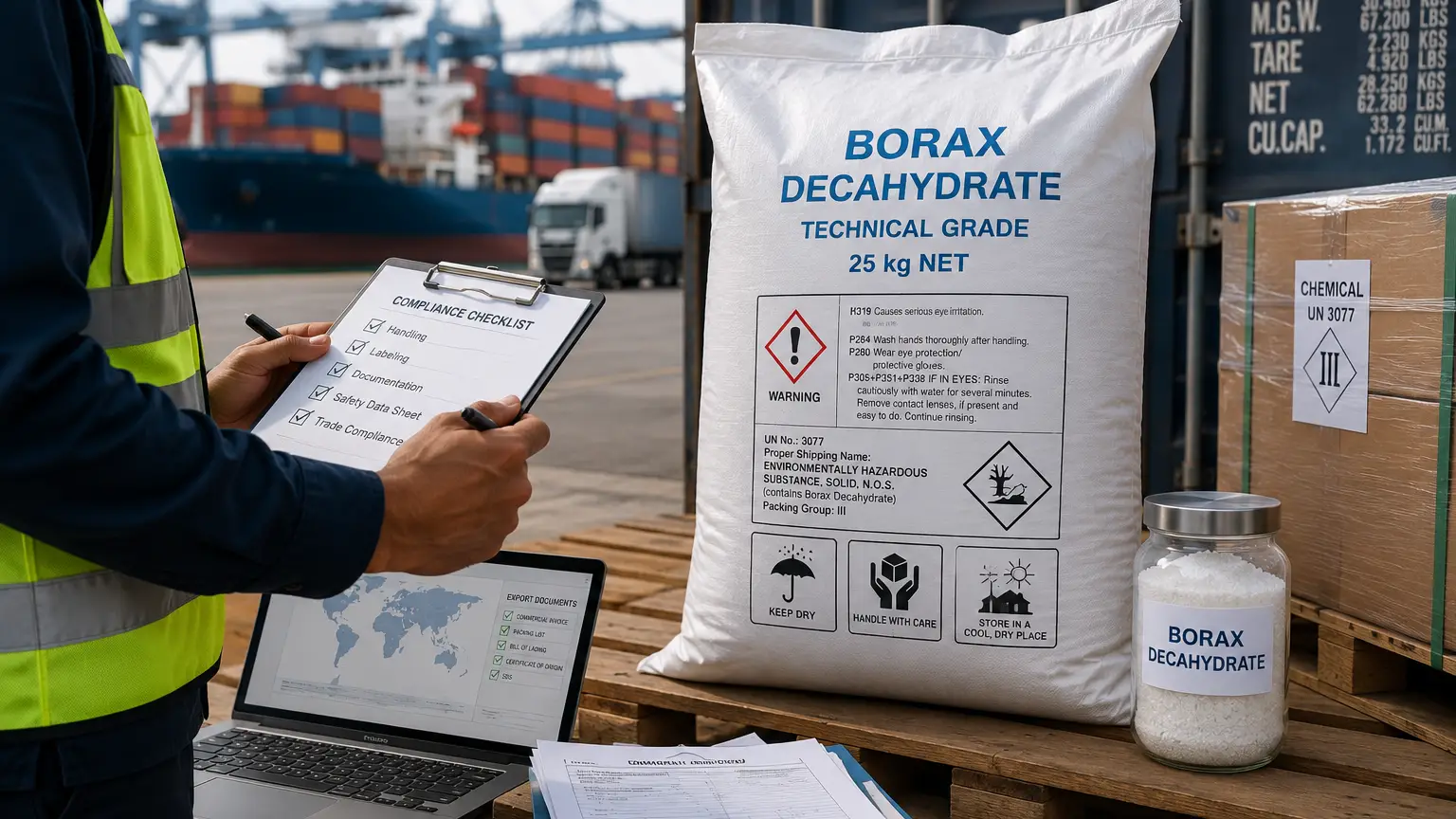
Labeling is a central element of compliance for borax decahydrate in Q2 2026, shaped by the GHS and its national or regional implementations. For industrial and professional users, labels must include the product identifier, supplier information, hazard pictograms (where classification as hazardous applies), signal word, hazard statements, and precautionary statements, all in the official language(s) of the country of sale. In the EU, for example, a borax decahydrate product classified as Repr. 1B may require the GHS08 (health hazard) pictogram, the signal word “Danger,” and relevant hazard statements. For mixtures containing borax decahydrate, classification thresholds and concentration limits must be carefully applied to determine whether reproductive toxicity or specific target organ toxicity classifications are triggered.
Safety Data Sheets (SDS) remain the primary vehicle for detailed hazard and safe-use information. By 2026, many jurisdictions require SDS to follow the 16-section GHS format, often with country-specific adaptations (such as EU Annex II to REACH or OSHA’s requirements). Distributors operating via chemtradeasia.com, chemtradeasia.in, and other regional portals must ensure that SDS are up to date with the latest regulatory classifications, exposure limits, and transport information, and that they are available in the appropriate languages for each market. For example, SDS in the EU must be provided in the official language(s) of the Member State, while markets like Indonesia or the UAE may require Bahasa Indonesia or Arabic versions, respectively.
Trade compliance for borax decahydrate extends beyond hazard communication to encompass customs, export controls, and product stewardship obligations. Accurate Harmonized System (HS) classification is essential for customs clearance and trade statistics; borax decahydrate is typically classified under HS code 2840.19 (or equivalent national codes for borates). While borax decahydrate is generally not subject to dual-use export controls, companies must still screen transactions for sanctions, embargoes, and restricted parties, especially when trading across politically sensitive regions. In some countries, borax-containing products may be subject to specific sectoral regulations, such as restrictions on boron content in consumer detergents or fertilizers. Robust internal compliance programs, supported by digital trade documentation and coordinated through networks like chemtradeasia.sg and chemtradeasia.ae, help ensure that shipments meet all applicable regulatory and documentary requirements, from certificates of analysis (CoA) and origin (CoO) to packing lists and commercial invoices.
Conclusion
As of Q2 2026, the market for borax decahydrate continues to be shaped by stable industrial demand and evolving regulatory expectations. Companies that rely on borax decahydrate in detergents, glass, ceramics, metallurgy, and specialty applications must navigate a patchwork of global rules governing classification, labeling, workplace safety, and cross-border trade. Those able to integrate regulatory intelligence into their sourcing, logistics, and product stewardship strategies can maintain supply continuity, reduce compliance risk, and respond quickly to new market opportunities.
Leveraging experienced B2B distribution partners and digital platforms such as chemtradeasia.com, chemtradeasia.in, chemtradeasia.co.id, chemtradeasia.ae, and chemtradeasia.sg can significantly simplify this landscape. These networks provide access to multiple borax decahydrate grades, consistent quality assurance, localized regulatory support, and documentation aligned with GHS, REACH, and other key frameworks. By combining robust internal safety management with reliable external partners, businesses can ensure that borax decahydrate is handled, labeled, and traded in a manner that protects workers, communities, and the environment while supporting efficient global operations.
This article is provided solely for general informational and market insight purposes and does not constitute technical, safety, regulatory, or professional advice. Users should independently verify all information with qualified experts, consult official documentation such as the latest MSDS/SDS and applicable regulations, and contact their suppliers or our team for guidance on specific products, uses, and compliance obligations.
Leave a Comment