Introduction
The global market for citric acid anhydrous continues to expand as food, beverage, pharmaceutical, and industrial manufacturers seek safe, versatile, and cost-effective acidulants. By 2026, citric acid anhydrous is expected to remain one of the most widely used organic acids worldwide, driven by its multifunctional role as an acidulant, chelating agent, buffering agent, and flavor enhancer. For procurement professionals, understanding evolving market dynamics, regulatory expectations, and supplier capabilities is essential to secure reliable and compliant supply at competitive prices.
This procurement guide is designed for global buyers who manage raw material portfolios across regions and industries. It focuses specifically on citric acid anhydrous, outlining key specifications, grades, applications, and sourcing strategies. It also highlights how digital supply chain platforms such as chemtradeasia.com, chemtradeasia.in, chemtradeasia.co.id, chemtradeasia.ae, chemtradeasia.sg, and leatherchemicalsasia.com can support more efficient and transparent procurement.
As supply chains become more complex and risk-sensitive, buyers must go beyond price comparisons and consider quality assurance, sustainability, logistics resilience, and supplier diversification. This article provides a structured framework to evaluate citric acid anhydrous suppliers globally, benchmark product quality and certifications, and align purchasing strategies with long-term operational and regulatory requirements through 2026 and beyond.
Global Market Overview for Citric Acid Anhydrous in 2026
Citrus fruits were once the primary source of citric acid, but modern industrial production relies almost entirely on microbial fermentation using carbohydrate feedstocks such as corn, sugarcane, or molasses. Global citric acid production capacity has grown significantly over the last decade, with China accounting for a large share of output, followed by Europe, North America, and parts of Southeast Asia. Industry reports project that the global citric acid market (monohydrate and anhydrous combined) may surpass USD 4–5 billion in value by the mid-2020s, with stable mid-single-digit annual growth driven by food and beverage demand.
By 2026, demand for citric acid anhydrous specifically is expected to increase in segments where lower moisture content and higher storage stability are critical, such as dry beverage mixes, instant powders, effervescent tablets, detergents, and some specialty industrial formulations. Buyers should anticipate continued competition for high-purity grades suitable for pharmaceuticals and nutraceuticals, where documentation, traceability, and regulatory compliance add complexity to procurement decisions.
Macroeconomic factors and geopolitical developments will continue to influence citric acid pricing and availability. Feedstock price volatility (corn, sugar), energy costs, freight rates, and trade policies can all affect landed costs. Post-pandemic supply chain restructuring has led many multinational buyers to diversify sourcing across multiple regions, mitigating overreliance on a single producing country. Platforms like chemtradeasia.com and its regional counterparts support this diversification by connecting buyers with vetted suppliers from Asia, the Middle East, and other key production hubs, helping to balance cost, lead time, and risk.
Key Specifications, Grades, and Quality Parameters
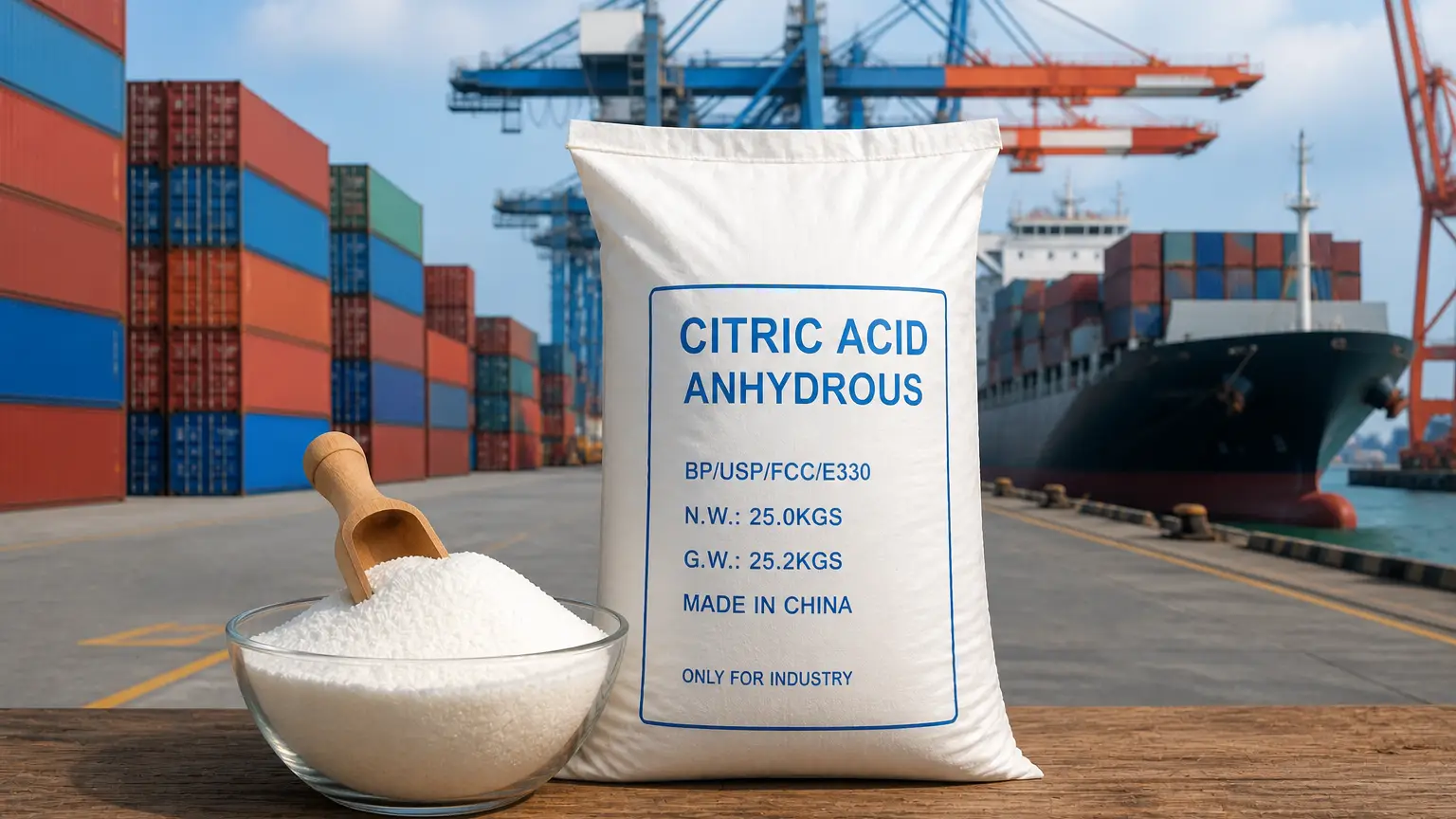
For procurement teams, a clear understanding of citric acid anhydrous specifications is fundamental to avoiding quality issues and production disruptions. Citric acid anhydrous is typically supplied as a white, crystalline solid with a tart, acidic taste and high solubility in water. It is the water-free form of citric acid, usually containing less than 0.5% moisture. Buyers should ensure that product specifications align with relevant standards such as the Food Chemicals Codex (FCC), European Pharmacopoeia (Ph. Eur.), United States Pharmacopeia (USP), or local regulatory requirements depending on the application.
Key quality parameters commonly specified in technical data sheets and COAs (Certificates of Analysis) include assay (usually ≥ 99.5% on an anhydrous basis), moisture content, sulfate and oxalate levels, heavy metals (such as lead), clarity of solution, color, and microbial limits. Particle size distribution is also critical, especially for tablet manufacturing, instant beverages, and cleaning powders. Some suppliers offer multiple particle size grades—fine, granular, or customized—to optimize flow properties, dissolution rates, and blending behavior. Buyers should work closely with technical teams to define acceptable ranges and avoid unnecessary over-specification that can increase cost.
Different end-use sectors require different grades. Food and beverage manufacturers typically specify food-grade citric acid anhydrous that complies with FCC and relevant local food regulations, often requiring certifications such as HACCP, ISO 22000, FSSC 22000, Halal, and Kosher. Pharmaceutical and nutraceutical applications may demand pharmaceutical-grade material meeting USP or Ph. Eur. standards, with stricter impurity and microbiological limits. Industrial and technical-grade citric acid anhydrous, used in detergents, metal cleaning, and water treatment, may have less stringent purity requirements but still require consistent quality. Platforms like chemtradeasia.sg and chemtradeasia.ae can help buyers match the correct grade and specification to their intended use, streamlining the qualification process.
Applications, Benefits, and End-Use Segments
Citring acid anhydrous is prized for its versatility across multiple industries. In the food and beverage sector, it functions primarily as an acidulant and flavor enhancer, providing a clean, sour taste and pH control in carbonated drinks, powdered beverages, candies, jams, and processed foods. Its anhydrous form is especially advantageous in dry mixes and instant products, where low moisture content improves shelf life and reduces the risk of caking. Many beverage and confectionery manufacturers specify citric acid anhydrous in granular or fine grades to achieve consistent dissolution and flavor distribution.
In pharmaceuticals and nutraceuticals, citric acid anhydrous is widely used in effervescent tablets, oral rehydration salts, vitamin C preparations, and syrups. It acts as a key component in effervescent systems when combined with bicarbonates, generating carbon dioxide upon contact with water. Its chelating properties also support formulation stability by binding trace metals that could catalyze degradation. Here, documentation—such as DMFs (where applicable), GMP compliance, and detailed impurity profiles—is as important as the physical product itself. Buyers sourcing through chemtradeasia.com and chemtradeasia.in often look for suppliers with strong regulatory support and a track record of servicing regulated markets.
Industrial sectors leverage citric acid anhydrous for its chelating, descaling, and environmentally friendly profile. It is used in household and institutional cleaners, dishwashing tablets, descalers, metal cleaning formulations, and even in certain oil and gas applications as a biodegradable chelating agent. In textiles and leather processing, citric acid can be used for pH adjustment and as a sequestering agent; buyers in this niche may explore specialized channels such as leatherchemicalsasia.com to integrate citric acid into broader leather chemical portfolios. Across these segments, benefits include its relatively low toxicity, biodegradability, and regulatory acceptance compared with many synthetic alternatives, supporting corporate sustainability goals and consumer preference for “cleaner” ingredient lists.
Strategic Sourcing and the Role of Tradeasia Platforms
Effective procurement of citric acid anhydrous in 2026 requires a strategic approach that balances cost, supply security, quality, and sustainability. Many organizations are moving away from single-source strategies toward multi-sourcing models that include both global and regional suppliers. This allows buyers to mitigate risks associated with transportation bottlenecks, geopolitical tensions, or sudden regulatory changes. It also creates leverage for price negotiations and service-level improvements. However, managing multiple suppliers across regions introduces complexity in qualification, documentation, and logistics coordination.
Digital platforms such as chemtradeasia.com, along with regional portals like chemtradeasia.co.id, chemtradeasia.in, chemtradeasia.ae, and chemtradeasia.sg, play an increasingly important role in simplifying this complexity. These platforms connect buyers with a network of vetted producers and distributors of citric acid anhydrous and related chemicals, offering transparent product information, technical data, and commercial terms. By centralizing supplier discovery, quotation requests, and order tracking, they reduce transaction costs and shorten the sourcing cycle.
Beyond basic sourcing, advanced procurement teams are leveraging data and analytics to optimize order quantities, safety stocks, and freight strategies. Working with a platform-based supplier such as Tradeasia can provide access to multiple shipment options (FCL, LCL, bulk, or repacked formats), various packaging sizes (25 kg bags, big bags, or customized packing), and multimodal transport solutions. This flexibility is critical when responding to demand fluctuations or entering new markets. In addition, buyers increasingly request sustainability-related data—such as information on feedstock origin, energy use, and environmental certifications—to support ESG reporting. Collaborating with service-oriented partners through chemtradeasia.com and its regional sites helps procurement teams integrate these emerging requirements without overburdening internal resources.
Conclusion
Citric acid anhydrous will remain a strategic raw material for many industries in 2026, from food and beverages to pharmaceuticals, detergents, and leather processing. Procurement professionals who understand product specifications, regulatory frameworks, and regional supply dynamics will be better positioned to secure stable, high-quality supply. Evaluating suppliers not only on price but also on technical support, documentation, logistics capabilities, and sustainability performance is essential to building resilient supply chains. As markets continue to evolve, buyers who adopt a structured, data-driven approach to sourcing will be able to respond more effectively to demand shifts, price movements, and regulatory changes.
Leveraging digital platforms such as chemtradeasia.com, chemtradeasia.in, chemtradeasia.co.id, chemtradeasia.ae, chemtradeasia.sg, and leatherchemicalsasia.com can significantly enhance sourcing efficiency for citric acid anhydrous. These portals provide access to a broad supplier base, standardized product information, and integrated logistics support, helping buyers compare options and negotiate more effectively. By combining internal technical expertise with external market intelligence and platform-based procurement tools, organizations can create a robust, flexible sourcing strategy that supports both cost optimization and long-term reliability.
This article is intended solely for informational and market insight purposes and does not constitute technical, safety, regulatory, or other professional advice. Buyers should independently verify all information with qualified experts, consult official documentation such as MSDS/SDS and applicable regulations, and, where appropriate, contact our team or their own advisors to assess suitability for specific processes, formulations, or applications.
Leave a Comment