Tightening discharge standards, accelerating water reuse mandates, and the regulatory retreat from chlorine-based chemistry have converged to make hydrogen peroxide one of the most commercially relevant oxidants in environmental treatment today. Global demand for hydrogen peroxide reached approximately 6.11 million tonnes in 2025, according to Mordor Intelligence, with wastewater treatment applications expanding at a 4.24% CAGR — outpacing the overall market average of roughly 3.9%. That gap is not accidental. It reflects a structural shift in how industrial operators and municipalities are being asked to manage contamination, discharge, and remediation.
Why Hydrogen Peroxide Is Gaining Ground in Environmental Markets
Hydrogen peroxide occupies an unusual position in industrial chemistry: it is a powerful oxidant whose only decomposition products are water and oxygen. That property, unremarkable in a laboratory context, carries significant commercial weight as environmental regulators tighten limits on persistent chemical residues in effluent and groundwater. Where chlorine-based oxidants leave behind halogenated by-products that trigger further compliance obligations, hydrogen peroxide leaves nothing behind. This characteristic has repositioned H2O2 from a specialty environmental input to a mainstream treatment agent across municipal, industrial, and remediation applications.
Producers have responded to this positioning with deliberate investment. Evonik Industries launched certified carbon-neutral hydrogen peroxide in the European market in 2024 under its Way to GO2 program, enabling downstream buyers to reduce their Scope 3 emissions without changing product specifications or logistics. Solvay, in partnership with Sapio Sciences, is building Europe's first green hydrogen peroxide hub at its Rosignano facility in Italy, powered by a 9.5 MW photovoltaic installation and targeting 756 metric tonnes of green hydrogen annually, with production scheduled to begin by mid-2026. These are not branding exercises. They reflect a producer-side bet that the environmental market for H2O2 will demand sustainability credentials alongside technical performance.
Wastewater Treatment: The Core Environmental Demand Driver
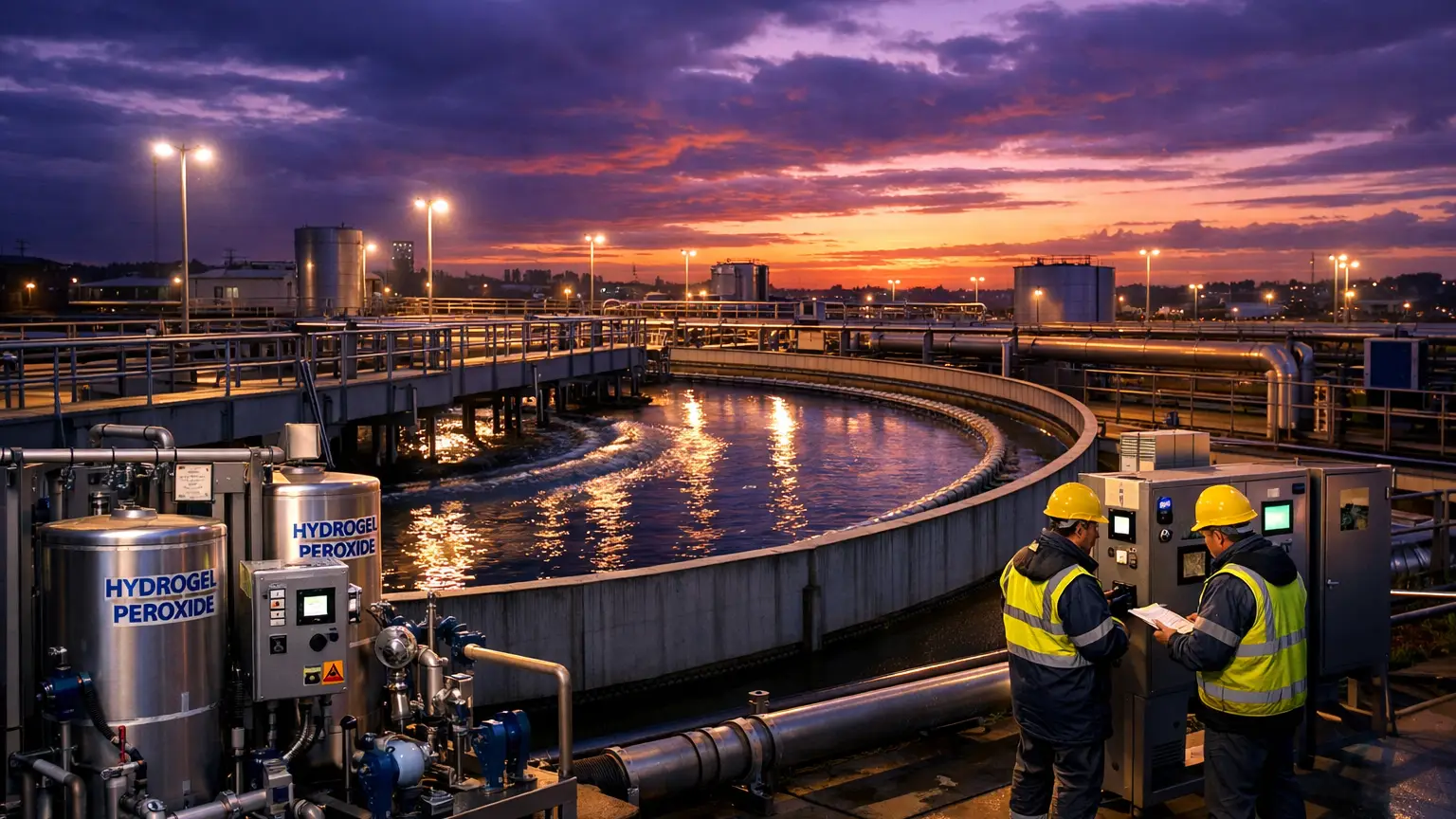
Municipal and industrial wastewater treatment represents the largest environmental end-use for hydrogen peroxide, and the application is structurally growing. The driver is regulatory: discharge standards for organic contaminants, pharmaceutical residues, and micropollutants are tightening across the EU, North America, and increasingly in Asia-Pacific. Hydrogen peroxide addresses these requirements through two distinct mechanisms — direct oxidation of pollutants at the effluent stage, and as a component in advanced oxidation processes (AOPs) where it is activated to produce hydroxyl radicals capable of degrading compounds that conventional biological treatment cannot reach.
Direct Oxidation and Odor Control
In conventional wastewater systems, hydrogen peroxide serves as a polishing oxidant for hydrogen sulfide removal — a persistent operational challenge in systems where oxygen-depleted conditions allow sulfur-reducing bacteria to flourish. At municipal plants managing seasonal odor complaints, peroxide dosing into distribution dead-ends and lift stations is well-established practice. Industrial facilities in food processing, mining, and petrochemicals use similar dosing strategies to meet effluent quality specifications without generating chlorinated organic residues that would require separate treatment stages.
Advanced Oxidation Processes (AOPs)
The more technically significant expansion is in AOP applications, where hydrogen peroxide functions as a hydroxyl radical precursor rather than a standalone oxidant. The UV/H2O2 combination is the most commercially mature AOP configuration, with established adoption in drinking water treatment and industrial effluent polishing for pharmaceutical compounds, pesticide residues, and endocrine-disrupting chemicals. Research published in Water Research in 2025 demonstrated effective removal of contaminants of emerging concern using combined UV/H2O2 and biochar processes, highlighting the integration of peroxide chemistry into multi-barrier treatment designs.
The Fenton and photo-Fenton processes — in which hydrogen peroxide is activated by iron catalysts under acidic conditions — account for the largest share of AOP industrial deployments globally, particularly in textile wastewater treatment where dye degradation is the primary target. According to a Scopus database analysis cited in MDPI Catalysts, over 400 research studies link hydrogen peroxide to wastewater decontamination, with iron-based Fenton chemistry dominating the application literature. As AOP deployment scales from demonstration projects to full municipal installations, peroxide consumption in this segment is expected to increase materially through 2028.
Onsite Generation: A Procurement Shift in Progress
One structural change worth tracking is the emergence of onsite hydrogen peroxide generation for water treatment facilities. The conventional supply model — central production via the anthraquinone process, followed by transport of concentrated peroxide in bulk tankers — carries inherent logistics and safety constraints that limit adoption in geographically dispersed or lower-capacity applications. Onsite electrochemical generation eliminates the transport risk and allows treatment facilities to produce hydrogen peroxide on demand, reducing both chemical logistics costs and the regulatory exposure associated with concentrated H2O2 storage. Cornell University researchers published results in December 2025 demonstrating solar-driven H2O2 generation using engineered covalent organic frameworks, a technology still at laboratory scale but representing a longer-term pathway to decentralized peroxide supply for water treatment. For procurement managers at municipal utilities, onsite generation warrants attention as a supply chain option for smaller or remote installations within a three- to five-year commercial horizon.
Soil and Groundwater Remediation: An Expanding Application Frontier
Contaminated soil remediation is hydrogen peroxide's fastest-growing environmental application segment in research volume, and commercialization is beginning to follow. The mechanism is well-understood: hydrogen peroxide, when activated by ferrous iron in the Fenton reaction at low pH, generates hydroxyl radicals that degrade petroleum hydrocarbons, polycyclic aromatic hydrocarbons (PAHs), and chlorinated solvents in contaminated soil matrices. The challenge — and the reason commercial adoption lags research intensity — is controlling H2O2 diffusion in heterogeneous soil environments.
Research published in Environmental Science & Technology in January 2025 by Zhejiang University introduced a precipitation-based fluorescent probe method for real-time, micrometer-scale mapping of hydrogen peroxide diffusion in soils, revealing diffusion rates ranging from 0.011 to over 0.56 mm per minute depending on soil type and permeability. The practical implication: effective Fenton-based remediation requires site-specific dosing design that accounts for soil reactivity and hydraulic conductivity — conditions that vary significantly across contaminated sites and limit the scalability of standardized treatment protocols.
Despite these constraints, hydrogen peroxide-based in-situ chemical oxidation (ISCO) is gaining traction at petroleum-contaminated industrial sites where speed of remediation is commercially necessary and biological treatment timelines are inadequate. A bibliometric analysis published in Environmental Science and Pollution Research in January 2025 confirmed that H2O2-based ISCO reduces remediation time relative to biological methods, with significant advantages in treating oil-contaminated soil when paired with biodegradation in a sequential treatment approach. One study within the review achieved 92% removal of petroleum hydrocarbons through hydrogen peroxide pre-oxidation followed by biodegradation. For site owners and environmental engineering contractors managing legacy petroleum contamination, the H2O2/bioremediation hybrid approach is becoming the operational benchmark for cost-effective ISCO execution.
PFAS Remediation: An Emerging Niche
The remediation of per- and polyfluoroalkyl substances (PFAS) in soil and groundwater is an emerging niche where hydrogen peroxide chemistry is being evaluated, though the technical pathway is less mature than for petroleum hydrocarbons. Evonik's Active Oxygens division has announced a cooperation with Intrapore specifically targeting PFAS immobilization using peroxide-based chemistry, signaling producer-side investment in this application. Given the scale of PFAS-contaminated sites in North America and Europe, and the absence of cost-effective large-scale treatment alternatives, this application carries significant long-term demand potential if technical performance can be validated at commercial scale.
Regulatory Environment: The Structural Tailwind Behind Demand
Environmental applications of hydrogen peroxide are not growing in isolation from regulatory pressure — they are, in large part, a product of it. Three regulatory dynamics are shaping demand across global markets in 2026.
In the European Union, the Urban Wastewater Treatment Directive revision underway in 2025 and 2026 is tightening requirements for micropollutant removal at large municipal treatment plants, directly increasing the market for AOP-compatible treatment agents including hydrogen peroxide. The EU's long-term objective of eliminating chlorine-based disinfection by-products from drinking water and reused wastewater is a structural demand tailwind for peroxide-based alternatives across the water treatment supply chain.
In North America, the US EPA's PFAS drinking water maximum contaminant levels established in 2024 are creating remediation obligations for water utilities and industrial site owners that will generate sustained demand for advanced treatment chemistries over a multi-year compliance horizon. EPA guidance on PFAS destruction and disposal methods published in the same period explicitly references oxidative treatment pathways, increasing the visibility of hydrogen peroxide-compatible technologies among environmental engineering contractors.
In Asia-Pacific, the demand trajectory is shaped less by specific PFAS or micropollutant mandates — which remain nascent — and more by the general tightening of industrial wastewater discharge standards in China and stricter environmental enforcement in India, Vietnam, and Indonesia. As these regulatory environments mature, the application mix for hydrogen peroxide in Asia will shift from predominantly textile and pulp bleaching toward a more balanced profile that includes wastewater treatment as a meaningful demand category alongside traditional uses.
Regional Demand Patterns in Environmental Applications
Asia-Pacific accounts for approximately 53% of total global hydrogen peroxide demand, driven primarily by textile bleaching, pulp and paper, and electronics manufacturing. Within that base, environmental applications are the fastest-growing sub-segment, driven by industrialization-related contamination and tightening discharge requirements. China's water treatment facilities reportedly serve 98.1% of municipalities as of 2021, according to International Trade Administration data, but the chemical inputs used in those facilities are shifting toward peroxide-based options as chlorine alternatives gain regulatory favor.
Europe represents the most mature environmental application market for hydrogen peroxide, where both regulatory compliance pressure and the availability of certified sustainable grades have accelerated adoption in wastewater treatment and AOP installations. Solvay's green hydrogen peroxide initiative at Rosignano and Evonik's carbon-neutral certification program are both aimed squarely at European industrial buyers facing Scope 3 emissions reporting requirements. These buyers are increasingly willing to pay a premium for peroxide grades that carry verifiable sustainability credentials, creating a price differentiation dynamic that does not exist in the same form in Asian or North American markets.
North America's environmental hydrogen peroxide demand is concentrated in municipal wastewater treatment, semiconductor fabs, and an expanding contaminated site remediation market. The US government's USD 5.8 billion investment in potable water and wastewater infrastructure, declared in February 2023, provides a multi-year demand floor for treatment chemicals including hydrogen peroxide in the municipal sector.
Green Production: How the Supply Side Is Responding
The structural alignment between hydrogen peroxide's environmental applications and its potential as a sustainably produced chemical is not lost on producers. Both Solvay and Evonik have committed to green hydrogen as the feedstock transition pathway, with Evonik's first green hydrogen-powered production site scheduled for 2026 and Solvay's Rosignano facility targeting the same year. These investments allow producers to offer the same H2O2 molecule with a substantially lower carbon footprint, enabling buyers in regulated industries to claim emissions reductions without reformulating their treatment processes.
The longer-term production innovation — solar-driven, decentralized H2O2 generation — remains pre-commercial but is moving toward scalable deployment. Cornell University's December 2025 research on covalent organic framework photocatalysts represents one technical pathway. The commercial case for decentralized production is strongest in water treatment applications where logistics costs and safety constraints currently limit peroxide adoption at smaller municipal facilities in developing regions. If photocatalytic generation reaches commercial viability within the next decade, it could structurally expand the addressable market for hydrogen peroxide in environmental applications beyond what centralized supply economics currently permit.
Conclusion
The environmental application market for hydrogen peroxide in 2026 is no longer an ancillary segment appended to a bleaching-dominated demand profile. Wastewater treatment, soil remediation, and advanced oxidation are active growth categories, each driven by specific regulatory pressures that are unlikely to reverse. The near-term commercial opportunity is concentrated in AOP deployments for micropollutant and pharmaceutical residue removal in European and North American municipal markets, and in hybrid ISCO-bioremediation applications for petroleum-contaminated industrial sites where H2O2's speed advantage over biological methods justifies the cost differential. Producers who can combine verified sustainability credentials with competitive technical performance — as Evonik and Solvay are already attempting — will be better positioned than commodity suppliers as buyers in regulated industries bring Scope 3 compliance criteria into their procurement decisions.
FAQ
What are the main environmental applications of hydrogen peroxide in 2026? Hydrogen peroxide is used primarily in municipal and industrial wastewater treatment, advanced oxidation processes (AOPs) for micropollutant removal, odor control in distribution systems, and in-situ chemical oxidation for contaminated soil and groundwater remediation. Emerging applications include PFAS immobilization.
How does hydrogen peroxide work in wastewater treatment? It functions as a direct oxidant for organic compounds and hydrogen sulfide, and as a hydroxyl radical precursor in advanced oxidation processes when activated by UV light or iron catalysts (Fenton chemistry). Unlike chlorine-based alternatives, it decomposes into water and oxygen, producing no persistent chemical residues.
What is the global market size for hydrogen peroxide in environmental applications? Total global hydrogen peroxide demand was approximately 6.11 million tonnes in 2025. Wastewater treatment applications are growing at a 4.24% CAGR, above the overall market average of roughly 3.9%, according to Mordor Intelligence.
What are advanced oxidation processes (AOPs) and how is hydrogen peroxide used in them? AOPs are water treatment technologies that generate hydroxyl radicals to degrade contaminants that conventional biological treatment cannot remove, including pharmaceuticals, pesticides, and PFAS compounds. Hydrogen peroxide serves as the hydroxyl radical source in UV/H2O2 and Fenton-based AOP systems.
Can hydrogen peroxide be used to clean up contaminated soil? Yes. In-situ chemical oxidation using hydrogen peroxide, particularly Fenton and Fenton-like systems, degrades petroleum hydrocarbons and PAHs in contaminated soil. Research from Zhejiang University published in 2025 has advanced understanding of how H2O2 diffuses through different soil types to optimize remediation effectiveness.
What is green hydrogen peroxide and who is producing it? Green hydrogen peroxide is produced using hydrogen generated from water electrolysis powered by renewable electricity, rather than from fossil fuel-derived hydrogen via the conventional anthraquinone process. Solvay and Evonik are the leading producers pursuing this pathway, with green hydrogen production facilities at their European sites scheduled to begin operation in 2026.
How do regulations drive demand for hydrogen peroxide in environmental applications? The EU's Urban Wastewater Treatment Directive revision, the US EPA's PFAS drinking water limits, and tightening industrial discharge standards in China and Southeast Asia are all increasing the regulatory requirement for advanced oxidation and peroxide-compatible treatment solutions. Each of these mandates creates sustained demand for hydrogen peroxide across municipal and industrial treatment markets.
What is the difference between Fenton and UV/H2O2 advanced oxidation processes? Fenton processes activate hydrogen peroxide using ferrous iron (Fe2+) under acidic conditions to generate hydroxyl radicals, and are typically used for industrial wastewater with high organic loads. UV/H2O2 processes use ultraviolet light for radical generation and are more common in drinking water and tertiary wastewater treatment where lower contaminant concentrations require a cleaner chemistry.