Formic acid (HCOOH) is produced predominantly in China, which holds the largest share of global production capacity and tops global export volumes, with key manufacturing clusters in Shandong Province. Asia-Pacific as a whole accounts for approximately 52–53% of global formic acid market volume. In 2026, that dominance is structurally intact — but Europe is investing in low-carbon production that may reshape premium-grade supply and sourcing preferences for regulated markets by the end of the decade.
Where Formic Acid Is Produced : China's Shandong Concentration and Asia's Hold
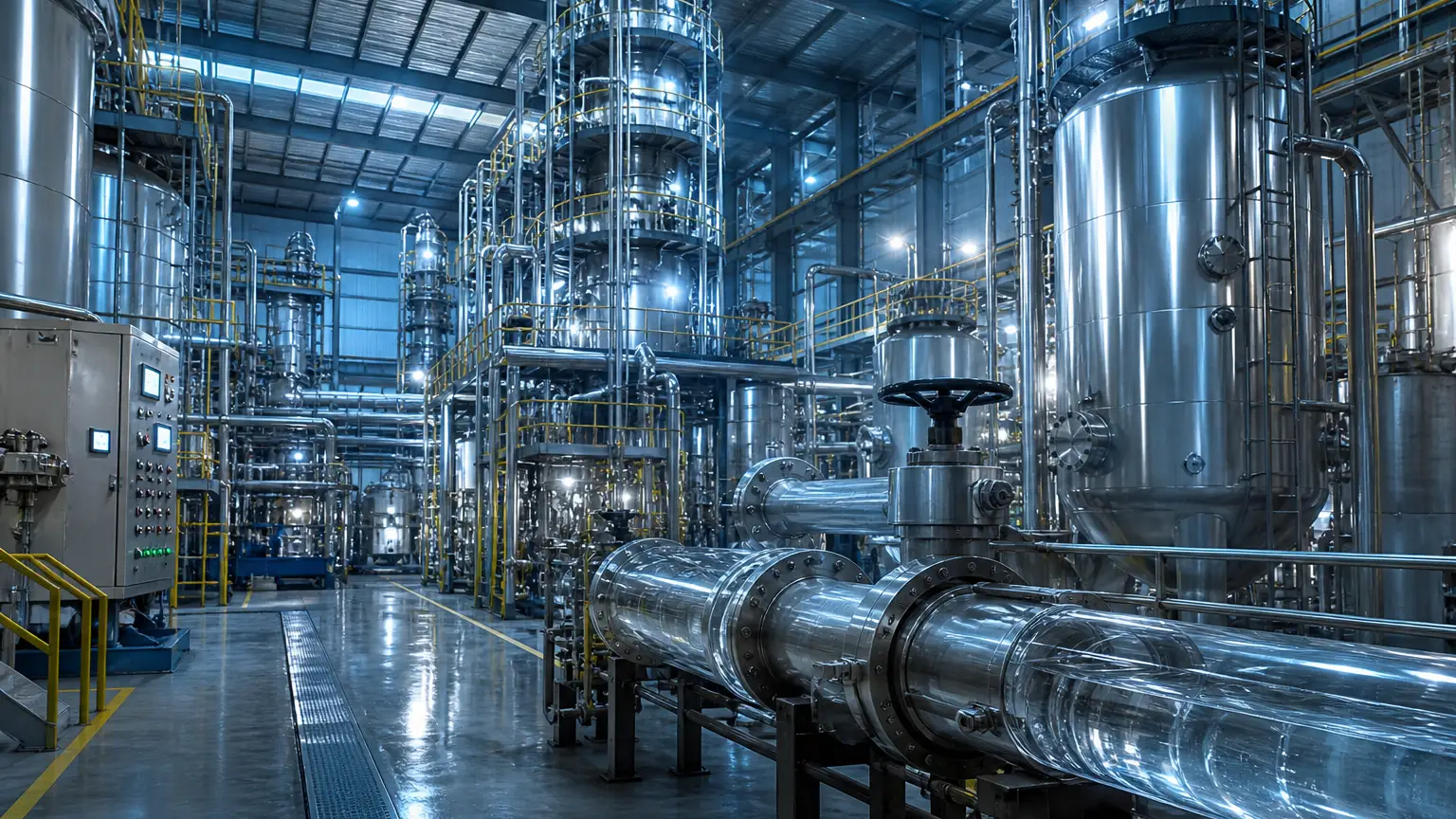
Formic acid production is more geographically concentrated than most buyers assume. China is the world's largest producer and exporter by a significant margin, with major capacity clustered in Shandong Province — home to Shandong Feicheng Acid Chemicals (100,000 MT/year capacity, over 10% of estimated global supply), LUXI Chemical Group (Liaocheng, Shandong), Shandong Rongyue Chemical, and Shandong Acid Technology Co. Ltd. These producers export to over 100 countries, covering Europe, the Americas, and Southeast Asia, shipping primarily from Qingdao, Tianjin, and Shanghai in ISO tanks, HDPE drums, and road tankers.
Germany is the second-largest global producer, where BASF SE operates the highest-capacity single-site formic acid facility in Europe at its Ludwigshafen Verbund site. BASF produces via methyl formate hydrolysis — the dominant global production route, holding roughly 59% of production volume in 2025 — and distributes to European feed, leather, and pharmaceutical markets. India rounds out the tier-two producing countries, with Gujarat Narmada Valley Fertilizers and Chemicals (GNFC) among the notable domestic producers. India's output, however, falls far short of its domestic consumption: the country remains heavily import-dependent, drawing the bulk of supply from Chinese exporters on CFR India terms.
The scale gap between China and the rest matters commercially. Chinese domestic EXW prices in mid-2025 sat around USD 340–455/MT depending on grade and quarter, while European CFR Rotterdam prices traded at approximately USD 457–670/MT — a differential that reflects not just freight but structural production cost advantages, methanol feedstock access, and competitive overcapacity in China's chemical sector. Buyers in Southeast Asia, the Middle East, and South Asia are essentially price-takers, tracking China's export quotes with adjustments for freight, duties, and regional currency moves.
Formic Acid's Primary Feedstock, Why Methanol Price Is the Key Risk Variable
The central supply chain risk for formic acid procurement is not port disruption or geopolitical restriction — it is methanol price volatility. Methanol accounts for 60–70% of production costs in the methyl formate hydrolysis route used by most Chinese and European producers. When natural gas prices spike, coal-to-methanol economics in China tighten, and when energy policy in Europe drives up gas costs, BASF's Ludwigshafen facility faces margin compression. Both dynamics have played out repeatedly since 2021.
In Q1 2025, Chinese formic acid prices rose modestly to around USD 455/MT on restocking demand after slipping through most of 2024 on oversupply and weak methanol costs. Northeast Asian producers faced margin pressure as export-oriented pricing intensified competition in European and North American import markets. By Q4 2025, global prices generally softened — European markets around USD 670/MT on average, while Asian export quotes continued trending below the five-year mean.
For buyers on term contracts, the practical implication is that formic acid pricing will continue to track methanol more closely than end-market demand. A sharp move in methanol — driven by a China energy policy shift, a cold winter constraining LNG, or a South American gas supply outage — will compress or expand margins within weeks, regardless of the agricultural or leather cycle. Buyers who do not monitor methanol benchmarks alongside their formic acid contracts are managing cost exposure incompletely.
Will 2026 Mark a Shift? Europe's Low-Carbon Production Investment
The clearest structural challenge to Asia's unchallenged dominance in formic acid supply is not another Asian competitor — it is Europe's decarbonization investment, which is specifically targeting formic acid production costs and carbon intensity.
BASF's 50 MW industrial heat pump project at Ludwigshafen, now under construction after receiving up to EUR 310 million in German federal funding, is the most consequential single development in global formic acid supply in years. The system uses waste heat from BASF's steam cracker and electricity from renewable sources to generate up to 500,000 MT of CO2-free steam per year, to be used primarily for formic acid production. BASF projects the heat pump will cut greenhouse gas emissions from Ludwigshafen formic acid output by up to 98%, equivalent to 100,000 MT of CO2 annually. Commissioning is scheduled for mid-2027.
In June 2025, BASF also launched formic acid sales through its eAuction digital procurement platform in China, signaling appetite to compete directly in Asian markets with a differentiated sustainability credential rather than ceding export position. Separately, in October 2025, Celanese Corp. announced a new bio-based formic acid product line derived from renewable ethanol feedstocks, targeting pharmaceutical solvents, paints, and inks — segments where carbon traceability is becoming a sourcing prerequisite. In November 2025, Jiangsu SOPO Chemical revealed plans to expand its formic acid capacity through capital market funding, adding another data point to China's ongoing capacity growth trajectory.
The picture that emerges is a bifurcating market: Asian producers — led by LUXI, Feicheng, Shandong Rongyue, and SOPO — will continue to dominate volume, cost competitiveness, and export reach into price-sensitive markets across South and Southeast Asia, the Middle East, and Africa. European producers, anchored by BASF, are repositioning around low-carbon product differentiation and premium-grade supply for regulated markets. For buyers procuring into EU-sensitive sectors — pharmaceutical ingredients, certified animal feed additives, or eco-labeled consumer products — this split will become commercially meaningful before the end of the decade.
Formic Acid Supply Risk Assessment What Buyers Need to Know
| Risk Dimension | Rating | Key Trigger |
|---|---|---|
| Concentration Risk | HIGH | China accounts for the largest share of global production and export; Shandong Province is the dominant cluster |
| Feedstock / Methanol Price | HIGH | Methanol is 60–70% of production cost; gas price shocks or China coal policy shifts transmit directly to spot pricing |
| Logistics / Hazmat | MEDIUM | Formic acid is classified as a corrosive material (Class 8); transport requires stainless steel or HDPE-lined ISO tanks; port compliance costs add lead time |
| Regulatory / Carbon Exposure | MEDIUM | EU carbon pricing and sustainability procurement requirements are beginning to differentiate low-carbon formic acid from conventional supply |
| Demand Substitution | LOW–MEDIUM | Acetic acid and propionic acid can partially substitute in animal feed applications; sustained price premiums could shift blending ratios in some markets |
The concentration risk deserves specific attention. Unlike commodities where multiple geographies contribute meaningful volume, formic acid's export supply is effectively anchored in a single province of a single country. China's 2021 urea export restrictions — which tripled spot prices within 60 days — demonstrated how quickly Beijing-level policy can disrupt commodity flows that buyers had treated as structurally stable. Formic acid has not faced equivalent export controls, but the concentration structure creates the same category of exposure. Buyers relying on a single Chinese origin without term contract coverage carry risk that is asymmetrically underpriced in quiet markets.
Frequently Asked Questions
Q: Who are the largest producers and exporters of formic acid?
A: China is the world's largest producer and exporter of formic acid, with major capacity in Shandong Province concentrated among producers including Shandong Feicheng Acid Chemicals (100,000 MT/year), LUXI Chemical Group, and Shandong Rongyue Chemical. Germany is the second-largest producing country, led by BASF SE's Ludwigshafen site. India produces domestically through GNFC but remains a large net importer, primarily sourcing from China on CFR terms.
Q: How is formic acid transported internationally?
A: Formic acid is classified as a Class 8 corrosive hazardous material and is shipped in stainless steel ISO tank containers or HDPE-lined drums for concentrations up to 85%; concentrations above 85% require austenitic chromium-nickel steel equipment. Key Chinese export ports are Qingdao, Tianjin, and Shanghai. For inland distribution in importing markets, road tankers and rail tankers are the standard modes, with careful compliance required for hazmat transport regulations.
Q: What drives formic acid prices?
A: Methanol is the primary driver, representing 60–70% of production costs in the dominant methyl formate hydrolysis route. When methanol prices rise — driven by natural gas prices, coal feedstock costs in China, or energy policy — formic acid spot prices follow within weeks. Freight rates between Shandong and key import markets (CFR India, CFR Southeast Asia) provide the second major pricing layer, particularly for buyers outside China.
Q: What are the main supply chain risks for formic acid buyers?
A: The highest-risk factor is production concentration — China's Shandong Province dominates global export supply, creating single-origin dependence that can be disrupted by export policy shifts, plant outages, or energy restrictions. Methanol price volatility is the second key risk, as it directly compresses or expands producer margins and passes through to spot contract pricing with a short lag.
Q: How do buyers typically source formic acid?
A: Most large industrial buyers split between term contracts (covering 60–70% of volume) for cost stability and spot procurement for market-opportunistic purchases. Direct sourcing from major Shandong producers is preferred for volume economics, while trading companies are used for flexibility and smaller lot sizes. Buyers sourcing into EU pharmaceutical or food-grade applications increasingly specify BASF-origin or bio-based certified material to meet traceability and carbon-footprint requirements from end customers.