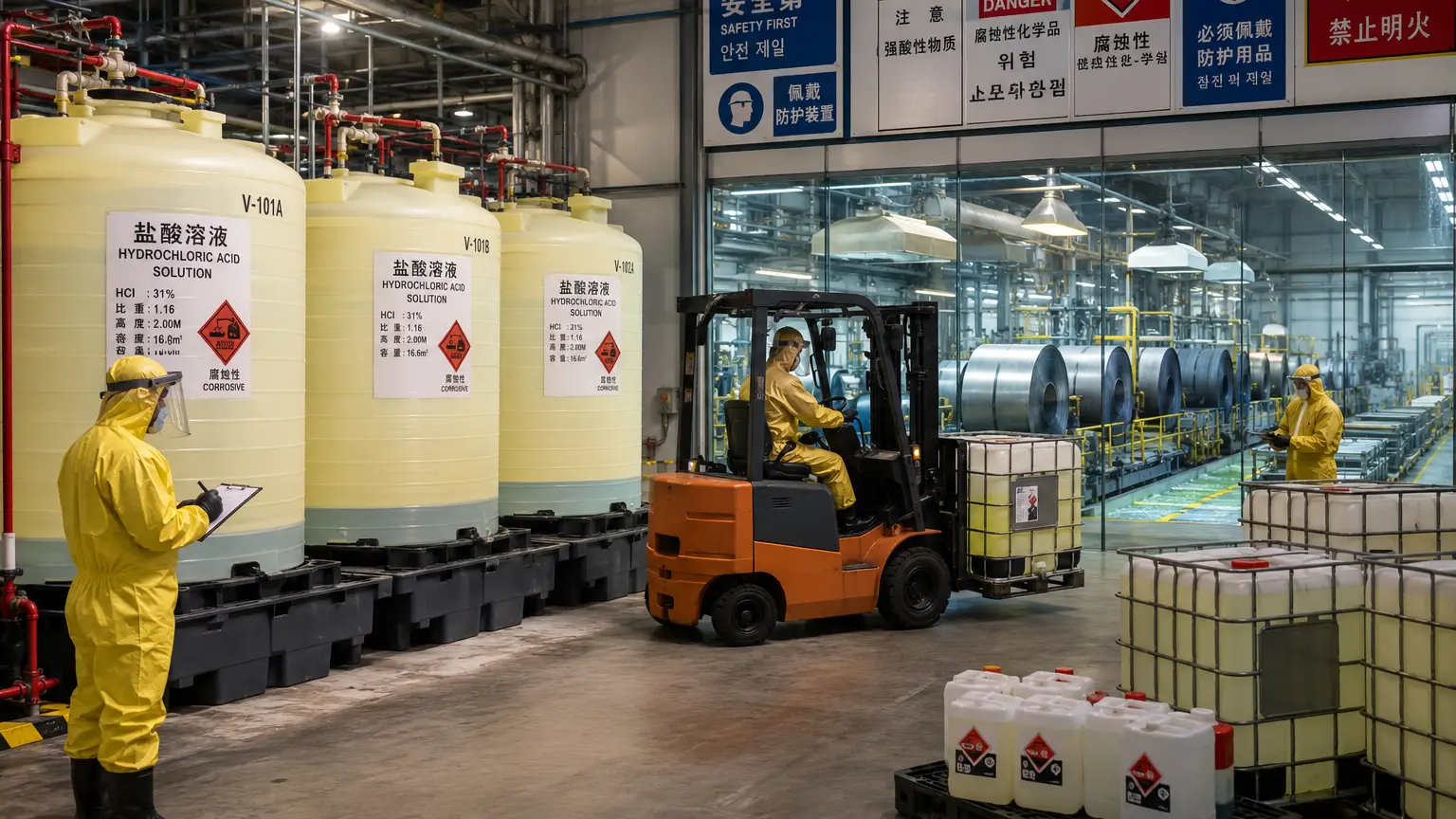
Asia-Pacific accounts for more than half of global hydrochloric acid consumption, over 52% of the total market by volume in 2025, and that dominance is not a single-industry story. The buyers of hydrochloric acid in Asia span steel mills and semiconductor fabrication plants, municipal water treatment authorities and pharmaceutical API manufacturers, food processors and textile finishing operations, mining companies and oil well service contractors. Each buyer segment operates with a distinct grade requirement, procurement structure, and supply chain logic. Understanding this buyer landscape is the starting point for any HCl sourcing or distribution strategy in the region.
What Is Hydrochloric Acid and Why Does Its Grade Matter to Buyers
Hydrochloric acid (HCl), also known as muriatic acid, is a strong inorganic acid produced commercially through two principal routes: synthetic production via the direct combination of hydrogen and chlorine gases, and as a by-product of chlor-alkali operations and the chlorination of organic compounds such as vinyl chloride monomer (VCM) and isocyanates. The by-product route accounts for approximately 61% of global HCl production, meaning the available supply of hydrochloric acid is partially determined by the production rates of other chemicals rather than by HCl demand itself. This structural feature creates periodic supply tightness and price volatility in Asian markets, most sharply illustrated by the 81% price surge in Northeast Asia between September and December 2025 when chlor-alkali operating rate reductions tightened regional by-product HCl availability.
The grade of hydrochloric acid, determined by its concentration and purity level, is the primary commercial variable that differentiates buyer segments. Industrial-grade HCl, typically supplied as a 30–33% aqueous solution, serves steel pickling, water treatment, chemical synthesis, and general industrial cleaning applications. Food-grade HCl meets standards set by the Food Chemicals Codex (FCC) and Codex Alimentarius, with strict limits on heavy metals and arsenic. Pharmaceutical-grade HCl complies with United States Pharmacopeia (USP) or European Pharmacopoeia (BP/EP) specifications. Electronic-grade or ultra-high-purity (UHP) HCl meets semiconductor fabrication requirements, with metal impurity limits measured in parts per billion. Industrial-grade accounts for approximately 53% of global market volume; the UHP electronic segment, while smaller in volume, commands 5–10x price premiums over commodity grades and is the fastest-growing segment by value across Asia.
Buyer Segment 1: Steel and Metal Processing, The Largest Volume Buyers
Steel pickling and metal surface treatment is the single largest end-use application for hydrochloric acid in Asia, accounting for over 35% of total HCl demand globally and an even higher share in Asia-Pacific given the region's dominant position in steel manufacturing. HCl is used in continuous pickling lines where hot-rolled steel strip passes through counter-current flows of acid solution at concentrations typically between 18% and 22%, dissolving iron oxides, rust, and mill scale from the steel surface before downstream processing such as cold rolling, galvanizing, wire drawing, or tin plate coating.
China is the world's largest steel producer and consumer, operating pickling lines that collectively consume millions of metric tonnes of HCl annually. Japan and South Korea, home to major integrated steel producers including POSCO, Nippon Steel, and JFE Steel, are Asia's second and third largest HCl buyers in this segment, with procurement on long-term supply contracts tied to production schedules. India's steel sector, expanding rapidly under the National Steel Policy targeting 300 million tonnes of production capacity by 2030, represents the fastest-growing steel-sector HCl buyer in Asia outside China.
Steel sector buyers of HCl have specific procurement requirements. Batch-to-batch concentration consistency, typically 31–33% HCl, is non-negotiable, as variations in acid strength cause over-etching, excessive metal loss, or inadequate scale removal that disrupts production throughput. Spent acid recovery and regeneration systems, installed in approximately 19% of Asian pickling facilities, allow some buyers to recycle HCl from pickling baths back to usable acid concentration, partially offsetting their gross procurement volumes. Steel sector buyers are generally large-volume, contract-based purchasers that negotiate annual supply agreements with producers or authorized distributors who can guarantee consistent quality and uninterrupted delivery logistics.
Buyer Segment 2: Water Treatment, High-Volume, Stable-Demand Buyers
Water treatment is the second largest application segment for hydrochloric acid in Asia, accounting for approximately 13% of global HCl consumption. HCl is used in three distinct water treatment functions: pH adjustment and neutralization of alkaline process or wastewater streams; regeneration of cation exchange resins in demineralization systems used in power plants, industrial boilers, and ion-exchange water purifiers; and production of polyaluminum chloride (PAC), a coagulant used in municipal drinking water treatment at scale across China, India, and Southeast Asia.
The water treatment buyer base in Asia is structurally broad and growing. Municipal water utilities across China's second and third-tier cities, under continuous pressure to upgrade treatment infrastructure to meet national drinking water standards, represent a large and sustained demand source. Industrial water treatment buyers include power generation plants, semiconductor fabrication facilities with ultra-pure water systems, pharmaceutical manufacturing plants, and petrochemical complexes, all of which operate demineralization systems requiring regular acid regeneration.
For water treatment applications, buyers generally require HCl at 30–33% concentration with documented purity specifications that include maximum iron content, maximum sulfate content, and absence of heavy metals above regulated limits. Suppliers serving municipal water treatment buyers must provide food-grade or technical-grade documentation depending on the application, municipal drinking water treatment requires higher documentation standards than industrial wastewater pH adjustment. Procurement patterns in this segment are characterized by steady, recurring contract volumes rather than the seasonal spike patterns seen in some industrial applications.
Buyer Segment 3: Chemical Manufacturing, Diverse and Specification-Intensive Buyers
Chemical manufacturing is the largest single application category for HCl globally when measured by organic chemical synthesis alone, accounting for approximately 47% of total HCl consumption through its use in producing vinyl chloride monomer (VCM), ethylene dichloride (EDC), and a wide range of organic and inorganic chemical intermediates. In Asia, chemical manufacturing buyers span chlorinated solvents producers, PVC resin manufacturers, fertilizer producers (calcium chloride, ammonium chloride), dye and pigment manufacturers, and specialty chemical companies producing intermediates for pharmaceutical and agrochemical applications.
China dominates Asian chemical synthesis HCl demand, with its massive integrated chemical manufacturing base consuming both captive HCl from chlor-alkali co-production and externally sourced material. India's chemical industry, particularly the Gujarat and Maharashtra clusters, is a growing buyer of HCl for organic synthesis, fertilizer production, and pharmaceutical intermediate manufacturing. Japan and South Korea's fine chemical and specialty chemical industries consume HCl for high-value synthesis applications requiring consistent quality and full regulatory documentation.
The chemical manufacturing buyer segment is the most specification-diverse in the HCl market. Some buyers require technical-grade bulk supply at commodity pricing; others need food-grade or pharmaceutical-grade quality with full traceability. What unifies them is sensitivity to supply continuity, a disruption in HCl supply can halt entire chemical production lines, creating disproportionate financial exposure relative to the cost of the acid itself. This makes supplier reliability and documentation quality procurement criteria of equal or greater weight than unit price for chemical manufacturers in this segment.
Buyer Segment 4: Semiconductor and Electronics, Fastest-Growing, Highest-Value Buyers
Semiconductor and electronics fabrication is the fastest-growing and highest-value buyer segment for hydrochloric acid in Asia by revenue, and the segment where supply chain management requirements are the most demanding. Ultra-high-purity (UHP) HCl is used extensively in semiconductor fabrication for silicon wafer cleaning and etching, where trace metal contamination at parts-per-billion levels can compromise chip performance and yield. The global semiconductor-grade HCl market was valued at approximately USD 800 million in 2025, growing at a CAGR of 6%, with Asia-Pacific dominating consumption through its concentration of leading fab operations.
Taiwan, South Korea, China, and Japan are the core Asian markets for UHP HCl procurement. Taiwan Semiconductor Manufacturing Company (TSMC) in Hsinchu and Tainan, Samsung and SK Hynix in Pyeongtaek and Icheon, and Chinese fabs expanding rapidly in Xi'an, Nanjing, and Wuhan are among the buyers setting the global standard for UHP HCl specifications. These buyers source under long-term supply contracts with dedicated purification infrastructure validation, single-source qualification procedures, and regular third-party purity auditing. UHP HCl commands 5–10x the price of industrial-grade material and is supplied in specialized corrosion-resistant containers with full chain-of-custody documentation.
The semiconductor buyer segment is expanding into Southeast Asia as well: Vietnam, Malaysia, and Thailand are attracting semiconductor assembly and advanced packaging investment, creating incremental UHP HCl demand from new Asian market entrants. ASEAN membrane chlor-alkali producers in Thailand and Vietnam have begun exporting surplus HCl to electronics assemblers in Malaysia, reflecting the regional supply chain development within Southeast Asia's emerging electronics manufacturing base.
Buyer Segment 5: Food Processing and Dairy, Food-Grade Procurement
Food-grade hydrochloric acid accounts for approximately 9% of global HCl consumption and is one of the most documentation-intensive procurement categories in the market. In food processing, HCl functions as an acidulant, a pH regulator, and a processing agent in applications including high-fructose corn syrup (HFCS) production, casein precipitation in dairy processing, glucose and starch hydrolysis, and gelatin manufacturing. The food and dairy processing industry across China, India, Japan, and South Korea represents the core of Asian food-grade HCl demand.
China's large-scale starch processing and HFCS manufacturing base is among the most significant food-grade HCl buyers in Asia, using acid for starch hydrolysis and glucose isomerization processes at industrial scale. Japan's food processing industry, with its emphasis on ingredient quality and traceability, typically sources food-grade HCl under strict COA requirements aligned with JECFA and Japanese Food Additive specifications. India's expanding dairy and protein processing sector is an emerging buyer in this segment as casein, whey protein, and dairy ingredient manufacturing capacity grows.
Food-grade HCl buyers require: arsenic content below 2 ppm (per FDA guidelines), iron content within defined limits, heavy metal limits compliant with FCC specifications, and full documentation including a Certificate of Analysis, MSDS, and regulatory compliance letter. These buyers are also among the most sensitive to supplier auditing, food processors with global retail customers conduct or require third-party supplier qualification audits that verify both product quality and manufacturing facility compliance.
Buyer Segment 6: Pharmaceutical Manufacturing, The Most Specification-Critical Buyers
Pharmaceutical-grade hydrochloric acid is used in API (active pharmaceutical ingredient) synthesis, pH adjustment in drug formulation manufacturing, and production of pharmaceutical salts, converting free-base drug compounds into their hydrochloride salt forms, which improves solubility and bioavailability. The pharmaceutical sector is the smallest by volume among major HCl buyer segments but the most demanding in terms of grade purity, documentation, and supply chain qualification requirements.
India is Asia's dominant pharmaceutical HCl buyer, reflecting its status as the world's largest generic drug manufacturer. API clusters in Hyderabad, Ahmedabad, and Mumbai source pharmaceutical-grade HCl for drug synthesis under GMP-compliant procurement procedures, with supplier qualification requiring USP or BP/EP grade documentation, batch records, and quality system certification. China's pharmaceutical manufacturing base, growing rapidly in both API and finished dosage form production, is an increasingly significant pharma-grade HCl buyer as domestic producers upgrade quality systems to meet international export market requirements.
Pharmaceutical buyers evaluate HCl suppliers on criteria that extend well beyond price: documented purity aligned with pharmacopoeial specifications, GMP-certified manufacturing process, stability of supply through qualified alternate sources, and the supplier's ability to provide regulatory starting material (RSM) documentation for drug regulatory submissions. Procurement is contract-based with fixed specifications and significant switching costs, qualifying a new HCl supplier in pharmaceutical manufacturing typically requires a 3–6 month validation process.
Buyer Segment 7: Textile and Leather Industries, Regional Concentration Buyers
Textile and leather processing buyers of HCl are geographically concentrated in the manufacturing clusters of China, India, Bangladesh, and Vietnam. In textile processing, HCl is used for fabric neutralization after alkali scouring, wool carbonizing (removing vegetable matter from wool fiber using acid), and dyeing process pH adjustment. In leather manufacturing, HCl is used in the pickling process that prepares hides for chromium tanning by adjusting the hide's pH and preserving it during transport.
India's textile sector, one of the world's largest, with major cotton processing clusters in Gujarat, Rajasthan, and Tamil Nadu, is a significant HCl buyer for fabric processing and dyeing applications. Bangladesh's export-oriented garment industry, while primarily a fabric consumer, relies on upstream textile chemical suppliers who use HCl in fiber and yarn processing. China's leather manufacturing clusters, concentrated in Guangdong and Zhejiang, represent the region's largest leather-sector HCl buyer base.
Textile and leather buyers typically source industrial-grade HCl through regional distributors rather than directly from producers, with procurement driven primarily by price and logistics proximity. These buyers represent the "distribution-driven volume" segment of the HCl market, their procurement is fragmented, price-sensitive, and best served by regional distribution infrastructure rather than direct manufacturer supply relationships.
What HCl Buyers in Asia Expect From Suppliers in 2026
Across all buyer segments, Asian HCl buyers in 2026 are moving beyond price as their primary procurement criterion. The supply chain disruptions of 2021–2024 and the sharp price volatility experienced in Northeast Asian markets in late 2025 have shifted procurement thinking toward supply security and reliability as primary qualifiers, with price secondary. Buyers in steel, semiconductor, and pharmaceutical applications now consistently cite supply continuity, quality consistency, and documentation completeness as their top three supplier evaluation criteria, ahead of unit cost.
This shift has concrete implications for supplier selection. Industrial HCl buyers are increasingly maintaining relationships with two to three qualified suppliers across different chlor-alkali production sites, recognizing that single-source dependence on by-product HCl creates vulnerability to plant outage disruptions. Semiconductor buyers are executing long-term contracts of 3–5 years with UHP HCl suppliers who have invested in dedicated purification capacity. Food and pharmaceutical buyers are requiring annual GMP audits of their HCl supply chain, including third-party quality system verification.
Tradeasia International supplies hydrochloric acid, including industrial-grade 30–33% and food-grade variants, to buyers across Asia, with regional operations in China, India, Indonesia, Singapore, Vietnam, and the Philippines. Buyers in steel processing, water treatment, food manufacturing, or chemical synthesis seeking a qualified, documentation-ready HCl supply source can contact our regional procurement teams to discuss grade specifications, volumes, safety documentation, and delivery logistics.
Market Outlook: Asia HCl Demand Through 2031
The global HCl market is projected to grow from approximately 8.1 million metric tonnes in 2026 to over 10.6 million metric tonnes by 2031, at a CAGR of approximately 5.5%. Asia-Pacific, already accounting for over 52% of global consumption, will lead this growth, with India projected to register the fastest CAGR in the region through 2033, driven by steel manufacturing expansion, pharmaceutical industry growth, and increasing textile and food processing capacity. China's "dual-carbon" policy goals are driving the phase-out of older, polluting chlor-alkali capacity, which may periodically tighten by-product HCl availability in the region and create upward pressure on industrial-grade pricing.
The most structurally significant trend for buyers is the bifurcation of the HCl market into two distinct growth profiles: commodity-grade volume growth driven by steel, water treatment, and chemical synthesis expansion; and value-grade growth driven by semiconductor fabrication, pharmaceutical manufacturing, and food processing, where purity requirements and documentation standards are tightening continuously. Buyers operating in commodity-grade applications face a market of adequate volume but periodic price volatility; buyers in value-grade applications face a market of constrained qualified supply and increasing supplier qualification requirements. Procurement strategies that account for this bifurcation, with differentiated sourcing approaches for commodity-grade and specialty-grade HCl needs, will deliver better supply security and cost outcomes than undifferentiated procurement models through 2031.