Introduction
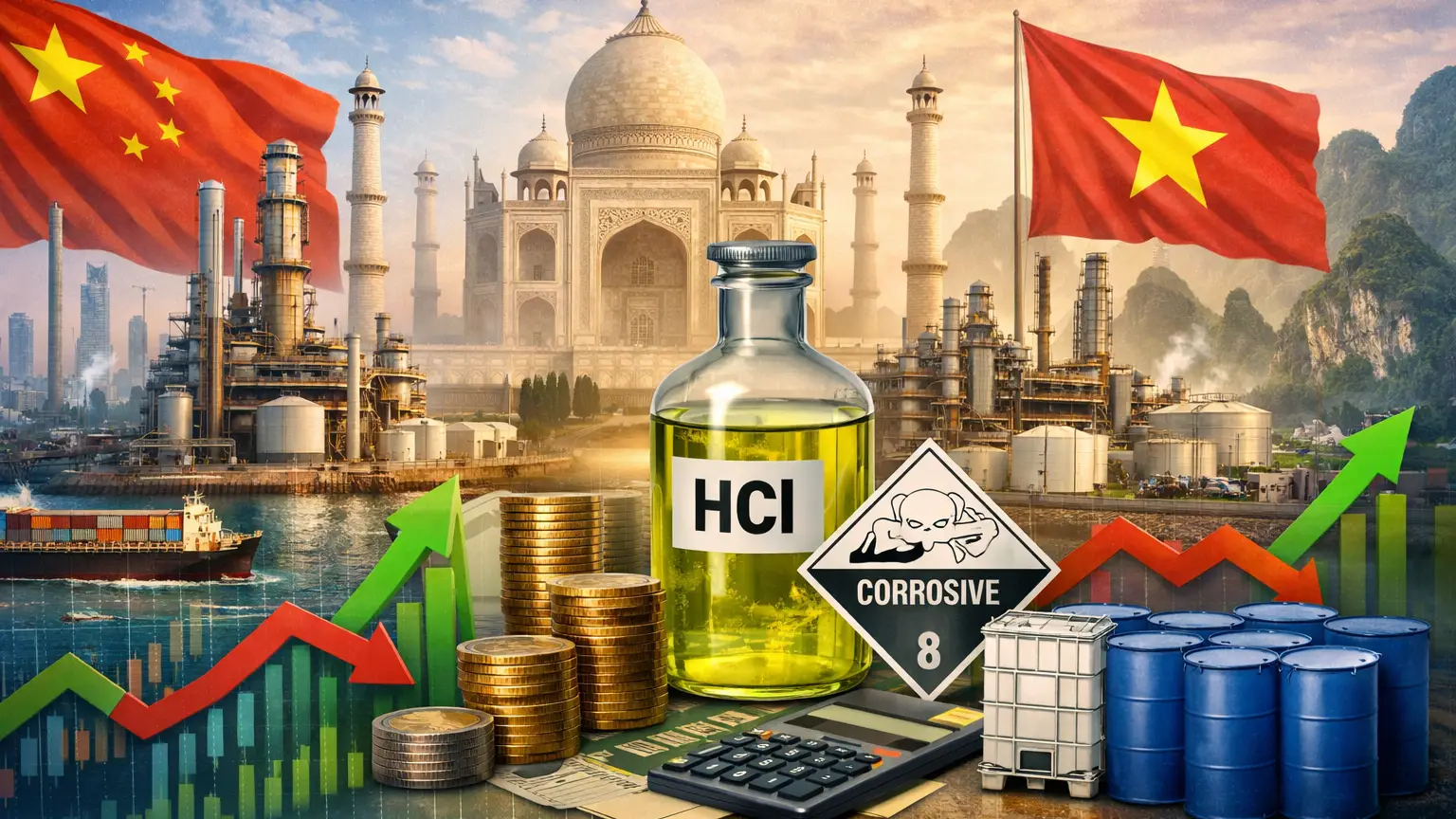
Hydrochloric acid is one of the most widely used inorganic acids in modern industry, underpinning value chains from PVC plastics and fertilizers to food processing and water treatment. For American buyers, understanding how hydrochloric acid price benchmarks differ between China, India, and Vietnam is essential to securing competitive and reliable supply. These three Asian producers have become increasingly important in the global trade of bulk HCl 31–33%, offering both cost advantages and diversified sourcing options.
Over the past decade, hydrochloric acid pricing has been shaped by several structural factors: the growth of chlor-alkali capacity, the health of downstream steel and construction sectors, energy prices, and environmental regulations. More recently, logistics disruptions, container freight volatility, and changing trade policies have added layers of complexity for U.S. importers. As a result, price benchmarking is no longer just about headline numbers; it requires a nuanced view of regional cost structures and supply reliability.
This article provides a structured comparison of hydrochloric acid prices in China, India, and Vietnam, with practical context for American procurement teams. It also explains how platforms like chemtradeasia.com help bridge geographic and information gaps, enabling U.S. buyers to access vetted producers, transparent quotations, and integrated logistics for bulk industrial hydrochloric acid.
Hydrochloric Acid: Properties, Grades, and Industrial Uses
Hydrochloric acid (HCl) is a strong, monoprotic mineral acid typically supplied as an aqueous solution. Commercial bulk grades usually range from 30% to 37% by weight, with HCl 31–33% being a common specification for industrial applications because it balances handling safety, corrosivity, and transport efficiency. The acid is colorless to slightly yellow, with a pungent odor, and is highly corrosive to most metals and organic tissue, necessitating appropriate materials of construction and strict safety protocols.
From a product standpoint, hydrochloric acid is often classified by purity and end-use: technical grade, industrial grade, food grade, and electronic grade. Industrial and technical grades are widely used in steel pickling, pH control, and inorganic salt production. Food-grade HCl, produced under stricter quality standards, is used in gelatin production, beverages, and as a processing aid in various food applications. Ultra-pure grades serve niche applications in electronics and pharmaceuticals, where trace metal content and organic impurities are tightly controlled.
In the United States, the largest consumption segments for industrial hydrochloric acid include steel pickling, oil and gas well stimulation, ion-exchange resin regeneration, and the manufacture of organic and inorganic intermediates such as calcium chloride and vinyl chloride monomer (VCM). Market analyses by major chemical consultancies have consistently shown that HCl demand in North America is closely tied to construction, automotive, and energy cycles. This linkage means that fluctuations in these downstream sectors can quickly translate into changes in HCl spot prices and contract negotiations.
Global Hydrochloric Acid Supply Landscape
Most hydrochloric acid is produced as a co-product of the chlor-alkali process, where chlorine and caustic soda are manufactured from brine via electrolysis. Hydrogen generated in this process is reacted with chlorine to form hydrogen chloride gas, which is then absorbed in water to produce aqueous HCl. Because HCl is largely co-generated rather than produced as a primary product, its availability and pricing are strongly influenced by chlorine and caustic soda demand. When chlor-alkali plants run at high utilization, HCl supply is abundant and prices tend to soften; when utilization drops, HCl can tighten and prices rise.
China, India, and, increasingly, Vietnam have all expanded chlor-alkali capacities to support domestic PVC, alumina, and chemical industries. China is the world’s largest chlorine producer, and consequently the largest producer of hydrochloric acid. India has grown its chlor-alkali base to serve both domestic infrastructure growth and export markets. Vietnam, though smaller in absolute capacity, has leveraged its strategic location in Southeast Asia to become a regional supplier of various basic chemicals, including HCl, particularly for neighboring ASEAN markets.
For American buyers, the global supply landscape is also shaped by logistics and regulatory considerations. Hydrochloric acid is typically shipped in bulk by ISO tanks, rubber-lined tankers, or IBCs, and is subject to hazardous materials regulations. Freight rates, port congestion, and vessel availability can significantly affect landed costs. In addition, trade policies—such as tariffs on certain chlor-alkali derivatives, environmental compliance requirements, and local content rules—can influence the competitiveness of imports versus domestic U.S. production. This interplay of production economics and logistics is central to any meaningful price benchmark exercise.
Price Benchmark: China vs India vs Vietnam
Benchmarking hydrochloric acid price across China, India, and Vietnam requires distinguishing between ex-works or FOB prices and fully landed costs into the United States. Historically, Chinese FOB prices for bulk HCl 31–33% have often been among the lowest due to large-scale chlor-alkali capacity, economies of scale, and government-supported infrastructure. However, domestic demand volatility—particularly from steel pickling and PVC production—can cause regional price swings. Periods of strong Chinese construction activity can tighten local supply and lift export offers, while oversupply phases can lead to aggressive export pricing.
India’s hydrochloric acid prices typically sit in a mid-range when compared to China. Indian producers often face higher energy and logistics costs, but benefit from a robust domestic market that stabilizes plant utilization. Exportable surpluses arise when local demand is temporarily weak or when new chlor-alkali capacities come online. In such periods, Indian FOB prices can be highly competitive, especially for U.S. East Coast or Gulf Coast buyers with favorable shipping routes. Additionally, India’s regulatory environment and long-standing trade relationships with the United States can make contracting and documentation more predictable.
Vietnam’s hydrochloric acid price profile is more niche and regionally focused. With smaller production volumes, Vietnamese suppliers often prioritize nearby ASEAN customers, where shorter transport distances lower freight costs. For the U.S. market, Vietnam can be competitive when container or tanker availability from larger exporting countries is constrained, or when buyers seek to diversify risk away from a single source country. In such cases, Vietnamese FOB prices may be slightly higher than Chinese averages, but the overall landed cost can be justified by supply security, flexible lot sizes, and shorter lead times through certain Pacific routes.
From a landed-cost perspective into America, the differential between these three origins is often narrowed or even reversed by ocean freight, insurance, and handling charges. For example, during periods of elevated container freight from North Asia, Indian or Vietnamese origin HCl may achieve parity or even a slight advantage over Chinese product. Conversely, when freight markets normalize and large-volume contracts are negotiated, Chinese material can again become the lowest-cost option. Professional buyers therefore track not only FOB benchmarks but also freight indices, port charges, and currency movements when comparing offers.
Sourcing Hydrochloric Acid via chemtradeasia.com for the U.S. Market
Digital trading platforms such as chemtradeasia.com have become important tools for American companies seeking to source industrial hydrochloric acid from Asia. Rather than negotiating individually with multiple producers across China, India, and Vietnam, U.S. buyers can access aggregated offers, standardized specifications, and coordinated logistics through a single interface. This approach reduces transaction costs, improves price transparency, and shortens the time required to benchmark options from different origins.
On chemtradeasia.com, hydrochloric acid is typically offered in common industrial strengths such as 30–33% and 35–37%, with detailed technical data sheets specifying assay, iron content, free chlorine limits, and other key parameters. Buyers can request quotations for various packaging formats, including ISO tank containers, bulk tankers, and IBCs, depending on their storage infrastructure and consumption profile. The platform’s supplier network includes established chlor-alkali producers in China, India, and Vietnam, whose facilities are generally audited for quality management systems and compliance with international standards.
For U.S.-based procurement teams, one of the main advantages of using chemtradeasia.com is the ability to compare total landed costs across origins in a structured way. The platform can incorporate ocean freight estimates, port handling, and inland transportation to American destinations, enabling apples-to-apples comparison of offers. In addition, trade documentation, export permits, and compliance with U.S. hazardous materials regulations can be coordinated centrally. This integrated service model helps mitigate typical import risks such as shipment delays, inconsistent product quality, or misaligned specifications.
Beyond price, the platform also supports strategic sourcing decisions. Buyers can diversify their supplier base by splitting volumes across Chinese, Indian, and Vietnamese producers, reducing exposure to localized disruptions such as plant outages, environmental enforcement actions, or regional logistics bottlenecks. For companies with multi-site operations in the United States, chemtradeasia.com can help align deliveries and contract structures with internal consumption patterns, smoothing inventory levels and reducing emergency spot purchases at unfavorable prices.
Conclusion
Hydrochloric acid remains a critical building block for U.S. industry, and its pricing is closely tied to global chlor-alkali dynamics, regional demand patterns, and logistics conditions. China, India, and Vietnam each offer distinct value propositions as export origins: China with its scale and historically low FOB prices, India with its regulatory familiarity and stable domestic base, and Vietnam with its regional agility and diversification benefits. For American importers, the most competitive option at any given time is rarely static; it reflects a moving balance of production costs, freight markets, and risk management priorities.
In this context, transparent benchmarking and structured sourcing are essential. By combining market intelligence on regional hydrochloric acid prices with practical tools for comparing landed costs, U.S. buyers can negotiate more effectively and design resilient supply strategies. Platforms like chemtradeasia.com add further value by connecting American demand with vetted Asian producers, standardizing product specifications, and coordinating logistics and documentation. This integrated approach helps ensure that hydrochloric acid supply remains both cost-effective and reliable, even as global chemical markets continue to evolve.
The information provided in this article is intended solely for general informational and market insight purposes and does not constitute technical, safety, engineering, legal, or other professional advice. Readers should independently verify all data and assumptions with qualified experts, consult official product documentation such as MSDS/SDS and relevant regulations, and contact our team or other competent professionals before making procurement decisions or using hydrochloric acid in specific applications.
Leave a Comment