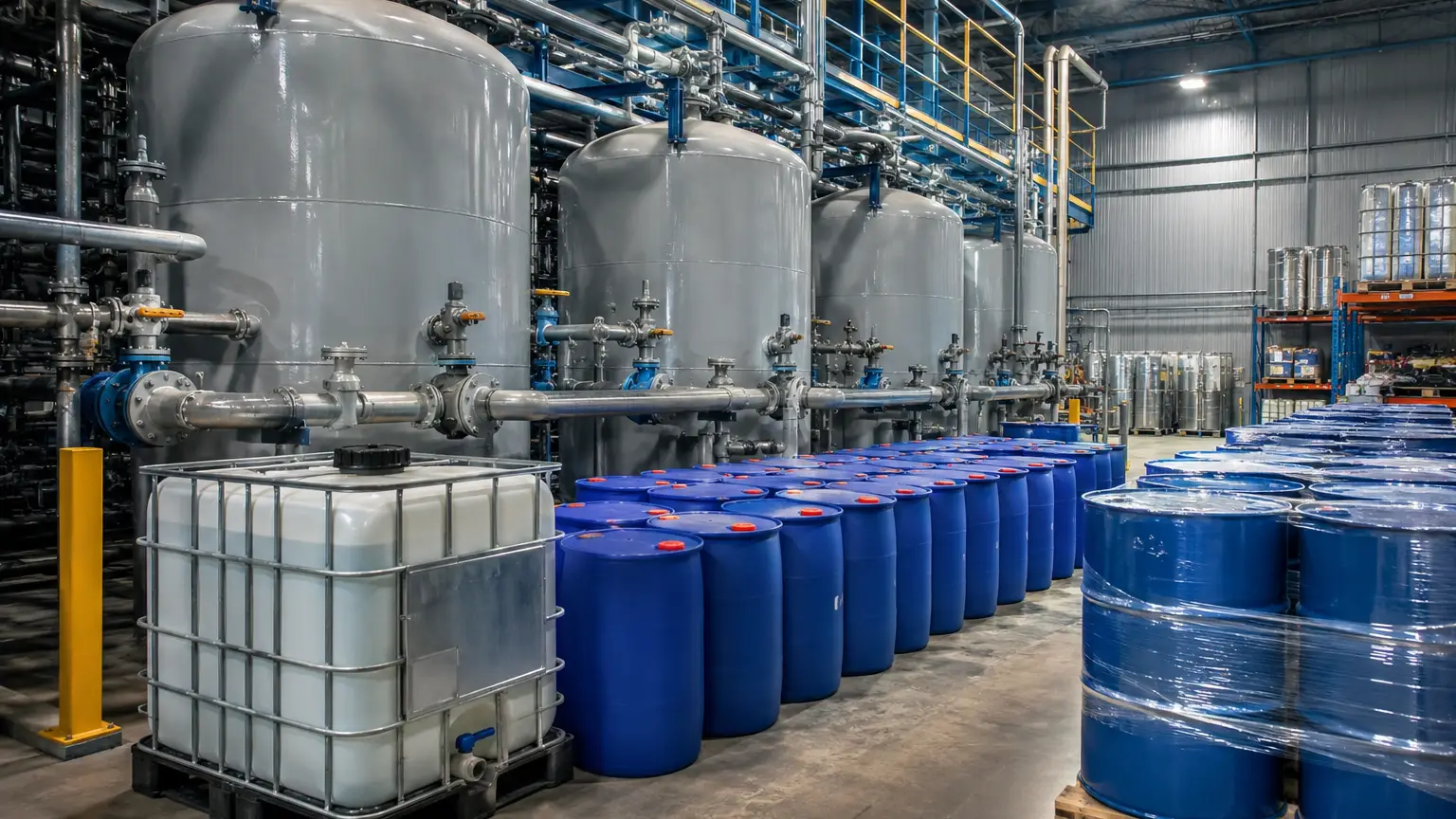
Hydrochloric acid sits at an uncomfortable intersection for procurement teams: it is one of the most widely used industrial chemicals in the world, consumed across steel pickling, oil well acidizing, water treatment, food processing, and semiconductor fabrication, yet its hazardous classification makes it one of the most logistically complex chemicals to source, transport, and store at industrial scale. The global hydrochloric acid market was valued at USD 2.45 billion in 2025 and is projected to reach USD 3.64 billion by 2032 at a CAGR of 5.80% (360iResearch, 2025), with Asia-Pacific accounting for over 52% of total volume consumption. For industrial buyers, the commercial challenge is not finding HCl suppliers. It is qualifying the right supplier for the right grade, with the documentation, logistics capability, and safety compliance required by the application and destination market.
How Hydrochloric Acid Is Produced and Why the Production Route Matters to Buyers
Hydrochloric acid reaches the market through two structurally different production routes, and the route determines the cost structure, availability, and consistency of supply that buyers should expect.
The chlor-alkali process is the dominant commercial production method, producing HCl as a co-product of chlorine and caustic soda manufacture through the electrolysis of brine. Because HCl production in this route is tied to chlorine and caustic soda output, its availability fluctuates with the operating rates of chlor-alkali plants rather than with HCl demand independently. When chlor-alkali producers curtail output due to low caustic soda margins or high energy costs, HCl co-product supply tightens simultaneously across all grades, regardless of downstream demand from steel mills or water treatment operators. Procurement teams sourcing from chlor-alkali-linked suppliers should monitor chlor-alkali market conditions, particularly caustic soda prices and energy costs in the producing region, as leading indicators of HCl supply availability.
The synthetic route produces HCl by direct combination of hydrogen and chlorine gas, or as a by-product of organic chlorination reactions in chemical manufacturing. Synthetic-route HCl tends to be available in more consistent purity and at higher concentrations than co-product material, making it the preferred feedstock for ultra-high-purity (UHP) grades used in semiconductor fabrication and pharmaceutical synthesis. By-product HCl from organic chlorination processes at companies such as Covestro, Olin Corporation, and Westlake Chemical represents a significant share of total industrial-grade supply in North America and Europe, and its availability is linked to the production schedules of the host organic chemical processes.
The practical implication for buyers is that single-source HCl procurement from a chlor-alkali co-product supplier creates exposure to supply discontinuity that has nothing to do with HCl market conditions. Pre-qualifying a secondary supplier from a different production route, or sourcing through a distributor with access to multiple production origins, is the structurally correct risk mitigation approach for high-volume HCl buyers.
Grades of Hydrochloric Acid: What Industrial Buyers Must Specify
Specifying the correct grade before approaching suppliers is not a preliminary step in HCl procurement. It determines which suppliers are technically qualified to serve the application and which compliance documentation is required at the receiving facility.
Industrial Grade (Technical Grade)
Industrial-grade HCl, typically supplied at 30-33% concentration (muriatic acid in some markets), is the volume workhorse of the global market, accounting for approximately 52.98% of total revenue in 2025 (Mordor Intelligence, 2025). It covers the majority of steel pickling, water treatment, pH adjustment, ore processing, and general chemical synthesis applications. Industrial grade does not require the heavy metals and organics specifications demanded by food and pharmaceutical applications, but buyers should still require batch-specific certificates of analysis (CoAs) verifying concentration, iron content, and suspended solids, as these parameters directly affect process performance in pickling baths and ion exchange resin regeneration systems.
Food Grade
Food-grade HCl is subject to regulatory limits on arsenic, heavy metals, and organic impurities, with the US FDA specifying arsenic limits at or below 2 ppm for food applications. It is used as an acidity regulator (designated E507 in the EU) in food processing, including the production of corn syrup, soy sauce, hydrolyzed vegetable protein, gelatin, and baby food formulations. Food-grade buyers must require suppliers to provide documentation confirming compliance with local food safety regulations, including FDA compliance for US-destined material and EU food additive standards for European market supply. The price premium for food-grade over industrial-grade HCl reflects both the tighter impurity specification and the additional documentation burden.
Pharmaceutical Grade
Pharmaceutical-grade HCl is used in active pharmaceutical ingredient (API) synthesis, pH adjustment in injectable formulations, and as a reagent in pharmaceutical manufacturing. It must comply with pharmacopeial standards, including USP (United States Pharmacopeia), EP (European Pharmacopoeia), or JP (Japanese Pharmacopoeia), depending on the destination market. Pharmaceutical-grade procurement requires GMP-documented production, full impurity profiles, and batch-level traceability. Supplier qualification processes in this segment commonly run six to twelve months and include facility audits.
Ultra-High-Purity (UHP) Grade
Ultra-high-purity HCl is a specialist grade targeting semiconductor wafer cleaning, battery-recycling hydrometallurgy, and analytical laboratory applications, where parts-per-trillion metal contamination limits apply. UHP production requires multi-step distillation and ion-exchange polishing beyond standard industrial purification, making it significantly more capital-intensive and priced at substantial premiums over industrial grade. Asia-Pacific dominates UHP HCl demand, driven by semiconductor fabrication clusters in Taiwan (Tainan, Hsinchu), South Korea (Pyeongtaek), and China (Xi'an), where domestic suppliers have integrated chlor-alkali plants with UHP purification trains to supply fabs directly. UHP grades are projected to expand at a 5.88% CAGR through 2031 (Mordor Intelligence, 2025), making them the fastest-growing value segment despite representing a small share of total volume.
Global Production Landscape: Where Hydrochloric Acid Is Made
Asia-Pacific is the world's dominant HCl production region, accounting for over 52% of global consumption volume in 2025 and driven by China's massive chlor-alkali industry, India's expanding chemical manufacturing base, and the semiconductor and electronics industries of Taiwan, South Korea, and Japan. China operates the largest chlor-alkali capacity globally, with production concentrated in Shandong, Xinjiang, and Inner Mongolia provinces. The scale and cost structure of Chinese production makes it the reference price origin for industrial-grade HCl across most Asian import markets.
India's HCl production base has expanded significantly over the 2020-2025 period, supported by the country's growing chlor-alkali sector and chemical manufacturing expansion. Gujarat's port connectivity enables industrial-grade HCl to be shipped inland to consuming industries efficiently, and Indian producers supply both the large domestic steel and water treatment market and export volumes to neighboring South and Southeast Asian markets.
In North America, HCl supply is split between chlor-alkali co-product production concentrated along the US Gulf Coast, and by-product HCl from organic chlorination facilities operated by Olin Corporation, Westlake Chemical, and others. The 2025 US tariff environment has forced supply chain recalibration, with some buyers diversifying toward Canadian and Mexican origins to reduce tariff exposure on imported material. Formosa Plastics Corporation operates significant US HCl production capacity integrated with its PVC manufacturing operations in Point Comfort, Texas.
Europe's HCl supply base includes integrated chlor-alkali producers such as INOVYN (a subsidiary of INEOS), Olin's European operations, Ercros in Spain, and BASF's Ludwigshafen Verbund site, which invested in infrastructure modernization in 2022 that increased capacity for acid chloride and chloroformate derivatives by approximately 30%. European buyers benefit from a relatively dense domestic supply base, but energy cost volatility, particularly natural gas pricing, creates chlor-alkali operating rate variability that transmits into HCl availability cycles.
The Middle East and Africa, despite being a large consumption region for HCl in oil well acidizing applications, remain structurally import-dependent for industrial-grade material. Import volumes arrive primarily from Asian origins, with India and China as the primary suppliers to Gulf Cooperation Council (GCC) markets.
Transport, Logistics, and Safety: The Non-Negotiable Procurement Parameters
Hydrochloric acid is classified as a Class 8 Dangerous Good (Corrosive) under international transport regulations, and its hazardous nature creates compliance requirements that are non-negotiable for qualified suppliers and that buyers must verify before finalizing supply agreements.
Road transport within Europe must comply with ADR (the European Agreement Concerning the International Carriage of Dangerous Goods by Road). In the United States, road and rail transport is governed by DOT 49 CFR. International sea freight must comply with the IMDG Code, requiring proper stowage away from food, feed, and chemically incompatible cargo. Suppliers should provide current ADR/IMDG-compliant transport documentation as standard practice, and buyers should reject suppliers who cannot produce this documentation on request.
Bulk industrial-grade HCl is transported in road tankers of 25-30 metric ton capacity with rubber-lined or HDPE-lined tanks, or in isotainers (ISO tank containers) for international shipment. Smaller quantities are shipped in HDPE drums or intermediate bulk containers (IBCs). The corrosive nature of HCl imposes strict material compatibility requirements on storage tanks at receiving facilities: rubber-lined steel, HDPE, or FRP (fiber-reinforced plastic) are the standard tank materials. Buyers establishing new HCl supply relationships must confirm that their storage tank material is compatible with the concentration and grade of HCl being supplied before the first delivery.
Safety Data Sheets (SDS) compliant with GHS format are mandatory for all HCl shipments and must be accessible to all personnel handling the material at the receiving facility. Buyers sourcing HCl for the first time or changing supplier should request SDS documentation alongside product specifications and verify that the SDS version is current and compliant with the regulatory format required in their jurisdiction.
Supplier Qualification: Four Parameters That Determine Supply Reliability
In 2026, industrial buyers are selecting HCl suppliers on criteria that extend well beyond price per metric ton. Variation in concentration, impurities, or delivery timing can cause equipment corrosion, off-specification production output, or regulatory violations, making supplier reliability a production continuity issue, not merely a procurement preference.
The four parameters that most reliably differentiate capable HCl suppliers from transactional intermediaries are: production-linkage transparency, documentation capability, logistics control, and safety compliance track record.
Production-linkage transparency means the supplier can identify the production facility or facilities supplying the material, the production route (chlor-alkali co-product, synthetic, or organic chlorination by-product), and the quality control steps applied before delivery. Suppliers who cannot or will not provide this information lack the supply chain visibility necessary to manage quality consistency and source diversification for buyers.
Documentation capability is the ability to provide batch-specific COAs verifying concentration (typically 30-37% for industrial grade), heavy metals content (iron below 5 ppm for most applications, below 1 ppm for sensitive applications), free chlorine, and the absence of organic impurities. On-time COA delivery, before or alongside the shipment rather than weeks after, is an indicator of operational maturity. Suppliers failing this standard create compliance risk for buyers operating under ISO or food safety management systems.
Logistics control encompasses the supplier's ability to deliver on schedule under normal and disrupted conditions, including contingency plans for alternative routing when primary logistics are unavailable. On-time delivery rates above 95% are a meaningful benchmark for operational reliability assessment.
Safety compliance track record should be verified through current certifications including ISO 9001 quality management, and where applicable, Responsible Care certification, which demonstrates commitment to environmental and safety stewardship. Third-party audit findings, rather than self-assessment questionnaires alone, provide more reliable evidence of actual safety management capability.
Procurement teams sourcing HCl across multiple grades and geographies can reduce the administrative complexity of managing separate supplier qualifications by working with an established chemical distributor with multi-origin sourcing capability and integrated documentation support. Tradeasia International, headquartered in Singapore with over 20 years of global chemical supply chain experience and offices across China, India, and Indonesia, supplies hydrochloric acid to industrial buyers across Asia, the Middle East, and Africa. Buyers seeking reliable HCl supply with full documentation, safety compliance support, and multi-origin sourcing flexibility can explore Tradeasia International's hydrochloric acid product page for grade specifications and procurement inquiries.
Regional Sourcing Considerations for Global Buyers
The right sourcing strategy for HCl differs by region, and procurement teams managing global or multi-regional supply chains need to account for regional price dynamics, lead times, and regulatory requirements simultaneously.
In Asia, China remains the lowest-cost production origin for industrial-grade HCl, and Chinese export pricing sets the floor for most regional markets. However, buyers in Southeast Asia and South Asia sourcing Chinese material face variable lead times driven by port congestion at Shanghai, Tianjin, and Qingdao, and should maintain safety stock sufficient to cover 30-45 day supply disruptions. Indian origin HCl offers a logistics advantage for buyers in the Indian Ocean region, with shorter transit times to the Middle East, Sri Lanka, Bangladesh, and East Africa compared to Chinese origin material.
In the Middle East, HCl demand from oil well acidizing and water treatment is served primarily by imports from Asia, with some regional production from petrochemical complexes in Saudi Arabia and the UAE. The Saudi Arabia Public Investment Fund's investments in domestic chemical manufacturing capacity may gradually reduce the region's import dependence over a five-to-ten year horizon, but the Middle East remains structurally an import market for the foreseeable procurement planning period.
In Europe, buyers sourcing HCl must navigate the EU's REACH regulation, which requires that HCl placed on the EU market is registered under the relevant substance registration and that suppliers provide REACH-compliant SDS documentation. Non-EU suppliers shipping into Europe must either be registered under REACH themselves or supply through an Only Representative (OR) arrangement. Buyers should verify REACH compliance status as part of non-EU supplier qualification.
Procurement Risk Management: Structuring Against Supply Disruptions
Three structural risks should shape HCl procurement strategy for industrial buyers managing material supply chains in 2025 and 2026.
Chlor-alkali production cycle risk is the most pervasive supply-side risk for buyers dependent on co-product HCl. When energy costs rise or caustic soda prices fall, chlor-alkali producers reduce operating rates, cutting HCl co-product output simultaneously. Buyers with annual supply agreements indexed to chlor-alkali operating conditions, or with approved secondary suppliers from synthetic or organic chlorination by-product origins, are better insulated from this risk than single-source buyers.
Geopolitical and tariff risk has become a more active procurement variable since 2025, with US tariff changes forcing supply chain recalibration for buyers importing HCl from Asian origins. Buyers supplying US-destined applications should maintain sourcing optionality across North American domestic production and import origins, with current cost modeling that incorporates landed tariff costs rather than FOB prices alone.
Logistics concentration risk is particularly relevant for buyers in landlocked markets or island locations with limited port access, where alternative sourcing during a primary supply disruption is geographically constrained. Working with distributors that maintain regional storage terminals or can reallocate volumes across their network when local disruptions occur provides a practical buffer against logistics-driven supply gaps. Tradeasia International's regional distribution network across Asia and the Middle East supports procurement teams navigating these supply continuity challenges, offering supply reliability and regional market expertise for buyers operating in complex logistics environments.
FAQ: Sourcing Hydrochloric Acid Globally
What is hydrochloric acid and what is it used for industrially? Hydrochloric acid (HCl), also known as muriatic acid, is a strong inorganic acid produced by dissolving hydrogen chloride gas in water. Industrially, it is used in steel pickling (removing scale and oxide layers from steel surfaces), oil well acidizing and pipeline cleaning in the oil and gas sector, pH control and ion exchange resin regeneration in water treatment, food processing as an acidity regulator (E507), chemical synthesis including PVC and chloride production, and semiconductor wafer cleaning in ultra-high-purity form.
What are the different grades of hydrochloric acid available for industrial buyers? The four principal commercial grades are: industrial/technical grade (30-33% concentration, used in steel, water treatment, general chemical processes), food grade (controlled heavy metals and arsenic limits, used in food and beverage production), pharmaceutical grade (USP/EP/JP compliant, used in API synthesis and pharmaceutical manufacturing), and ultra-high-purity (UHP) grade (parts-per-trillion metal limits, used in semiconductor fabrication and battery hydrometallurgy).
How is hydrochloric acid transported and what regulations apply? HCl is classified as a Class 8 Dangerous Good (Corrosive) under international transport regulations. Road transport in Europe must comply with ADR, in the US with DOT 49 CFR, and international sea freight with the IMDG Code. Bulk industrial HCl is transported in rubber-lined or HDPE-lined road tankers (25-30 metric ton capacity) or ISO tank containers for international shipments. Smaller quantities use HDPE drums or IBCs. Suppliers must provide compliant transport documentation and current GHS-format SDS.
What specifications should buyers require on the certificate of analysis for industrial-grade HCl? Key COA parameters for industrial-grade HCl (30-33%) include: actual concentration by assay, iron content (below 5 ppm for standard applications, below 1 ppm for sensitive applications), free chlorine, suspended matter, and heavy metals where relevant to the application. For food-grade, arsenic must be at or below 2 ppm (US FDA requirement). For pharmaceutical grade, full pharmacopeial compliance documentation is required. Buyers should request batch-specific COAs, not product-type certificates that cover all batches.
Why is HCl supply linked to chlor-alkali production and how does this affect buyers? Most industrial-grade HCl is produced as a co-product of chlorine and caustic soda manufacture in chlor-alkali plants. When chlor-alkali producers reduce operating rates due to low caustic soda prices or high energy costs, HCl co-product output falls simultaneously, regardless of HCl demand from end-use industries. This creates supply tightening that is entirely independent of HCl market conditions and is the primary structural supply risk for buyers dependent on a single chlor-alkali-linked supplier.
What storage infrastructure is required for hydrochloric acid at industrial facilities? HCl storage tanks must be constructed from corrosion-resistant materials compatible with the acid concentration: rubber-lined steel, high-density polyethylene (HDPE), or fiber-reinforced plastic (FRP) are standard. Carbon steel and most metals are not compatible and will corrode rapidly. Secondary containment bunding is required at most regulated facilities. Buyers establishing a new HCl supply relationship should verify tank material compatibility with the specific concentration and grade being supplied before the first delivery.
What is REACH compliance and why does it matter for HCl procurement in Europe? The EU REACH Regulation requires that chemical substances placed on the EU market are registered with the European Chemicals Agency (ECHA). Non-EU HCl suppliers must either be registered under REACH themselves or operate through an Only Representative (OR) arrangement. EU buyers should verify REACH compliance status for all non-EU HCl suppliers and require REACH-compliant SDS documentation as part of supplier qualification.
Where can industrial buyers source hydrochloric acid with full documentation and safety compliance support? Tradeasia International supplies hydrochloric acid in industrial and food grades to buyers across Asia, the Middle East, and Africa, with multi-origin sourcing capability, batch-specific COA documentation, safety compliance support, and established hazardous chemical logistics networks. With over 20 years of global chemical distribution experience headquartered in Singapore, Tradeasia International supports industrial procurement teams seeking dependable HCl supply with the regulatory and logistics documentation required for their application and destination market. Contact Tradeasia International for grade specifications, safety documentation, and volume pricing.