Introduction: The One Ingredient, Two Worlds Problem
In the global supply chain of functional ingredients, Mannitol occupies a unique and often frustrating position. It is a "crossover" ingredient. In the food industry, it is a commodity sweetener and texturizer used in millions of tons of sugar-free chewing gum and mints. In the pharmaceutical industry, it is a critical excipient used as a diluent in chewable tablets and a bulking agent in freeze-dried injectables.
For a procurement manager or supply chain director, this duality creates a significant logistical headache. While the molecule ($C_6H_{14}O_6$) is chemically identical in both industries, the regulatory paperwork and impurity profiles required to sell it are vastly different. Managing the inventory for Mannitol requires navigating a minefield of conflicting standards: the United States Pharmacopeia (USP) and European Pharmacopoeia (EP) for pharma, and the Food Chemicals Codex (FCC) for food. A mix-up in the warehouse—sending a food-grade pallet to an injectable drug manufacturing line—is not just a quality failure; it is a regulatory violation that can shut down a factory.
Decoding the Standards: USP/EP vs. FCC
To manage inventory effectively, the supply chain team must understand why the grades are different. It is not just about price; it is about specific chemical attributes that affect the end product's safety and stability.
The Pharma Standard (USP/EP)
The Pharmacopeia standards are designed for patient safety, assuming the ingredient might be injected into the bloodstream or used in a life-saving drug.
-
Reducing Sugars: USP/EP grades typically have very strict limits on "Reducing Sugars" (impurities like glucose or fructose). Why? Because reducing sugars can react chemically with active pharmaceutical ingredients (APIs), causing the drug to degrade or lose potency (Maillard reaction).
-
Microbial Limits: The allowable bioburden (bacteria/mold count) is extremely low.
-
Endotoxins: For injectable grades, testing for pyrogens (bacterial endotoxins) is mandatory.
The Food Standard (FCC)
The Food Chemicals Codex focuses on safety for ingestion.
-
Heavy Metals: Strict limits on Lead and Arsenic are paramount.
-
Assay: The purity must still be high (usually 98%+), but the limit on "Reducing Sugars" is often looser than Pharma. Why? Because a small amount of residual sugar in a chewing gum formulation does not pose a safety risk or stability issue.
The Inventory Risk: Segregation vs. Consolidation
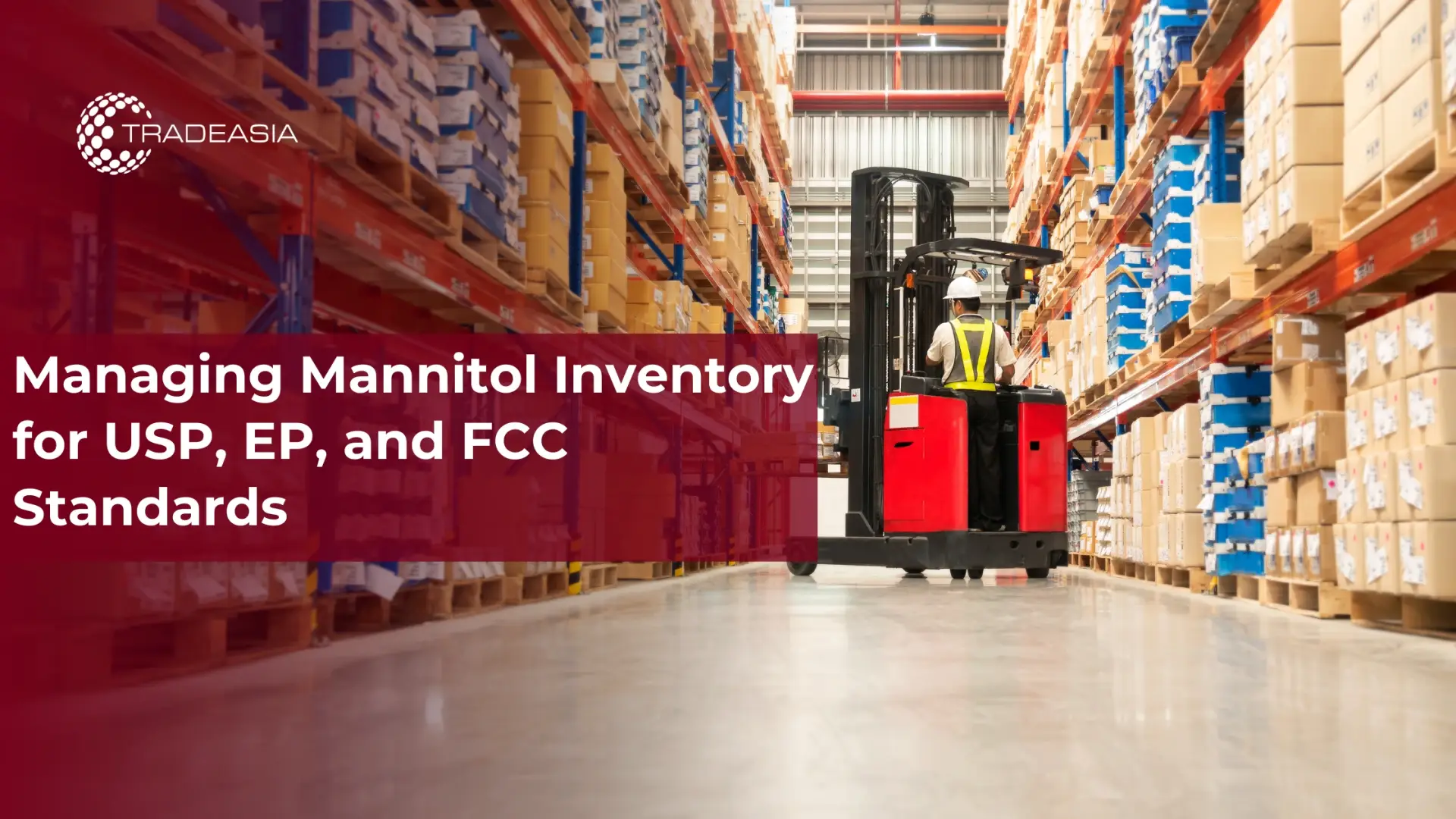
The default approach for many companies is Segregation. They buy "Grade A" (Pharma) for their drug division and "Grade B" (Food) for their confectionery division to save money. This creates a "Two-SKU" system. While cost-effective on paper, it introduces massive operational risk.
The Risk of Cross-Contamination:
If a warehouse operator inadvertently picks the FCC pallet for a Pharma batch record, the resulting tablets may fail stability testing months later due to high reducing sugars. Conversely, using expensive USP Mannitol for chewing gum destroys profit margins.
The Logistics of Segregation:
This strategy requires rigid physical separation.
-
System Controls: The Warehouse Management System (WMS) must be hard-coded to prevent cross-picking.
-
Labeling: Pallets must be aggressively color-coded (e.g., Green for Pharma, White for Food) to provide a visual check for forklift drivers.
The "Golden SKU" Strategy: Rationalizing Inventory
To mitigate these risks, many modern supply chain managers are moving toward an Inventory Rationalization or "One-SKU" strategy. This involves purchasing a single, high-grade Mannitol that meets all standards simultaneously.
The "Dual-Certified" Approach:
Manufacturers produce Mannitol that is tested against both USP/EP and FCC monographs.
-
The Benefit: You hold one SKU. This eliminates the risk of picking the wrong grade. It simplifies warehousing, reduces safety stock requirements (since you pool the demand), and streamlines supplier audits.
-
The Cost Analysis: While the unit price of a Dual-Certified grade is higher than standard Food Grade, the "Total Cost of Ownership" often drops. You save on administrative costs, reduce inventory holding costs, and eliminate the potential cost of a recall due to grade mix-ups.
When to Use Which Strategy?
-
High Volume / Low Margin (Gum): If you produce 500 tons of gum a month, the price premium for Pharma grade is too high. Segregation is the only viable option.
-
High Mix / Sensitivity (Contract Manufacturing): If you are a toll manufacturer making both vitamins and drugs, the Golden SKU saves you from operational nightmares.
Critical Documentation: Change Control and Quality Agreements
The final piece of the inventory puzzle is the paper trail. Managing different grades requires different relationships with your supplier.
Pharma Grade (Change Control is King):
When buying USP/EP Mannitol, you are not just buying powder; you are buying stability. You must sign a Quality Agreement with the supplier. This legally binds them to notify you of any change in their manufacturing process (e.g., changing the catalyst, moving the factory, changing packaging). In Pharma, a "small change" can alter the crystal structure of Mannitol, affecting how a tablet dissolves.
Food Grade (Safety is King):
For FCC Mannitol, the priority is GFSI certification (BRC/FSSC 22000) and Halal/Kosher status. Suppliers are less likely to agree to strict Change Control notifications for commodity food ingredients. Supply chain managers must ensure that the COA for every incoming shipment is verified against the specific monograph required for that specific PO.
Conclusion
Managing Mannitol inventory is a balancing act between the rigid purity requirements of the Pharmacopeia and the cost pressures of the food industry. Whether you choose to segregate your inventory into two distinct streams or consolidate into a single high-quality "Golden SKU," the decision dictates your warehouse protocols.
Success lies in visibility. Your procurement team must buy to the specification, your quality team must release to the monograph, and your warehouse team must respect the difference.
Partner with Food Additives Asia for Regulatory Compliance
Navigating the complex landscape of Mannitol grades requires a supplier who speaks both languages. At Food Additives Asia, we supply Mannitol tailored to your specific regulatory environment:
-
Dual-Certified Grades: Mannitol verified against USP, EP, and FCC standards for simplified inventory.
-
Dedicated Pharma Grades: Low endotoxin, low reducing sugar options for sensitive formulations.
-
Cost-Effective Food Grades: High-purity texturizers optimized for confectionery.
Streamline your inventory today.
Contact us for cross-referenced specification sheets, dual-grade COAs, and audit support at foodadditivesasia.com.