Introduction: The Fifth Taste
For decades, food science operated under the assumption of four basic tastes: sweet, sour, salty, and bitter. It wasn't until the early 20th century that a fifth taste was scientifically identified: Umami. Often described as "savory," "brothy," or "meaty," umami is the specific taste of glutamates and nucleotides signaling the presence of protein to the human brain.
In industrial food formulation, achieving this savory depth solely through expensive raw materials—like beef stock reductions or dried mushrooms—is often commercially unviable. This is where Flavor Enhancers come into play. These compounds do not have a strong aroma on their own; instead, they act as keys that unlock and amplify the savory notes already present in the food matrix.
The three pillars of savory enhancement are Monosodium Glutamate (MSG), Disodium Inosinate (IMP), and Disodium Guanylate (GMP). Understanding how to use these ingredients—individually and in combination—is the secret to creating crave-able soups, snacks, and sauces at a competitive cost.
Monosodium Glutamate (MSG): The Foundation of Umami
Monosodium Glutamate (E621) is the sodium salt of Glutamic Acid, one of the most abundant amino acids in nature. It is the chemical responsible for the savory taste of naturally umami-rich foods like tomatoes, parmesan cheese, and kelp.
-
Mechanism of Action: MSG works by stimulating specific glutamate receptors (T1R1/T1R3) on the tongue. When dissolved in water, the sodium and glutamate dissociate. The free glutamate binds to these receptors, sending a direct signal to the brain that creates salivation and a "mouth-watering" sensation.
-
Production Method: Modern industrial MSG is not synthesized chemically; it is produced through fermentation, largely similar to how yogurt or vinegar is made. Manufacturers use microorganisms (such as Corynebacterium glutamicum) to ferment starch sources like corn, sugar beet, tapioca, or cassava.
-
Sodium Reduction Strategy: MSG is a potent tool for sodium reduction.
-
Table Salt (NaCl): ~39% Sodium by weight.
-
MSG: ~12% Sodium by weight.
-
The Strategy: Because MSG amplifies the perception of saltiness, replacing a portion of table salt with MSG can often enable a 20–40% reduction in total sodium content, depending on the specific food matrix (e.g., soups vs. dry snacks).
-
The Nucleotides: IMP and GMP
While MSG provides the "base note" of savory flavor (the initial impact), the 5'-Ribonucleotides—Disodium Inosinate (IMP) and Disodium Guanylate (GMP)—provide complexity, body, and lingering aftertaste.
-
Disodium Inosinate (IMP / E631):
-
Flavor Profile: IMP is naturally associated with animal proteins (meat and fish). It provides the heavy, "meaty" body found in beef stocks and pork broths.
-
Sourcing Note: Historically isolated from fish (bonito), modern E631 is produced via fermentation. However, procurement teams must check the origin, as some older processes utilize animal sources, which would affect Halal/Kosher/Vegan certification.
-
-
Disodium Guanylate (GMP / E627):
-
Flavor Profile: GMP is naturally found in fungi and plants (like shiitake mushrooms). It provides earthy, vegetable notes and a broader, more complex sensation than IMP.
-
Potency: GMP often exhibits higher synergistic potency with MSG than IMP, meaning it can create a stronger savory effect at lower dosages in many vegetable-based applications.
-
-
I+G (Disodium 5'-Ribonucleotides / E635): In our catalog, you will often see a product simply labeled as "I+G". This is a 50:50 blend of IMP and GMP. This blend is the industry standard because it offers a balanced profile that works universally across chicken, beef, and vegetable applications.
The Science of Synergy: The 1 + 1 = Stronger Principle
The most critical technical concept in flavor enhancement is Synergy.
If you taste MSG alone, it tastes slightly salty. If you taste I+G alone, it is weak. However, if you mix them, the intensity skyrockets.
-
The Mechanism: Imagine the receptor on the tongue is a "Venus Flytrap."
-
MSG enters the trap.
-
Nucleotides (I+G) bind to the hinge of the trap, locking it shut.
-
Result: The signal sent to the brain is significantly stronger and lasts much longer.
-
-
The Golden Ratios: Because nucleotides are significantly more expensive than MSG, they are used sparingly.
-
98:2 Blend (98% MSG + 2% I+G): A cost-effective starting point for general savory enhancement.
-
95:5 Blend (95% MSG + 5% I+G): The industry "Sweet Spot." This ratio can deliver several-fold increases in perceived umami intensity compared to MSG alone, making it highly efficient for premium applications.
-
50:50 Blend: Rarely used pure. Usually sold as a concentrate (I+G) for manufacturers to blend themselves.
-
Applications in Modern Food Processing
-
Instant Noodles and Soups: The seasoning sachet relies heavily on the MSG + I+G synergy to transform a simple hot water broth into a "slow-simmered" soup experience instantly. It provides the mouth-coating richness and lingering savory sensation that water and salt lack.
-
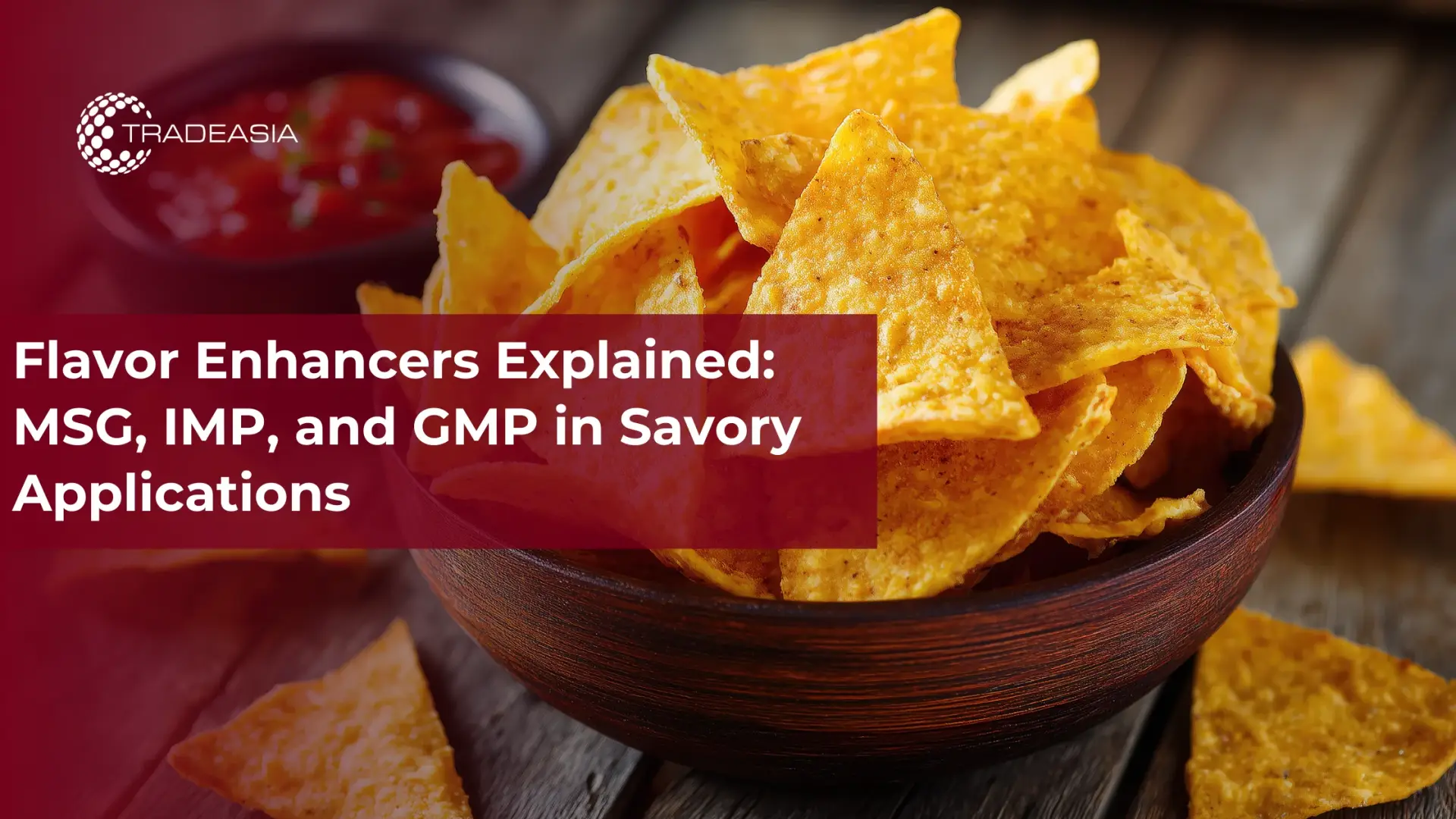
Snack Foods (Chips and Extruded Snacks): In seasoning dusts, flavor enhancers are critical for the initial "pop" of flavor. They help the seasoning blend (e.g., BBQ or Sour Cream) release its flavor immediately upon touching the tongue.
-
Processed Meats (Sausages and Hams): In injected hams or emulsified sausages, water and starch are often added to reduce cost, diluting the natural meat flavor. Adding IMP (or an I+G blend) restores the "meaty" impact lost during processing.
-
Plant-Based Meat Alternatives: One of the biggest challenges in vegan meat is replicating the savory depth of beef. Since plant proteins often lack natural IMP, adding exogenous nucleotides (from yeast fermentation) is essential to mask "beany" off-notes and build a convincing meaty profile.
Regulatory Status and Labeling
-
Global Safety: Flavor enhancers are among the most thoroughly tested food ingredients in history. They are recognized as safe by major regulatory authorities, including:
-
US FDA: Generally Recognized As Safe (GRAS).
-
EFSA (Europe): Authorized food additives with defined Acceptable Daily Intakes (ADI).
-
JECFA (WHO/FAO): Evaluated and confirmed safe for general populations.
-
-
Labeling Requirements:
-
E-Numbers:
-
MSG: E621
-
Disodium Guanylate: E627
-
Disodium Inosinate: E631
-
Disodium 5'-Ribonucleotides (I+G): E635
-
-
Clean Label Alternatives: For brands wishing to avoid E-numbers, the industry utilizes Yeast Extracts or Hydrolyzed Vegetable Proteins (HVP). These ingredients naturally contain high levels of glutamate and nucleotides and can be labeled as "Yeast Extract" or "Natural Flavoring."
-
Conclusion
Flavor enhancers are the unsung heroes of the food industry's cost-efficiency model. They allow formulators to reduce sodium, lower the reliance on expensive meat extracts, and ensure flavor consistency across batches.
The key to success lies not in simply adding MSG, but in mastering the Synergy. By carefully balancing MSG with Nucleotides (I+G), you can unlock a flavor intensity that creates loyal repeat customers while managing your formulation costs.
Partner with Food Additives Asia for Flavor Solutions
Optimizing your savory profile requires precise blending. At Food Additives Asia, we supply the full spectrum of enhancers—from pure MSG crystals (various mesh sizes) to high-purity I+G and Yeast Extracts.
Whether you are formulating a budget-friendly snack seasoning or a premium vegan broth, our technical team can help you determine the exact 95:5 or 98:2 ratio needed to hit your flavor target.
Elevate your product's taste profile today. Contact us for samples and specification sheets at foodadditivesasia.com.