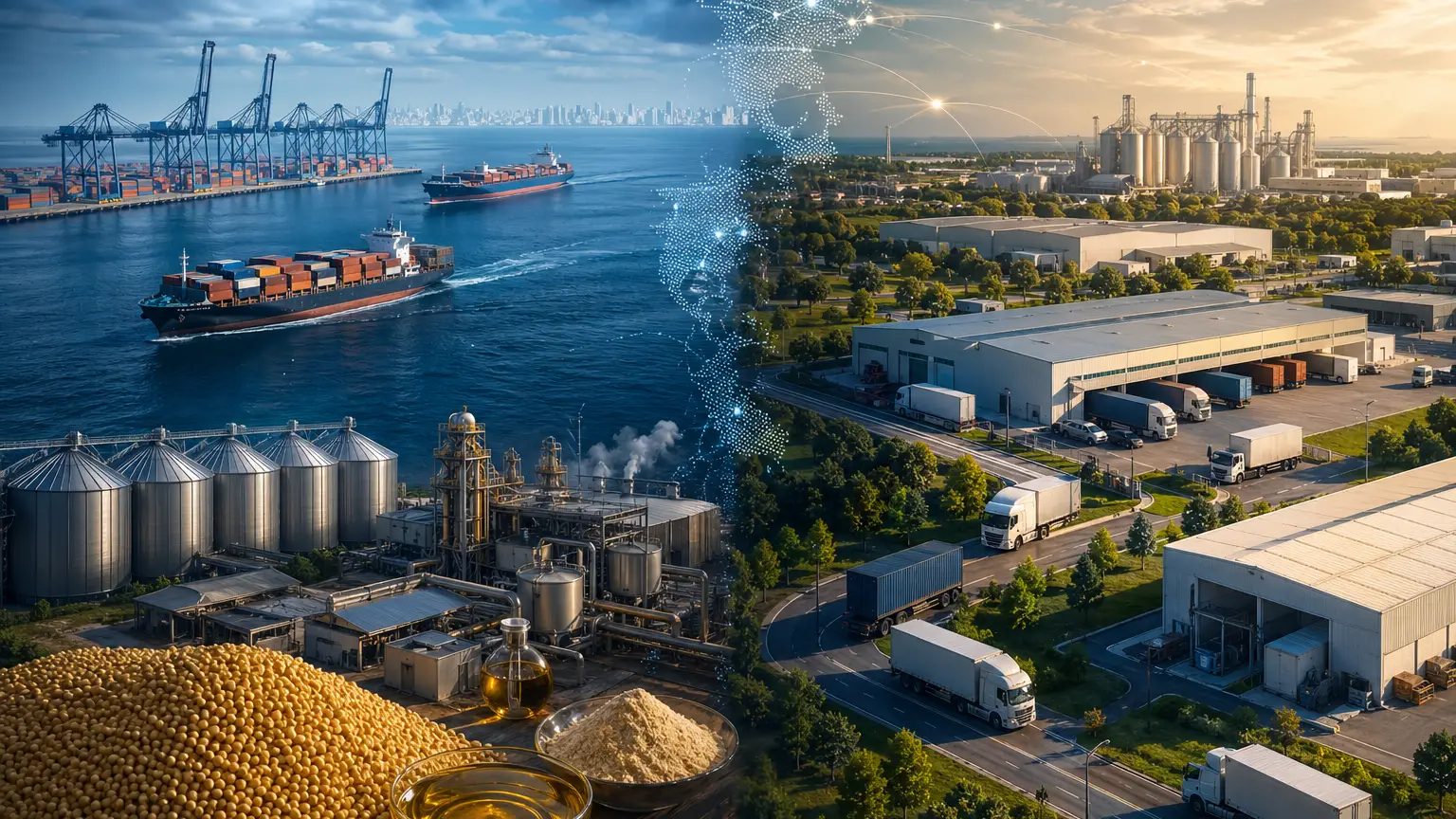
Soya lecithin supply remains structurally tied to soybean crushing in Brazil, Argentina, and the United States — but 2026 buyers in North America and Europe are actively redistributing risk toward nearshore and friend-shore origins, driven by tariff uncertainty, non-GMO traceability mandates, and the Q1 2025 Brazil processing backlog that delayed European shipments by 12 days. For most mid-volume buyers, a hybrid model — term-contracted offshore volumes anchored in South America, supplemented by nearshore secondary supply from India or Ukraine — now represents the lower-risk footprint.
What Is Soya Lecithin ?
Soya lecithin is a phospholipid mixture extracted during soybean oil refining, captured at the degumming stage before the oil is processed further. It is not a primary crop product — it is a co-product of soybean crushing, which means its availability is directly determined by crushing volumes driven by soybean meal and oil demand, not by lecithin demand itself. When soybean crushers run hard to meet biodiesel mandates or livestock feed demand, lecithin supply rises. When crushers cut utilization — because of drought, export restrictions, or weak meal margins — lecithin tightens, regardless of what food manufacturers need.
This structural dependency is the starting point for any sourcing decision. Buyers who treat soya lecithin as a commodity they can reorder on demand misunderstand the supply architecture. The origin question matters enormously: which crushing centers you are connected to determines your exposure to weather events, US-China trade policy, port congestion, and GMO regulation, all of which are live risk variables in 2026.
Global soya lecithin production is estimated at approximately 1.2 million MT in 2026, with prices for crude-grade material ranging USD 900–1,500/MT and specialty or non-GMO grades commanding USD 3,000/MT and above, according to market data from Food Additives Asia and ChemAnalyst.
The Offshore Model That Dominated for Three Decades — and Its Current Vulnerabilities
The traditional soya lecithin supply chain is structurally offshore. South America and the United States account for the overwhelming majority of global lecithin export volume: between July 2024 and June 2025, the United States, Brazil, and Argentina collectively generated the largest global export shipment count, with the US at 3,060 shipments, Brazil at 2,075, and Argentina at 1,678, according to trade data compiled by Towards Food & Beverages.
| Origin | Role in Global Supply | Key Export Destinations | 2026 Risk Profile |
|---|---|---|---|
| Brazil | Dominant crusher and exporter; 108.2 MT soybeans shipped in 2025 | China (65%), EU, Southeast Asia | Processing concentration; backlog events; biofuel competition for crush capacity |
| Argentina | World's leading soybean meal exporter; major lecithin processor near Rosario | EU, China, India | Currency volatility; farmer selling behavior; harvest timing |
| United States | Second-largest producer; strong domestic demand | Turkey, Netherlands, Russia | China trade policy exposure; domestic biofuel demand absorbing crush |
| China | Rising export hub for commodity-grade lecithin | Southeast Asia, MENA | GMO-labeling incompatibility with EU/non-GMO markets |
| India | Growing non-GMO and organic lecithin exporter | EU, Middle East, Southeast Asia | Scaling infrastructure; FSSAI and USDA organic compliance |
Argentina's crushing infrastructure is concentrated in and around Rosario, where oilseed processors export through the Paraná River hydroway. Brazil's primary lecithin export capacity is linked to its massive Santos and Paranaguá port complexes. Both are highly efficient but geographically concentrated — a point that became commercially visible in Q1 2025, when soybean processing delays in Brazil caused a 12-day backlog in lecithin shipments to European buyers.
The offshore model's core advantages — scale, price competitiveness, and volume reliability during normal conditions — remain intact. The problem in 2026 is that "normal conditions" has become an increasingly narrow description of the actual supply environment.
Three Forces Rewriting the Sourcing Calculus in 2026
1. US-China Trade Dynamics Are Redirecting Soybean Flows — and Lecithin With Them
Soya lecithin cannot be decoupled from the soybean trade war. When China restricts US soybean purchases, as it did effectively in 2025 after booking zero US soybeans for the 2025/26 marketing year, Brazilian and Argentine crushing volumes absorb the displaced demand. This increases South American crush throughput and, in theory, raises lecithin output. But it simultaneously congests South American port logistics as vessels queue for soybean cargo, compresses freight availability for lecithin, and introduces pricing volatility that propagates from the soybean spot market into lecithin terms within 30–60 days.
For North American lecithin buyers specifically, the inverse is also true. When US-China soybean tension eases — as it did when China pledged to resume purchases — US crush margins tighten, which can reduce lecithin co-product availability in the domestic market while simultaneously reducing the arbitrage that made South American origins cheaper on a landed basis.
The lesson for procurement teams is structural: soya lecithin prices in 2026 cannot be forecasted without tracking US-China agricultural trade headlines. The two are not loosely correlated — they are mechanically linked through the crushing margin.
2. Non-GMO and Organic Compliance Is Creating a Two-Tier Supply Chain
Conventional and non-GMO/organic soya lecithin are effectively different products in 2026, with separate supply chains, separate pricing, and separate traceability requirements. Non-GMO lecithin now trades at approximately a 22% premium over conventional material, according to Rotterdam Commodity Exchange data. In Germany alone, over 70% of organic food manufacturers require lecithin inputs to be certified both organic and identity-preserved (IP), per 2024 data from the German Federation of Organic Food Producers.
This premium market does not flow from the same origins as commodity lecithin. Brazil's crushing industry is overwhelmingly conventional-GMO, which limits its eligibility for European clean-label supply chains. Argentina's outputs face similar GMO classification constraints. The non-GMO lecithin supply corridor runs increasingly through India — which has expanded organic soybean cultivation by 19,000 hectares since 2023 under government programs including the Paramparagat Krishi Vikas Yojana — and through certified processors in Europe (Netherlands, Germany) who receive non-GMO beans from verified sources in Brazil and North America.
For buyers who need non-GMO certification, the offshore/nearshore question is already partially resolved: the qualifying supply chain involves either Indian origin or verified-IP Brazilian/US beans processed at certified facilities, which commands full-chain traceability documentation. A 2024 Rainforest Alliance audit found that 14% of non-GMO soy lecithin shipments to the US contained traces of glyphosate linked to incomplete segregation — a data point that is accelerating investment in blockchain traceability systems among buyers with regulatory exposure.
3. Tariff and Freight Risk Is Shifting the Cost Model
The 2025 tariff environment has fundamentally altered the total landed cost comparison between offshore and nearshore supply for North American buyers. Survey data from QIMA indicates that nearly one in two US businesses planned to increase nearshoring volumes in 2025, with Latin American origins gaining share specifically because of their lower tariff exposure relative to Asian suppliers. For European buyers, inspection and audit demand in Mediterranean nearshore hubs surged in Q2 2025 — Morocco up 53% year-on-year, Egypt up 73%, Tunisia up 35%.
For soya lecithin specifically, freight normalization from post-pandemic peaks has partially reduced the cost disadvantage of long-haul South American origins. However, Red Sea disruptions have added complexity to European-bound shipments routed via the Suez Canal, and the ongoing uncertainty around US-China trade policy adds a freight rate volatility premium that nearshore origins do not carry. The CFR Rotterdam price averaged approximately USD 1,093/MT in Q3 2025, per ChemAnalyst. For buyers importing from South America to Europe, freight represents a meaningful share of that landed number — and that share is not predictable 6–12 months forward.
What Nearshoring Actually Means for Soya Lecithin Buyers
Nearshoring a soya lecithin supply chain does not mean abandoning South American origins — it means supplementing them with secondary supply from origins that reduce transit time, tariff exposure, and traceability risk. The relevant nearshore and friend-shore options differ by buyer region.
| Buyer Region | Offshore Anchor (Primary) | Nearshore/Friend-Shore Alternative | What the Alternative Provides |
|---|---|---|---|
| North America (US, Canada, Mexico) | Brazil, Argentina | US domestic (Cargill, ADM, Bunge Ohio); Mexico processing | Tariff avoidance; USMCA compliance; shorter lead times |
| Europe (EU, UK) | Brazil (CFR Rotterdam via Santos/Paranaguá) | India (non-GMO certified); Ukraine (Cargill 2025 investment); Netherlands/Germany processors | Non-GMO IP traceability; EU Organic compliance; Red Sea freight bypass |
| Southeast Asia | Brazil, Argentina | India; local Indonesian/Thai processors using imported Brazilian beans | Regional freight advantage; ASEAN Economic Community trade facilitation |
| Middle East | Brazil, Argentina | India (Gujarat, Maharashtra processors) | Shorter transit; competitive pricing; non-GMO availability |
For European buyers with non-GMO requirements, India is not a compromise — it is frequently the only compliant origin at competitive pricing. India leads crude non-GMO soya lecithin exports and maintains compliance with FSSAI, USDA, and EFSA organic certifications. Gujarat-based processors including Gujarat Ambuja Exports and Maharashtra Solvent Extraction have developed export infrastructure that serves EU buyers with documented IP supply chains.
For North American buyers, the nearshoring logic is more cost-and-tariff-driven than compliance-driven. Bunge Limited's Ohio-based facility, which produces lecithin from soybeans grown by regional farmers, represents the most direct nearshore option for US food manufacturers who need to demonstrate domestic origin for labeling or procurement policy reasons. Cargill's announced investment in Ukrainian soybean processing — intended specifically to offset dependency on Brazil for European supply — represents a different form of friend-shoring: geopolitically adjacent, non-GMO-capable, and shipping to EU ports without Red Sea transit risk.
The Co-Product Trap: Why Nearshoring Lecithin Is Not as Simple as Nearshoring Any Other Ingredient
Soya lecithin's status as a co-product of soybean oil processing means that nearshore lecithin supply is only available where soybean crushing is active. A buyer cannot create a local lecithin supply by simply finding a processor willing to handle the product — the crusher needs an economic reason to process soybeans in volume, and that reason is driven by meal and oil demand, not by lecithin orders.
This creates a structural constraint on nearshoring ambitions. The United States has robust crushing infrastructure driven by domestic biodiesel and animal feed demand. Ukraine has expanding soybean processing capacity. India's crushing sector is government-supported and growing. But regions with strong local lecithin demand and weak crushing bases — including most of Southeast Asia and the Middle East — are structurally dependent on imports and cannot realistically nearshore by building local processing. For buyers in those regions, the nearshoring strategy is not about processing location but about diversifying between South American origins and Indian origins, which shortens the supply arc by 10–15 transit days and reduces Red Sea exposure.
The buyers who benefit most from nearshoring are European and North American food manufacturers with direct access to a crushing hub. Everyone else is managing a medium-haul vs. long-haul choice between competing offshore origins.
Supply Risk Assessment: Offshore vs. Nearshore Footprints Compared
| Risk Dimension | Deep-Offshore (Brazil/Argentina) | Nearshore/Friend-Shore (India, Ukraine, US Domestic) |
|---|---|---|
| Concentration risk | HIGH — two countries supply majority of global export volume | MEDIUM — India/Ukraine capacity is smaller but growing |
| Geopolitical risk | HIGH — exposed to US-China soybean trade policy | LOW-MEDIUM — India politically neutral; Ukraine carries war-zone proximity risk |
| GMO compliance risk | HIGH for EU non-GMO buyers; Brazil/Argentina output is predominantly GMO | LOW — India produces certified non-GMO and organic grades |
| Freight/logistics risk | MEDIUM-HIGH — Red Sea, port congestion, 30-60 day transit | LOW-MEDIUM — shorter transit, fewer chokepoints for Indian origin |
| Price volatility | HIGH — directly linked to CBOT soybean spot market | MEDIUM — partially insulated, though soybean input costs still apply |
| Scalability | HIGH — Brazil/Argentina can supply very large volumes | MEDIUM — India and Ukraine capacity constraints for large-tonnage buyers |
The core risk asymmetry is this: deep-offshore supply in South America offers the lowest base price during calm conditions and the largest absolute available volume, but the highest tail risk during disruption events. The 2021 drought that cost Argentina 30 million tonnes of soybean production and caused crush volumes to fall 30% year-on-year is the benchmark disruption scenario. Buyers who had no alternative qualified source during that period absorbed both the supply shock and the price spike simultaneously.
What Buyers Should Do Now: Three Concrete Actions for 2026
1. Segment your lecithin volume by grade before choosing an origin strategy. Non-GMO and certified organic volumes should be sourced through India or IP-certified European processors as a primary supply route, not as a backup. Conventional commodity lecithin can remain anchored in South America on term contracts. Mixing origins to serve different grade requirements is now standard practice among professional procurement teams — it is not complexity, it is structure.
2. Build a secondary qualified source within the current term cycle. Buyers with 100% of volume on South American contracts should qualify at least one Indian or Ukrainian alternative supplier in 2026, before the next disruption. Qualification takes 60–90 days including documentation review, CoA verification, and a trial shipment. Starting after a supply event is too late. The Q1 2025 Brazil backlog removed that buffer from buyers who had not done this work.
3. Restructure procurement contracts to include origin-switching rights. Most lecithin supply contracts specify a single origin. In 2026, buyers with meaningful volume should negotiate origin flexibility provisions — the right to request a shift from, say, Brazilian to Indian origin with 30–60 days' notice, within an agreed price index. This requires pre-qualifying the alternative origin but does not require splitting volume in normal conditions. It is insurance with a concrete activation mechanism.
Conclusion
The nearshoring vs. offshoring debate for soya lecithin does not resolve cleanly in either direction in 2026 — and buyers who expect it to are looking for a simpler answer than the supply chain actually offers. South American origins remain essential for volume and competitive pricing on conventional lecithin. But the structural concentration of crushing in Brazil and Argentina, the tariff volatility imposed by US-China trade dynamics, and the non-GMO compliance requirements of European and North American markets have all moved from background risks to active procurement decisions.
The buyers who are better positioned heading into 2027 are those who have combined a primary offshore contract with a secondary qualified source closer to home — and who have built the documentation infrastructure to move between them when conditions require. That is not nearshoring as ideology. It is supply chain architecture as risk management.
For procurement teams assessing origin diversification for soya lecithin, Tradeasia International provides multi-origin sourcing capabilities across South American, Indian, and Southeast Asian supply chains, with grade-specific CoA documentation and logistics coordination for both conventional and non-GMO certified volumes.
Frequently Asked Questions
What is the difference between nearshoring and offshoring in soya lecithin procurement? Offshoring refers to sourcing soya lecithin from geographically distant origins — primarily Brazil, Argentina, and to some extent China — where most global crushing capacity is concentrated. Nearshoring means sourcing from origins closer to the buyer's manufacturing base, such as India for European buyers, or US domestic processors for North American manufacturers. For soya lecithin, the nearshoring option is constrained by the need for active soybean crushing infrastructure at the nearshore location, which limits the viable alternatives to countries with domestic crushing capacity.
Why is non-GMO soya lecithin harder to nearshore than conventional lecithin? Non-GMO lecithin requires identity-preserved (IP) soybeans that have been segregated throughout the crushing process. Brazil and Argentina's crushing industries are predominantly GMO, which disqualifies most of their output for EU organic labeling requirements. India is currently the most commercially viable non-GMO origin for European and Middle Eastern buyers, supported by government-backed organic farming programs and EFSA-compliant certification infrastructure.
How does the US-China soybean trade war affect soya lecithin prices? The connection is direct and mechanical. When China redirects soybean purchases from the US to Brazil and Argentina, South American crush margins improve, output rises, and lecithin availability increases from those origins — but port congestion also increases as bulk soybean cargo competes for vessel and berth space with lecithin shipments. When US-China agricultural trade normalizes, US crushing margins improve, but South American export premiums adjust. Lecithin procurement teams should monitor USDA FAS export inspection data and CBOT soybean futures as leading indicators for origin-level supply availability 6–10 weeks forward.
What is the typical lead time advantage of nearshore vs. offshore soya lecithin? Indian origin lecithin shipped to European buyers via the Arabian Sea transits approximately 18–22 days to Rotterdam, compared to 28–35 days from Brazilian ports via the South Atlantic. For North American buyers using domestic US sources, lead times can be reduced to 5–10 days for truck or rail delivery, versus 30–45 days from South America. This lead time differential is operationally significant for buyers managing lean inventory policies or responding to short-notice reformulation requirements.
Is the EU-Mercosur trade deal relevant for soya lecithin sourcing? The pending EU-Mercosur agreement, which covers Brazil, Argentina, Paraguay, and Uruguay, would reduce tariff barriers on agricultural goods including soybean products entering the EU. If ratified, it would modestly improve the cost position of South American lecithin for European buyers, but would not resolve the non-GMO compliance issue — which is regulatory, not tariff-based. The deal's timeline to full implementation remains uncertain as of early 2026.