
Introduction
In the vast landscape of food and industrial ingredients, corn starch stands as a fundamental pillar. For procurement managers, product developers, and business owners across America, understanding the nuances between its two primary forms—native and modified—is crucial for both budgetary and performance outcomes. A common and immediate point of inquiry is the significant price difference between these products. While native corn starch is often seen as a cost-effective commodity, modified corn starch commands a premium. This disparity is not arbitrary; it is a direct reflection of added value, advanced functionality, and complex production processes. This comprehensive guide delves beyond the surface-level cost per pound, exploring the intrinsic factors that dictate pricing, the tangible benefits that justify the investment in modified variants, and the current market dynamics in the American landscape. By the end, buyers will be equipped with the knowledge to make strategic sourcing decisions that align cost with application-specific performance requirements.
The decision between native and modified starch is rarely just about price; it's about value engineering. Selecting the wrong type can lead to product failure, consumer rejection, or inefficient manufacturing processes, ultimately incurring far greater costs than the initial ingredient savings. This article aims to demystify the pricing structure, providing a clear framework for evaluation. We will examine the chemical and physical distinctions, break down the cost drivers from processing to market demand, and highlight real-world applications where the premium for modified starch is not an expense but a necessary investment in quality and consistency.
Defining the Core Products: Native vs. Modified Corn Starch
To comprehend the price difference, one must first understand the fundamental nature of each product. Native corn starch is the simplest form, extracted directly from the endosperm of corn kernels through a process of steeping, milling, separation, and drying. It is a naturally occurring polymer composed of amylose and amylopectin. In its pure form, it is a white, tasteless powder with limited functionality. Its behavior is heavily dependent on heat and moisture; it must be cooked to gelatinize and thicken, but this gel is unstable, prone to syneresis (weeping), and breaks down under acidic conditions, high shear, or freeze-thaw cycles. Its applications are thus confined to simple, immediate-use thickening where long-term stability is not a concern.
In contrast, modified corn starch is native starch that has been physically, enzymatically, or chemically treated to alter its inherent properties. This "modification" is a controlled industrial process designed to overcome the limitations of native starch. Common modifications include cross-linking (to enhance stability against heat, acid, and shear), stabilization (to prevent retrogradation and improve freeze-thaw stability), and bleaching or thinning. The result is a specialized ingredient engineered for precise performance. For instance, a cross-linked starch will maintain viscosity in a acidic fruit pie filling during prolonged baking, while a stabilized starch will keep a frozen sauce creamy after reheating. This transformation from a simple commodity to a performance-driven, application-specific ingredient is the primary source of added value and cost.
Key Drivers of the Price Difference
The premium for modified corn starch can be attributed to several interconnected factors. The most significant is the cost of production and processing. While native starch processing is a relatively standardized, high-volume operation, modification introduces additional, often proprietary, steps. These steps require specialized equipment, controlled reaction environments, precise quality control, and often the use of specific reagents or enzymes. Each modification type (e.g., acetylated distarch adipate, hydroxypropylated starch) has its own process cost structure. Furthermore, manufacturers often produce modified starches in smaller, dedicated batches to meet specific customer specifications, losing the economies of scale enjoyed by bulk native starch production.
Secondly, research and development (R&D) and technical service represent a substantial embedded cost. Starch companies invest heavily in R&D to create new modified starch profiles for emerging food and industrial trends, such as clean-label solutions or enhanced textural properties. This innovation cost is recouped through product pricing. Additionally, suppliers of modified starches typically provide extensive technical support—helping clients with formulation, troubleshooting, and process optimization—a service rarely needed or offered with native starch. Finally, supply chain and market dynamics play a role. While native starch is heavily influenced by the volatile price of corn as a commodity, modified starch pricing is more insulated from raw material swings and more closely tied to its performance value and the cost of the modification technology itself.
Applications and Value Proposition: Where the Investment Pays Off
The justification for the higher price of modified corn starch becomes unequivocally clear when examining its application-specific benefits. In the food industry, consistency and consumer experience are paramount. A native starch-thickened yogurt may separate on the shelf, leading to waste and brand damage, whereas a stabilized modified starch ensures a smooth, creamy texture throughout the product's shelf life. In canned soups and sauces, a cross-linked modified starch withstands the high-temperature retort process and acidic environment, maintaining desired viscosity where native starch would completely break down. In frozen foods, the ability of modified starch to endure freeze-thaw cycles without syneresis is a non-negotiable requirement, directly preventing product failure.
Beyond food, industrial applications leverage modified starch for its engineered properties. In the paper industry, modified starches are used as wet-end additives to improve sheet strength and as surface sizing agents for better printability—functions native starch cannot perform effectively. In textile manufacturing, modified starches serve as durable warp sizing agents that withstand high-speed weaving. In adhesives and construction materials, specific modifications provide enhanced binding power, water resistance, or controlled set times. In each case, the modified corn starch is not merely an ingredient but a functional component critical to the manufacturing process and the quality of the final goods. The cost is measured against the value of reduced production downtime, superior end-product performance, regulatory compliance, and ultimately, customer satisfaction.
Market Trends Impacting Corn Starch Pricing in America
The American market for corn starch is influenced by a complex set of trends that affect both native and modified varieties differently. A dominant trend is the growing consumer demand for clean-label and non-GMO ingredients. This has spurred innovation and premium pricing for modified starches derived from identity-preserved (IP) non-GMO corn and those using physical or enzymatic modification methods, which can be labeled more simply (e.g., "enzyme-treated starch") compared to chemically modified versions. The demand for gluten-free and plant-based products has also increased starch consumption as a key texturizer, supporting overall market prices.
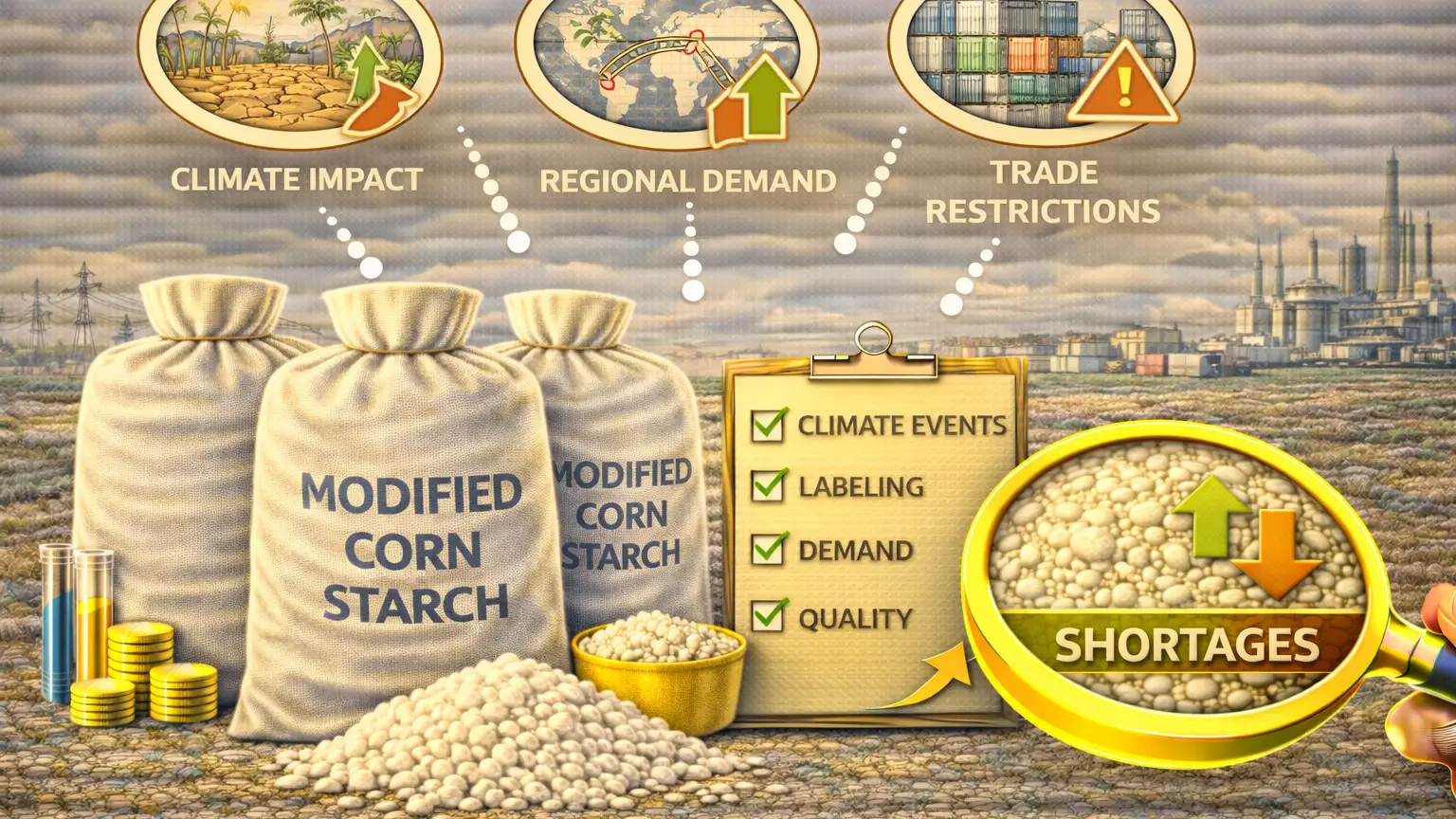
On the supply side, volatility in corn commodity prices, driven by factors like weather patterns, ethanol policy, and global export demand, directly impacts the baseline cost of native starch. While modified starch is somewhat buffered, a sustained rise in corn costs eventually flows through the entire supply chain. Furthermore, logistics and energy costs in North America significantly affect delivered prices. Geopolitical events and trade policies can disrupt supply chains or alter tariff structures, adding another layer of pricing complexity. For buyers, understanding these macro-trends is essential for anticipating price fluctuations and building resilient sourcing strategies, potentially through partnerships with reliable distributors who can provide market intelligence and supply stability.
How to Make an Informed Purchasing Decision
Choosing between native and modified corn starch should be a deliberate process grounded in your product's technical requirements and total cost-in-use. The first step is a thorough application analysis. Define the necessary functional attributes: What viscosity profile is needed? What pH, temperature, and shear forces will the starch encounter? What is the required shelf life and storage condition (frozen, refrigerated, ambient)? If the application involves high heat, acid, shear, or requires long-term stability, modified corn starch is almost certainly required, and its cost is justified by preventing product failure.
Next, conduct a true cost evaluation. Look beyond the price per kilogram. Consider how a more efficient modified starch might allow for a lower usage level compared to native starch. Factor in potential savings from reduced production waste, fewer customer complaints, and extended product shelf life. Engage with suppliers early in the development process. Reputable suppliers, such as Chemtradeasia.com, can provide sample quantities of different modified starches for testing and offer technical guidance to pinpoint the most cost-effective solution for your specific need. This collaborative approach ensures you are not over-specifying (using an overly expensive high-performance starch for a simple task) or under-specifying (risking product failure with an inadequate native starch).
Conclusion
The price difference between native and modified corn starch is a direct reflection of a value-added transformation. Native starch serves as an economical workhorse for simple, non-demanding applications. Modified starch, however, is a precision-engineered ingredient, designed through advanced processing to deliver consistent, reliable performance under challenging conditions. For buyers in America's competitive food and industrial sectors, the decision should not be driven by ingredient cost alone but by the total value delivered to the final product and manufacturing process. By understanding the drivers behind the pricing, recognizing the non-negotiable applications for modified variants, and evaluating costs within the broader context of product success, procurement professionals can make strategic choices that optimize both their budgets and their product quality.
Disclaimer: This article is provided for informational and market insight purposes only. It is not intended as technical, safety, or professional advice for any specific application. The information presented, including pricing factors and product functionalities, is based on general market trends and should be independently verified. We strongly advise readers to consult directly with technical experts, review all relevant official documentation such as Material Safety Data Sheets (MSDS/SDS) and product specifications, and contact our team at Chemtradeasia for detailed guidance tailored to your specific requirements and intended use.