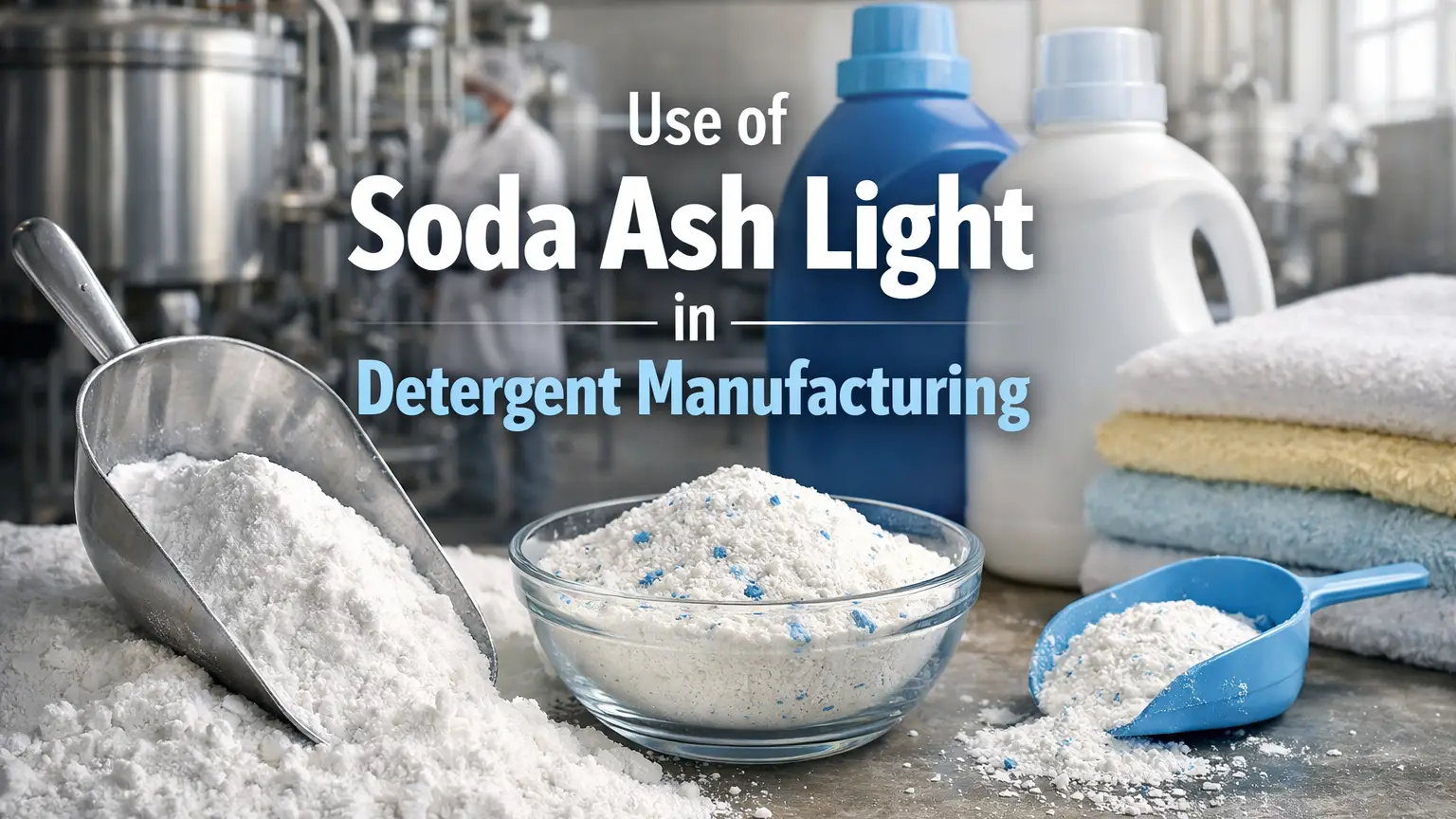
Soda ash light is one of the most widely used alkaline builders in modern detergent manufacturing. Its ability to regulate pH, soften water, and enhance surfactant performance makes it a core ingredient in laundry detergents, industrial cleaners, and household cleaning products. For detergent manufacturers, formulation chemists, and procurement teams, understanding how soda ash light functions within detergent systems is essential for achieving consistent cleaning performance and cost efficiency.
This article explains the role of soda ash light in detergent formulations, its technical advantages, formulation considerations, safety aspects, and why it remains a preferred raw material across global detergent markets.
Understanding Alkaline Builders in Detergent Formulations
Alkaline builders are essential components in detergents because they create the optimal chemical environment for cleaning. Most detergent systems operate effectively within a pH range of 9 to 11, where surfactants perform efficiently and stains break down more easily.
Maintaining this alkaline condition helps remove greasy soils, body oils, and protein based stains from fabrics and hard surfaces. Without sufficient alkalinity, surfactants lose efficiency, resulting in poor cleaning outcomes.
Another critical function of alkaline builders is water softening. Hard water contains calcium and magnesium ions that interfere with surfactant action. Builders bind or precipitate these ions, preventing scale formation and preserving surfactant activity. Soda ash light plays a central role in this process, especially in regions where water hardness varies widely.
Functional Role of Soda Ash Light in Detergents
One of the primary functions of soda ash light in detergents is pH adjustment. By increasing alkalinity in the wash liquor, it supports the breakdown of fats through saponification and helps hydrolyze protein based stains. This chemical action improves overall stain removal performance.
Soda ash light also acts as an effective water softener. It reacts with calcium and magnesium ions to form insoluble carbonates, preventing these minerals from deactivating surfactants. This function is especially valuable in hard water regions, where detergent performance can otherwise decline significantly.
In addition, soda ash light enhances surfactant efficiency by increasing ionic strength in the wash solution. This improves wetting, emulsification, and soil suspension, helping dirt remain dispersed in water instead of redepositing on fabrics.
Applications Across Different Detergent Types
In powder laundry detergents, soda ash light is commonly used at concentrations ranging from 10 to 30 percent. It is widely applied in heavy duty laundry powders and detergent bars designed for both cold and hot washing conditions.
Liquid detergents and concentrates also utilize soda ash light, although at lower levels. In these formulations, it contributes to alkalinity control and supports formulation stability when balanced with appropriate surfactant systems.
Industrial and institutional cleaning products rely heavily on soda ash light for high alkalinity performance. Floor cleaners, metal cleaners, and degreasers benefit from its ability to emulsify oils and loosen mineral deposits.
Household products such as dishwashing powders and multipurpose cleaners also incorporate soda ash light to deliver broad cleaning effectiveness across different surfaces.
Advantages of Soda Ash Light in Detergent Manufacturing
One of the key advantages of soda ash light is its excellent solubility, even in cold water. This ensures rapid dispersion during production and minimizes the risk of undissolved residues in finished products.
From a commercial perspective, soda ash light is cost effective. It is widely available from global producers and offers lower cost per unit of alkalinity compared to many alternative builders. This makes it suitable for both premium and mass market detergent formulations.
Compatibility is another major benefit. Soda ash light works well with anionic and nonionic surfactants, enzymes, optical brighteners, and fragrances without causing formulation instability. This allows manufacturers to maintain consistent performance across multiple product batches.
Formulation and Dosage Considerations
Typical usage levels of soda ash light range from 5 to 25 percent, depending on the detergent type, target pH, and local water hardness. In regions with moderate water hardness, a dosage of around 15 percent is often sufficient to achieve effective building performance.
Higher concentrations can improve cleaning strength but may require buffering agents to prevent excessive alkalinity. pH levels above 11 can negatively affect fabric integrity and enzyme stability, so careful formulation balance is necessary.
Soda ash light also contributes to product stability by binding trace metal ions that can accelerate oxidation reactions. This helps extend shelf life, especially in humid storage conditions.
Formulators often balance soda ash light with nonionic surfactants to manage viscosity and ensure enzymes remain active within the desired pH range.
Conclusion
Soda ash light continues to be a foundational ingredient in detergent manufacturing due to its reliable performance in pH control, water softening, and surfactant enhancement. Its balance of technical effectiveness, cost efficiency, and regulatory acceptance makes it suitable for a wide range of detergent applications.
For manufacturers and distributors seeking consistent quality and supply, sourcing high purity soda ash light from a trusted partner is critical. Chemtradeasia supplies soda ash light tailored for detergent manufacturing needs, supporting formulation reliability and long term production efficiency. If you are looking to optimize your detergent formulations or secure a dependable soda ash light supply, Chemtradeasia is ready to support your business requirements.