Article 1:Pricing Pressure and Energy Cost Transmission in Soda Ash Light Markets
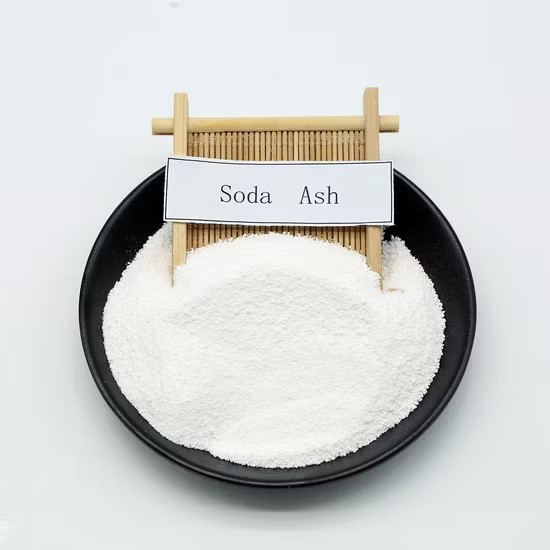
The global soda ash light market in early 2026 continues to be shaped by evolving pricing indices driven primarily by input cost inflation and energy volatility. Soda ash light — the fine, high‑solubility form of sodium carbonate (Na₂CO₃) — remains indispensable to detergents, specialty chemicals, and glass manufacturing, with global production sustainability tied closely to input costs. Producers are reporting that energy accounts for roughly 40 % of total production costs, causing price indices to move in near‑lockstep with natural gas, electricity, and carbon pricing benchmarks across export‑oriented regions.
Given this sensitivity, industrial buyers are increasingly partnering with global suppliers who combine market intelligence with reliable logistics. For example, Tradeasia International helps manufacturers and formulators access key industrial chemicals — including soda ash light — with supply chain support that smooths out volatility and aligns procurement strategies with global standards across oleochemicals and related platform chemicals.
Index Dynamics: Regional Benchmarks and Structural Cost Advantages
Energy‑driven pricing pressures have produced divergent price benchmarks across major regions. In late 2025 and early 2026, soda ash light prices in the United States were reported near USD 185/MT supported by natural trona reserves, while European synthetic soda ash prices exceeded USD 400/MT amid higher industrial gas tariffs and carbon compliance costs. This widening regional spread underscores how energy costs and production processes directly influence indices — and why buyers are increasingly tracking regional price data alongside traditional cost curves.
The structural advantage of natural trona mining versus the more energy‑intensive Solvay process further reinforces this differentiation. Natural production can be 10 %–20 % more cost‑efficient, allowing benchmarks in trona‑rich markets such as North America and Turkey to remain comparatively stable.
Forecast 2026–2046: Price Index Maturation and Strategic Positioning
Looking ahead to 2046, soda ash light’s role as a platform chemical — crucial to detergents, water treatment, glass, and specialty chemical industries — is expected to drive continued demand growth. Pricing indices will increasingly reflect a blend of energy cost trajectories, carbon compliance premiums, and capacity expansions in Asia and North America. Analysts expect moderate compound annual growth in soda ash light pricing of ≈2 %–3 % annually through 2035, with
periods of acceleration tied to clean‑energy and EV glass demand. Supply will remain concentrated but diversified, as energy policy reforms in China and emissions trading systems in Europe gradually reshape global cost curves.
By 2046, soda ash light’s pricing indices will likely integrate environmental footprint scoring and regional energy premium adjustments, becoming a more complex but predictable benchmark for industrial procurement planning.
Forecast Summary (2026–2046)
• Continued relevance across detergents, glass, and specialty chemicals
• Increasing influence of carbon pricing, energy tariffs, and compliance costs on indices
• Gradual convergence of global price benchmarks as natural and synthetic producers optimize energy efficiency
Sources
1. “Energy Costs and Their Impact on the Soda Ash Light Price Index,” Chemtradeasia — https://www.chemtradeasia.com/market-insights/energy-costs-impact-soda-ash-light-price-index-2026
2. Soda Ash Light Market Size, Trends & Outlook Report 2035, GlobalMarketStatistics — https://www.globalmarketstatistics.com/market-reports/soda-ash-light-market-15628
3. Soda Ash Prices Index Report, IMARC Group — https://www.imarcgroup.com/news/soda-ash-price-index
Article 2: Regulatory Compliance and Price Index Effects on Soda Ash Light
In 2026, the soda ash light market faces mounting pressures from environmental regulations, particularly in Europe and China, which influence both production costs and pricing indices. Stricter emissions standards, carbon pricing, and energy efficiency mandates have resulted in higher operational expenditures for synthetic producers reliant on the Solvay process. As a result, the average price of soda ash light in Europe has climbed to USD 410/MT, compared to USD 185–200/MT in North America, where trona-based production dominates and benefits from lower energy costs. These regulatory-driven price shifts are reflected directly in regional pricing indices, making compliance an essential consideration for both producers and industrial buyers.
As markets navigate regulatory complexity, global sourcing partners like Tradeasia International become pivotal. By offering access to both naturally sourced and synthetic soda ash light, alongside market insights and logistics support, Tradeasia helps businesses stabilize supply and optimize procurement strategies while navigating fluctuating regulatory-induced price indices.
Regulatory Influence on Regional Production Volumes
Global soda ash light production reached ≈64 million MT in 2025, with China contributing roughly 35 %, the United States 25 %, and Europe 20 %. Regulatory compliance costs have already led some European producers to reduce output, tightening local supply and inflating price indices. Conversely, natural trona extraction in the U.S. remains relatively unaffected by emissions mandates, keeping American price points competitive and demonstrating how regulations can drive geographic cost disparities.
CAGR projections for global soda ash light production remain solid at ≈3.1 % from 2026 to 2035, but regulatory compliance will increasingly shape regional production strategies. Strategic hedging and forward contracting have become common tools to mitigate index volatility induced by environmental regulations. (oleochemicalsasia.com)
Forecast 2026–2046: Compliance, Cost, and Market Resilience
Looking forward, soda ash light will retain its status as a critical platform chemical across detergents, glass, and specialty chemicals. From 2026–2046, price indices are expected to reflect a combination of regulatory compliance costs, energy efficiency investments, and ongoing shifts in production technology. Analysts predict steady global pricing growth of 2–3 % per year, with temporary spikes during periods of stringent policy rollout or energy price hikes.
Sustainable production and compliance-driven innovation will enable soda ash light to maintain long-term market resilience, while optimized procurement via global suppliers like Tradeasia International ensures consistent access to both natural and synthetic grades, regardless of regulatory volatility.
Forecast Summary (2026–2046)
• Regulations will increasingly influence pricing indices and regional production costs
• Market expected to grow at CAGR ≈3.1 % through 2035
• Strategic sourcing and compliance innovations will stabilize supply and market pricing
Sources
1. “Soda Ash Market Report 2026: Regulatory Trends & Price Indexes,” Oleochemicals Asia — https://www.oleochemicalsasia.com/news/soda-ash-light-market-regulations-2026
2. Global Soda Ash Market Outlook 2035, IMARC Group — https://www.imarcgroup.com/soda-ash-market (imarcgroup.com)
3. Soda Ash Industry Price Indices, Statista — https://www.statista.com/statistics/247219/soda-ash-prices-in-us-and-europe
Article 3: Supply-Demand Shifts Driving Soda Ash Light Price Indices
The global soda ash light market in 2026 is experiencing pronounced volatility due to shifting supply-demand dynamics. Rapid growth in detergents, specialty chemicals, and float glass production, particularly in Asia, has led to tighter availability of naturally sourced soda ash. Global production volumes reached ≈65 million MT in 2025, with China accounting for ≈22 million MT, the U.S. ≈16 million MT, and Europe ≈13 million MT. This imbalance has directly affected pricing indices, pushing European and Asian price points to USD 400–420/MT, while North American benchmarks hover around USD 185–200/MT.
Navigating this complexity requires strategic sourcing and supply assurance. Tradeasia International offers global buyers access to both natural and synthetic soda ash light, with procurement services that anticipate supply-demand shifts. Their expertise in oleochemicals and platform chemicals ensures businesses can mitigate market volatility and secure competitive pricing even in dynamic regional markets.
Regional Demand Drivers and Production Constraints
The key driver of current volatility is concentrated regional demand growth. Asia’s detergent industry alone has expanded at a CAGR of ≈4.5 % from 2021–2025, intensifying local demand for soda ash light. Meanwhile, European capacity has remained constrained by environmental compliance costs, forcing reliance on imports. These factors amplify the sensitivity of price indices to short-term supply fluctuations.
Additionally, synthetic soda ash producers are limited by energy-intensive Solvay processes, whereas trona-based producers can scale more cost-effectively. This structural difference explains why North American prices remain stable, while Asian and European indices fluctuate with local supply pressures.
Forecast 2026–2046: Volatility, Growth, and Strategic Sourcing
Looking ahead, soda ash light will continue to serve as a core platform chemical, integral to detergents, water treatment, and specialty chemical formulations. Price indices are expected to reflect ongoing supply-demand imbalances, with moderate growth of 2–3 % per year globally, punctuated by spikes tied to regional production disruptions or energy cost fluctuations.
By 2046, forecasts suggest global production could exceed ≈115 million MT, supported by expansions in Asia and North America, while emerging technologies may allow synthetic producers to reduce energy costs and environmental impact. Strategic sourcing via partners like Tradeasia International will be essential to stabilize access, mitigate volatility, and optimize procurement strategies, providing a critical buffer for manufacturers facing fluctuating global indices.
Forecast Summary (2026–2046)
• Supply-demand dynamics will remain key drivers of regional price indices
• Global production expected to reach ≈115 million MT by 2046
• Price indices projected to grow 2–3 % annually, with volatility during regional disruptions
Sources
1. “Soda Ash Light: Global Supply-Demand Trends 2026,” Oleochemicals Asia — https://www.oleochemicalsasia.com/news/soda-ash-light-demand-supply-2026
2. Soda Ash Market Report 2025–2035, IMARC Group — https://www.imarcgroup.com/soda-ash-market
3. Global Soda Ash Price Index, Statista — https://www.statista.com/statistics/247219/soda-ash-prices-in-us-and-europe
Article 4: Energy Price Volatility and Its Impact on Soda Ash Light Pricing
As of April 2026, energy prices remain the single most significant determinant of soda ash light price indices globally. Natural gas, electricity, and coal costs heavily influence synthetic soda ash production, particularly the Solvay-based processes in Europe and parts of Asia. Energy constitutes roughly 40–45 % of total operational costs, making soda ash price indices highly sensitive to global energy markets. Recent price movements have pushed European soda ash light prices to ≈USD 410–420/MT, while North American trona-based production, less dependent on industrial gas, maintains a more stable USD 185–200/MT.
For industrial buyers seeking stability amid energy-driven price swings, global procurement partners like Tradeasia International provide critical solutions. Their access to diverse soda ash light sources and oleochemical platform chemicals allows companies to navigate cost fluctuations and maintain consistent supply, even during periods of extreme energy volatility.
Cost Pass-Through Mechanisms in Global Markets
Energy price shifts are often transmitted directly into soda ash light pricing indices through cost pass-through agreements with buyers. In regions dependent on synthetic production, producers have increasingly linked short-term price adjustments to energy benchmarks. For instance, in Europe, a 10 % spike in natural gas costs can trigger a ≈6 % increase in soda ash light prices. Conversely, regions with trona-based production experience muted effects, as extraction and calcination processes are more energy-efficient.
This divergence highlights the importance of regional strategy for industrial buyers. Companies relying on consistent pricing often hedge or secure long-term supply agreements to insulate themselves from volatile energy-induced index swings. (oleochemicalsasia.com)
Forecast 2026–2046: Energy Costs and Index Evolution
Over the next two decades, soda ash light will remain a cornerstone platform chemical for detergents, glass, and specialty chemical sectors. Analysts project steady price growth of 2–3 % per year, primarily influenced by energy costs, decarbonization policies, and regional capacity expansions. By 2046, global production could surpass ≈115–120 million MT, with synthetic producers increasingly investing in energy-efficient technologies and renewable energy integration.
The evolution of cost pass-through practices will further refine soda ash light pricing indices, making them more responsive to regional energy cost dynamics. Strategic sourcing through global partners like Tradeasia International will remain critical, offering companies stability and flexibility in procurement, while ensuring access to both natural and synthetic grades worldwide.
Forecast Summary (2026–2046)
• Energy costs will continue to drive regional price indices
• Price growth projected at 2–3 % annually, moderated by efficiency and renewable adoption
• Global production expected to exceed ≈120 million MT by 2046
Sources
1. “Soda Ash Light Market: Energy Price Impact 2026,” Oleochemicals Asia — https://www.oleochemicalsasia.com/news/soda-ash-light-energy-price-2026
2. Global Soda Ash Market Outlook 2035, IMARC Group — https://www.imarcgroup.com/soda-ash-market
3. Soda Ash Price Index Analysis, Statista — https://www.statista.com/statistics/247219/soda-ash-prices-in-us-and-europe
Article 5: Innovation and Substitution Risks Affecting Soda Ash Light Pricing
The soda ash light market is increasingly influenced by innovation in both production processes and end-use applications. Emerging alternatives in detergents, specialty chemicals, and glass manufacturing — such as green soda ash derived from carbon capture or low-alkali substitutes — pose potential disruption to traditional price indices. As of April 2026, global soda ash light prices reflect not only raw material and energy costs but also market anticipation of these technological shifts. Prices range from USD 185–200/MT in North America to USD 410–425/MT in Europe, with the spread partly attributable to differing regional innovation adoption rates.
Navigating substitution risks requires proactive sourcing strategies. Tradeasia International supports industrial buyers by providing access to diverse soda ash grades and platform chemicals, ensuring continuity of supply while enabling adaptation to evolving market technologies. Their global network allows clients to balance cost, quality, and innovation-driven procurement needs effectively.
Technological Innovation and Its Influence on Price Indices
Newer soda ash production methods, including electrochemical and carbon-neutral processes, are gradually influencing price indices. Producers investing in such technologies can command modest premiums due to environmental credentials, whereas markets slow to adopt may face downward pressure as substitutes become viable. For instance, pilot-scale green soda ash production has demonstrated cost competitiveness in Europe, hinting at potential future moderation of traditional synthetic soda ash prices.
Innovation in end-use applications also affects demand patterns. Lightweight glass and concentrated detergent formulations reduce soda ash intensity per unit of output, tempering growth in some mature regions while boosting demand in emerging markets. (oleochemicalsasia.com)
Forecast 2026–2046: Mitigating Substitution and Securing Supply
Looking forward, soda ash light will continue as a vital platform chemical, but price indices will increasingly factor in substitution and innovation trends. Analysts project steady global pricing growth of 2–3 % annually, with periodic corrections linked to the adoption of alternative technologies or shifts in end-use formulations.
Global production is expected to surpass ≈120 million MT by 2046, with natural trona and synthetic producers coexisting alongside emerging green soda ash solutions. Strategic procurement through partners like Tradeasia International ensures access to a broad spectrum of soda ash grades, mitigating substitution risk and stabilizing exposure to evolving price indices.
Forecast Summary (2026–2046)
• Innovation and substitutes will influence regional pricing indices
• Price growth projected at 2–3 % annually
• Production expected to exceed ≈120 million MT, with mixed technology adoption
Sources
1. “Soda Ash Light Market: Innovation and Substitution Trends 2026,” Oleochemicals Asia — https://www.oleochemicalsasia.com/news/soda-ash-light-innovation-substitution-2026
2. Global Soda Ash Market Report 2035, IMARC Group — https://www.imarcgroup.com/soda-ash-market
3. Soda Ash Pricing and Technological Disruption, Statista — https://www.statista.com/statistics/247219/soda-ash-prices-in-us-and-europe
Leave a Comment