Introduction: The Sensory Engineering of the Liquid Core
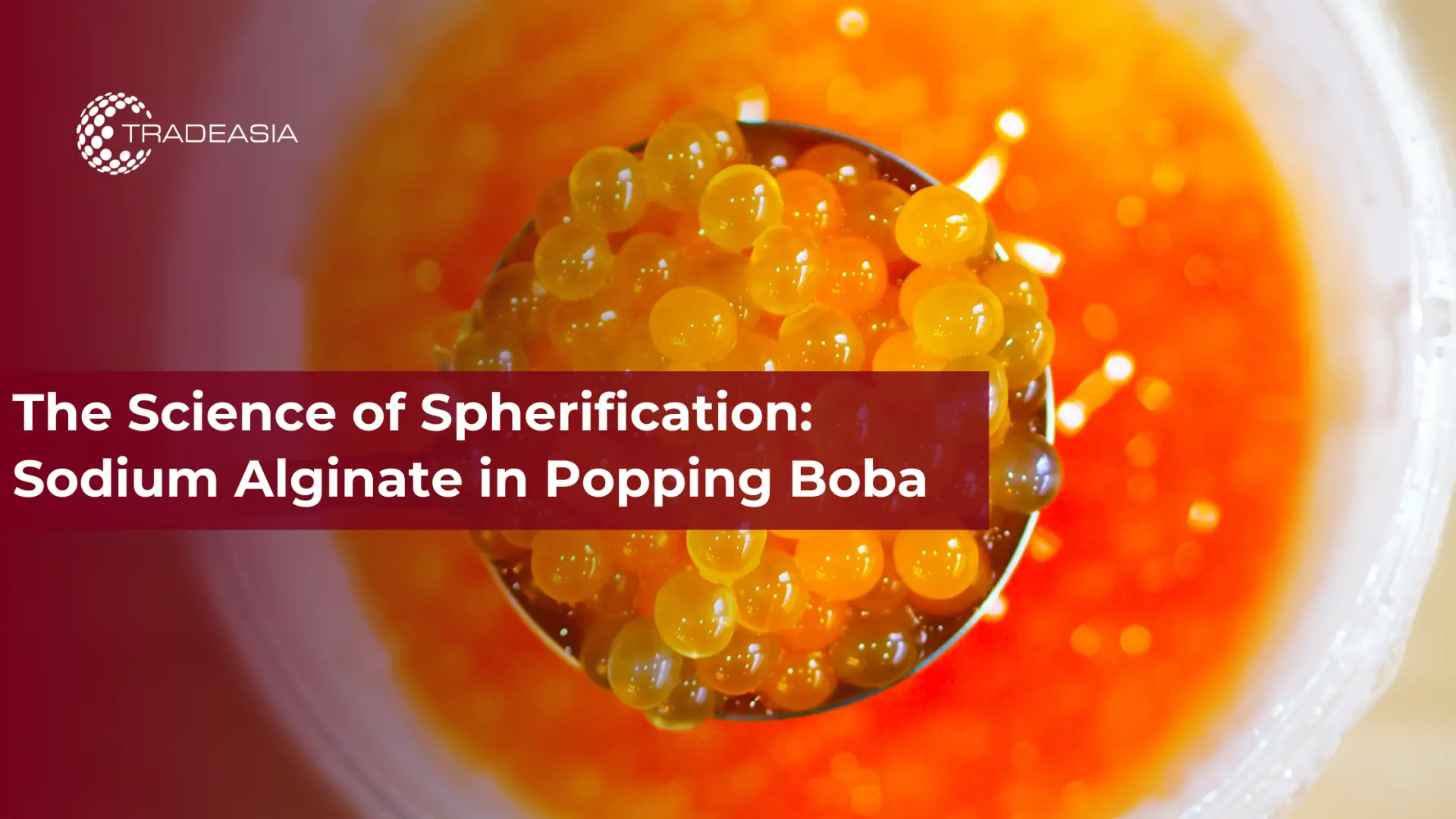
The global expansion of the bubble tea, frozen yogurt, and premium dessert markets has significantly reshaped consumer expectations regarding beverage texture and sensory interaction. While traditional tapioca pearls provide a dense and chewy texture, modern consumers increasingly seek products that deliver more dynamic and interactive experiences. This demand has contributed to the rapid commercialization of “popping boba”—small spherical capsules containing liquid flavor cores that release their contents when bitten. Producing this distinctive sensory effect requires more than simple culinary preparation; it represents an application of molecular gastronomy principles that have been adapted for large-scale industrial manufacturing. At the center of this process is a specialized marine hydrocolloid: sodium alginate.
Translating this delicate structure from small-scale culinary experimentation to automated commercial production introduces several biochemical and engineering challenges. The membrane surrounding the liquid juice core must remain extremely thin so that consumers perceive a burst of liquid rather than a gelatinous texture. At the same time, the membrane must possess sufficient mechanical strength to withstand pumping, storage in acidic fruit solutions, pasteurization treatments, and transportation without rupturing prematurely. Achieving this balance requires precise control over the interaction between sodium alginate and soluble calcium salts such as calcium lactate. By understanding the principles of ionic cross-linking, fluid rheology, and raw material quality control, food scientists can successfully apply spherification techniques at industrial scale to produce consistent popping boba products.
The Biochemistry of the Alginate Polymer: M and G Blocks
The structural foundation of the popping boba membrane originates from brown seaweed (Phaeophyceae), particularly kelp species harvested from cold ocean waters. Sodium alginate is extracted from this marine biomass as a linear, water-soluble polysaccharide with an anionic structure. However, describing sodium alginate simply as a thickening agent overlooks the complex internal architecture responsible for its unique gelling behavior. The polymer is composed of two distinct monomeric units: β-D-mannuronic acid (M) and α-L-guluronic acid (G).
These monomeric units do not appear randomly along the polymer chain. Instead, they form clusters known as M-blocks, G-blocks, and alternating MG-blocks. The relative distribution of these regions—commonly described in technical specifications as the M/G ratio—plays a crucial role in determining the functional properties of the resulting gel network. G-blocks possess a rigid molecular structure and demonstrate strong affinity for divalent cations such as calcium. When exposed to calcium ions, alginates containing a higher proportion of G-blocks form relatively strong and brittle gels that fracture easily when mechanical pressure is applied. This brittle fracture contributes to the sharp rupture that produces the characteristic “pop” when a boba sphere is bitten.
In contrast, M-blocks are structurally more flexible and tend to produce softer and more elastic gels. While elasticity may be desirable in some hydrocolloid applications, excessive M-block dominance in a popping boba formulation can produce membranes that stretch rather than rupture cleanly. This results in a thicker and more rubber-like texture that does not deliver the intended sensory effect. For this reason, formulation scientists typically select sodium alginate grades with relatively higher G-block content to achieve the brittle gel structure required for successful spherification.
Direct vs. Reverse Spherification: Engineering the Drop
Industrial-scale spherification relies on selecting the appropriate chemical configuration for the gelation reaction. Two primary techniques are used in food applications: direct spherification and reverse spherification. Both approaches rely on the interaction between sodium alginate and calcium ions, but the sequence in which these components are introduced determines the stability of the final product.
In direct spherification, sodium alginate is dissolved directly into the flavored liquid that will form the boba core. This alginate-containing liquid is then dropped into a calcium-containing bath. As the droplet contacts the solution, calcium ions diffuse inward and begin cross-linking the alginate polymers at the surface, forming a gel membrane. However, because unreacted alginate remains inside the droplet, calcium ions continue to diffuse into the interior over time. This progressive gelation gradually solidifies the entire droplet, eventually transforming the liquid center into a solid gel. In addition, direct spherification can become unstable when the liquid core contains high levels of natural calcium or strong acidity, which may trigger premature gelation.
To overcome these limitations and achieve the shelf stability required for commercial products, manufacturers typically employ reverse spherification. In this method, the calcium salt—commonly calcium lactate or calcium lactate gluconate—is dissolved within the flavored liquid core. The calcium-rich solution is then introduced into a bath containing hydrated sodium alginate. As the droplet enters the bath, calcium ions diffuse outward from the liquid core and cross-link the surrounding alginate to form a thin membrane. Because the alginate is located only in the external bath, gel formation stops once the droplet is removed and rinsed. This allows the internal liquid core to remain fluid while the outer membrane remains structurally stable during storage and distribution.
The Calcium Cross-Linking Mechanism: Crafting the "Pop"
The transformation of sodium alginate solution into a gel membrane is driven by ionic cross-linking, commonly described using the “egg-box model.” Unlike hydrocolloids such as gelatin or agar that rely on temperature-driven gelation, alginate gelation occurs through interactions between polymer chains and multivalent ions at room temperature. This property makes alginate particularly useful for industrial processing because it eliminates the need for heating and cooling stages during gel formation.
When calcium ions encounter alginate chains during reverse spherification, the divalent calcium ions replace sodium ions originally associated with the polymer. The calcium ions fit into cavities formed by adjacent guluronic acid residues and form cross-links between neighboring alginate chains. Because each calcium ion carries two positive charges, it can connect two negatively charged polymer strands simultaneously, creating a three-dimensional network structure.
The arrangement of calcium ions within these guluronic acid cavities resembles eggs placed within the compartments of a carton, which explains the origin of the “egg-box” terminology. As thousands of these ionic bridges form, the liquid alginate solution rapidly transforms into a stable gel matrix. The thickness and strength of the resulting membrane depend largely on the residence time of the droplet in the alginate bath. Short exposure times create thin membranes that rupture easily, while longer exposure times produce thicker and stronger gels. In commercial production lines, controlling this residence time with precision is essential to produce spheres that maintain structural stability during handling while still delivering the desired bursting effect during consumption.
Rheological Synergy: Managing Viscosity for High-Speed Extrusion
Scaling spherification to industrial production requires careful management of fluid rheology. Commercial popping boba facilities typically use automated droplet-forming systems capable of producing thousands of uniform spheres per minute. These systems may employ specialized nozzle designs or droplet generators to deliver consistent droplets into the alginate bath.
If the flavored liquid core has very low viscosity, droplet formation becomes unstable during extrusion. Low-viscosity liquids can deform upon impact with the setting bath, producing irregular shapes or fragmented gels rather than uniform spheres. To stabilize droplet formation, formulators frequently adjust the rheological profile of the liquid core using secondary hydrocolloids such as xanthan gum.
Small amounts of xanthan gum increase the viscosity and introduce shear-thinning flow behavior, which improves droplet formation during extrusion. The modified liquid detaches cleanly from the nozzle, maintains structural integrity as it enters the setting bath, and forms a symmetrical sphere before gelation occurs. At the same time, the viscosity of the alginate bath itself must be controlled to ensure proper droplet penetration and prevent aggregation. Maintaining stable rheological conditions in both the liquid core and the setting solution is essential for continuous industrial production.
Procurement Strategy: Alginate Purity, M/G Ratios, and QA SOPs
For procurement teams and quality assurance specialists overseeing large-scale boba production, sourcing sodium alginate requires careful attention to raw material consistency. Because alginate originates from marine seaweed, natural variations in species, harvest season, and ocean conditions can influence the resulting polymer composition and M/G ratio. Seaweed harvested from colder regions often produces alginate with higher guluronic acid content, while other sources may produce alginate with higher mannuronic acid proportions.
Purchasing sodium alginate based solely on price without evaluating functional specifications can lead to formulation inconsistencies. Procurement teams typically require suppliers to provide detailed Technical Data Sheets and Certificates of Analysis specifying parameters such as viscosity range, gel strength characteristics, and other quality indicators relevant to spherification performance.
Handling procedures also play an important role in maintaining consistent processing conditions. Sodium alginate powders tend to hydrate rapidly at the surface when added directly to water, forming lumps sometimes referred to as “fish eyes.” These partially hydrated particles dissolve slowly and can interfere with extrusion systems if not properly dispersed. To prevent this issue, manufacturers may use high-shear mixers or premix alginate with dry ingredients before hydration. Because alginate is derived from natural marine sources, routine quality control testing—including microbiological screening and monitoring for trace heavy metals—also forms part of standard quality assurance procedures.
Conclusion
The commercial production of popping boba demonstrates how principles of food science and polymer chemistry can be applied to create unique sensory experiences in modern beverages and desserts. Through the controlled interaction between sodium alginate and calcium ions, manufacturers can transform liquid fruit juices into thin-walled spheres that release their contents when bitten.
Successful implementation of this technology requires careful selection of alginate grades with suitable M/G ratios, precise control over the spherification process, and appropriate management of fluid rheology during extrusion. When these formulation considerations are combined with consistent raw material sourcing and quality assurance practices, manufacturers can produce popping boba products that maintain structural integrity during processing and deliver the distinctive sensory effect expected by consumers.
Partner with Food Additives Asia for Ingredient Security
The performance and consistency of industrial spherification systems depend heavily on the quality and reliability of the hydrocolloids used in the process. At Food Additives Asia, we supply sodium alginate sourced from established marine extract producers and supported by detailed technical documentation. Our ingredient portfolio also includes calcium lactate and xanthan gum solutions commonly used in spherification and beverage applications.
By providing standardized hydrocolloid ingredients with verified specifications, we help manufacturers maintain consistent formulation performance and stable production processes. If your company is developing or scaling popping boba products, our team can assist with ingredient information and sourcing inquiries. For further details about sodium alginate specifications and availability, please visit foodadditivesasia.com and contact our team for technical support and supply information.