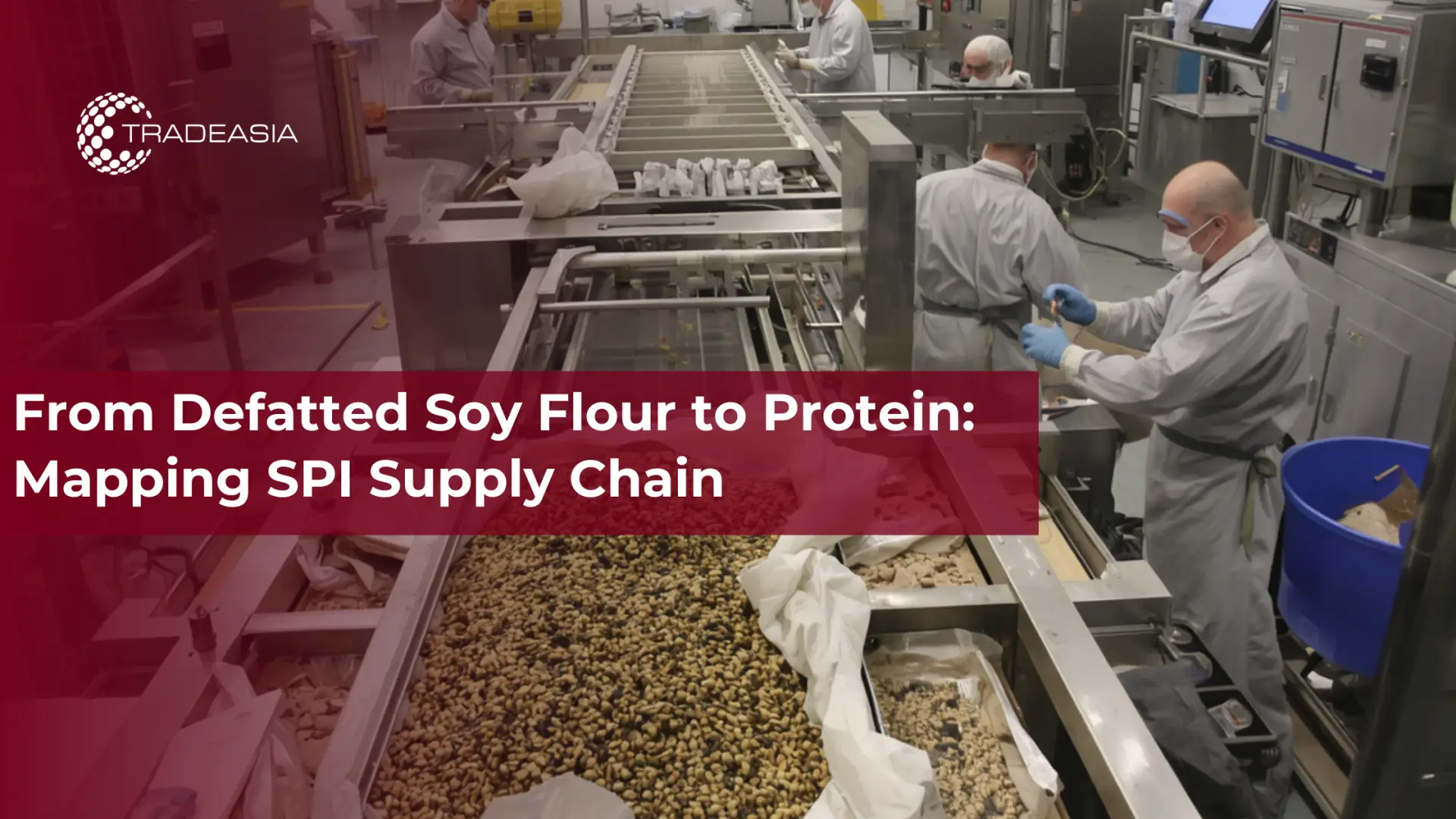
Introduction: Transforming Agricultural Output into Functional Protein Systems
Soy Protein Isolate (SPI) stands as one of the most technologically refined ingredients within the global plant-based protein industry, not because of its agricultural origin, but because of the complex, multi-stage transformation process that converts a relatively low-value raw material into a high-performance functional protein. Unlike many food ingredients that retain much of their original composition, SPI is the result of a deeply engineered supply chain that progressively isolates, purifies, and enhances the protein fraction of soybeans to achieve a purity level typically exceeding 90 percent on a dry basis. This transformation reflects a broader shift in modern food systems, where value is no longer derived primarily from raw materials, but from the processing capabilities and technological sophistication embedded within the supply chain.
At its core, the SPI supply chain is an example of vertical integration across multiple industrial domains, beginning with soybean cultivation and extending through oilseed crushing, intermediate material preparation, protein extraction, purification, and final powder production. Each of these stages is interdependent, meaning that variations in upstream quality or process conditions can propagate downstream, affecting yield, cost, and functional performance. As a result, the production of SPI is not simply a sequence of steps, but a tightly coordinated system where material flow, process control, and quality management must be continuously aligned.
The journey from defatted soy flour to SPI is particularly significant because it marks the transition from commodity processing to high-value ingredient manufacturing. While soybeans and soybean meal are traded in bulk markets with relatively thin margins, SPI occupies a premium position due to its specialized applications in food, beverage, nutraceutical, and industrial formulations. Understanding this journey provides critical insight into how value is created, where efficiency gains can be realized, and how supply chain design influences the final product’s performance and economic viability.
Stage 1: Soybean Crushing and Defatting—The Industrial Foundation
The SPI supply chain begins long before protein isolation, at the level of soybean processing. Soybeans are among the most widely cultivated oilseeds globally, with annual production exceeding 370 million metric tons. However, their primary economic value lies not in direct human consumption, but in their role as a feedstock for oil extraction and protein-based products. The first major transformation occurs in soybean crushing facilities, where beans are cleaned, conditioned, cracked, and flaked to prepare them for solvent extraction.
During extraction, typically using hexane as a solvent, the oil fraction is removed, leaving behind soybean meal with a significantly reduced fat content. This defatted meal contains approximately 44 to 48 percent protein and serves as the primary input for further protein processing. However, for SPI production, this meal undergoes additional refinement to produce defatted soy flour, a more uniform and finely milled intermediate that facilitates efficient protein extraction.
This stage is characterized by high throughput and relatively low value addition, but it is critically important because it establishes the baseline quality of all downstream products. Parameters such as residual oil content, protein integrity, and particle size distribution must be carefully controlled, as they directly influence extraction efficiency and final product functionality. Moreover, this stage is highly integrated with agricultural supply chains, meaning that factors such as crop quality, harvest conditions, and storage practices can have cascading effects throughout the entire SPI production system.
From a supply chain perspective, soybean crushing represents the anchor point of integration, linking agricultural production with industrial processing. Facilities are typically located near soybean-growing regions or major transportation hubs, ensuring a steady supply of raw materials and efficient distribution of outputs. While the economic margins at this stage are relatively modest, the scale and efficiency of operations are essential for supporting the more specialized and higher-value processes that follow.
Stage 2: Protein Extraction—Unlocking the Functional Fraction
Once defatted soy flour is prepared, the supply chain transitions into a more specialized and technically demanding phase: protein extraction. This stage is fundamentally a wet processing operation, where the goal is to separate the protein fraction from other components such as carbohydrates, fiber, and residual minerals. The process begins by dispersing the flour in water to create a slurry, which is then subjected to pH adjustment—typically raised to an alkaline range between pH 8 and 10.
At this elevated pH, soy proteins become highly soluble, allowing them to dissolve into the aqueous phase while most non-protein components remain insoluble. These insoluble materials are subsequently removed through centrifugation or filtration, leaving behind a protein-rich liquid known as protein extract liquor. This step is critical because it determines both the yield of protein recovery and the preservation of functional properties that will be required in downstream applications.
The efficiency of protein extraction depends on a delicate balance of process variables, including temperature, pH, mixing intensity, and residence time. Excessive heat or mechanical shear can lead to protein denaturation, reducing solubility and impairing functional characteristics such as emulsification and gelation. Conversely, insufficient processing can result in incomplete extraction, lowering overall yield and economic efficiency.
From a supply chain standpoint, this stage marks a significant shift in both value and complexity. Unlike the bulk handling of soybean meal, protein extraction requires precise control systems, significant water usage, and robust wastewater management infrastructure. It also introduces new cost drivers, including energy consumption and chemical inputs, which must be carefully managed to maintain profitability. Despite these challenges, this stage adds substantial value by concentrating the protein fraction and removing lower-value components, setting the stage for further purification.
Stage 3: Isoelectric Precipitation—Achieving Protein Purity
Following extraction, the next critical step is the isolation of protein from the liquid phase, which is achieved through isoelectric precipitation. This process exploits the unique property of proteins to become least soluble at their isoelectric point, which for soy proteins is approximately pH 4.5. By gradually lowering the pH of the protein extract, the dissolved proteins lose their charge and begin to aggregate, forming a solid precipitate.
This precipitated protein is then separated from the surrounding liquid using centrifugation or filtration, resulting in a highly concentrated protein mass. At this stage, the protein content typically exceeds 90 percent on a dry basis, meeting the defining criteria for SPI. However, the significance of this step extends beyond purity; it also plays a crucial role in determining the functional behavior of the final product.
The conditions under which precipitation occurs—such as the rate of pH adjustment, temperature, and mixing dynamics—can influence protein structure at a molecular level. Subtle variations can affect properties such as solubility, viscosity, and gel strength, which are critical for different applications. For example, SPI used in beverages requires high solubility, while SPI used in meat analogs may prioritize gelation and water-binding capacity.
From a supply chain perspective, isoelectric precipitation represents a major inflection point in value creation. It is at this stage that the material transitions from an intermediate product to a high-purity ingredient with specialized applications. However, this increased value is accompanied by greater sensitivity to process conditions, requiring advanced control systems and skilled operation to ensure consistent quality.
Stage 4: Washing, Neutralization, and Refinement—Enhancing Quality and Stability
After precipitation, the protein curd undergoes multiple washing steps to remove residual impurities, including soluble sugars, salts, and other non-protein components. This purification process is essential for improving both the sensory and functional properties of SPI, reducing off-flavors and enhancing color and texture.
Following washing, the protein is neutralized to a pH close to neutral, typically between 6.5 and 7.0. This step stabilizes the protein and prepares it for drying, while also influencing its functional characteristics. Improper neutralization can lead to protein aggregation or instability, underscoring the importance of precise process control.
This stage contributes significantly to the refinement and standardization of SPI, ensuring that it meets the stringent requirements of food and industrial applications. It also introduces additional operational complexity, including the need for accurate chemical dosing, water management, and quality monitoring systems.
Stage 5: Drying and Powder Formation—Finalizing the Product
The final stage in the SPI supply chain is the conversion of the wet protein mass into a stable, transportable powder. This is most commonly achieved through spray drying, a process in which the protein slurry is atomized into fine droplets and exposed to hot air, rapidly removing moisture.
Spray drying is both energy-intensive and technologically sophisticated, as it must balance efficient moisture removal with the preservation of protein functionality. Parameters such as inlet temperature, airflow, and droplet size are carefully controlled to produce a powder with the desired characteristics, including particle size, bulk density, and solubility.
The resulting SPI powder typically has a moisture content below 7 percent, ensuring long shelf life and stability during storage and transportation. At this point, the product is fully transformed into a high-value ingredient suitable for global distribution.
From a supply chain perspective, this stage is critical because it determines the logistical and commercial viability of SPI. Powder form enables efficient packaging, storage, and transport, allowing the product to be traded internationally and integrated into diverse applications.
Value Addition Across the Supply Chain
One of the most defining characteristics of the SPI supply chain is the progressive increase in value at each stage of processing. While soybeans are relatively low-cost commodities, SPI commands a significantly higher price due to its purity, functionality, and application versatility. This value is not inherent in the raw material but is created through a series of controlled transformations that require significant capital investment, technical expertise, and operational precision.
Each stage contributes incrementally to this value creation, from the initial concentration of protein in defatted soy flour to the final refinement and drying processes that produce a high-performance ingredient. The cumulative effect is a product that is not only nutritionally rich but also functionally adaptable, capable of meeting the needs of a wide range of industries.
Integration and System Efficiency in SPI Supply Chains
SPI production is rarely an isolated operation. Instead, it is typically integrated with broader soybean processing systems, allowing for resource optimization and cost efficiency. By leveraging shared infrastructure, such as utilities and logistics networks, producers can reduce operational costs and improve overall efficiency.
This integration also enables the effective utilization of by-products, ensuring that all components of the soybean are used productively. Such system-level optimization is essential for maintaining competitiveness in a market where processing costs play a significant role in determining profitability.
Conclusion: Precision Processing as the Core of Value Creation
The journey from defatted soy flour to Soy Protein Isolate illustrates how modern supply chains transform agricultural commodities into highly specialized and valuable ingredients. Through a sequence of carefully controlled processes, soy proteins are isolated, purified, and engineered to meet the demands of diverse applications.
This transformation highlights the importance of processing technology, supply chain integration, and quality management in creating value beyond raw materials. As industries continue to demand higher levels of functionality and consistency, the ability to manage and optimize this complex supply chain will remain a key determinant of success.
For businesses seeking high-quality Soy Protein Isolate or other food ingredients products and reliable sourcing solutions, visit foodingredientsasia.com for more information about specifications, applications, and supply capabilities. For direct inquiries, product details, or customized requirements, please contact food@chemtradeasia.com. Our team is ready to assist you with professional support and comprehensive solutions tailored to your needs.