Introduction
The American food and beverage industry operates within one of the world's most stringent regulatory environments. In recent years, the convergence of the Food Safety Modernization Act (FSMA), evolving Good Manufacturing Practices (cGMP), and heightened consumer awareness has created a new paradigm for compliance. For manufacturers, this means every component in their supply chain, down to foundational ingredients like sodium bicarbonate (baking soda), must be sourced with verified safety and traceability. The pressure is not solely on food producers; it cascades directly to their chemical and ingredient suppliers.
Suppliers are no longer just vendors of bulk commodities; they have transformed into critical partners in risk mitigation and quality assurance. This article delves into how leading chemical suppliers, including global partners like Chemtradeasia.com, are proactively responding to these rising food-grade compliance standards. We will explore the specific regulatory challenges, the strategic investments being made, and how these efforts translate into tangible benefits for American manufacturers seeking reliable, high-purity ingredients such as food-grade sodium bicarbonate.
The Evolving Landscape of Food Safety Regulations in America
The cornerstone of modern U.S. food safety is the Food Safety Modernization Act (FSMA), signed into law in 2011. FSMA represents a fundamental shift from responding to contamination to preventing it. Its rules, particularly the Preventive Controls for Human Food rule, mandate that food facilities implement risk-based preventive controls. This includes evaluating their supply chains and ensuring that raw materials and ingredients, like sodium bicarbonate used as a leavening agent, pH adjuster, or cleaning agent, do not introduce hazards. Suppliers must now provide documentation proving their products are safe, produced under sanitary conditions, and free from adulteration.
Alongside FSMA, Current Good Manufacturing Practices (cGMP) for food, as outlined in 21 CFR Part 117, set the baseline operational requirements. These cover everything from personnel hygiene and plant sanitation to equipment design and process controls. For a supplier of food-grade chemicals, cGMP compliance is non-negotiable. Furthermore, many American manufacturers require suppliers to adhere to even more rigorous third-party certification schemes, such as the Safe Quality Food (SQF) Institute, British Retail Consortium (BRC) Global Standards, or ISO 22000. This layered regulatory and standards framework means suppliers must operate at a level of transparency and rigor unprecedented in past decades.
Core Compliance Pillars for Ingredient Suppliers
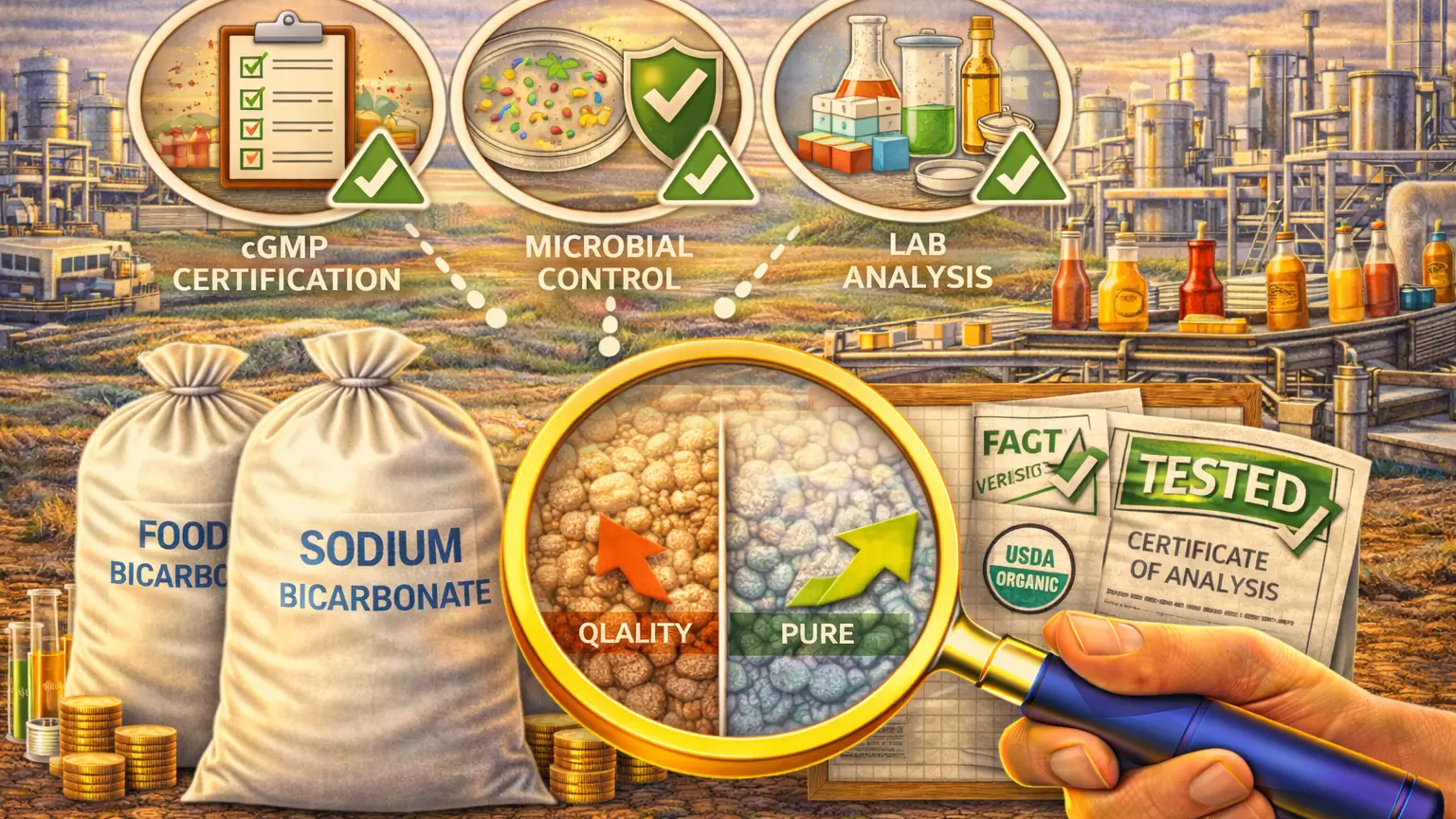
To navigate this complex environment, forward-thinking suppliers have built their compliance strategies around several core pillars. The first is facility and process certification. Leading suppliers invest heavily in obtaining and maintaining certifications like those mentioned above. These are not one-time achievements but require continuous audits, internal reviews, and process improvements. A certified facility provides immediate assurance to buyers that systemic controls are in place. The second pillar is robust documentation and record-keeping. Every batch of product, such as a lot of food-grade sodium bicarbonate, must have a complete pedigree: certificates of analysis (CoA), material safety data sheets (SDS), traceability records back to raw materials, and documentation of any storage or transportation conditions.
The third pillar is proactive hazard analysis and risk assessment. Under FSMA's supplier verification programs, suppliers must identify potential biological, chemical (including allergens and heavy metals), and physical hazards specific to their products and processes. For a chemical like sodium bicarbonate, this involves rigorous testing for contaminants like lead, arsenic, and mercury, and ensuring packaging prevents foreign material introduction. Finally, supply chain transparency is paramount. Suppliers must vet their own raw material sources (e.g., trona ore or synthetic soda ash) and be able to provide visibility deep into the supply chain, assuring customers of consistency and safety from origin to delivery.
Spotlight on Food-Grade Sodium Bicarbonate: Specifications & Assurance
Food-grade sodium bicarbonate is a versatile workhorse ingredient used in baking, beverage carbonation, pH balancing, and as a cleaning agent in food processing equipment. Its "food-grade" designation is not arbitrary; it is defined by strict purity and compositional standards set by the Food Chemicals Codex (FCC) and the U.S. Pharmacopeia (USP). Compliant suppliers guarantee their product meets or exceeds these specifications. Key parameters include a minimum assay (purity) of 99.0-100.5%, strict limits on heavy metals (e.g., lead ≤ 2 mg/kg), and controlled levels of moisture, chloride, and sulfate.
Assuring this quality requires a multi-faceted approach. First, raw material qualification is critical. Whether sourced from natural mineral deposits or produced synthetically, the precursor materials are rigorously tested. The manufacturing process itself, often involving purification, carbonation, and crystallization, is conducted in cGMP-compliant, dedicated food-grade lines to prevent cross-contamination. Finally, batch-level testing is the ultimate guarantee. Each production lot undergoes analytical testing, and the resulting Certificate of Analysis (CoA) becomes a legal document of compliance. Suppliers like Chemtradeasia.com facilitate this by providing easy access to batch-specific CoAs, ensuring American manufacturers can seamlessly integrate this documentation into their own FSMA-mandated food safety plans.
Beyond basic FCC purity, advanced supplier services include offering tailored grades. For instance, a finely milled, free-flowing grade might be optimized for dry mix applications, while a specific granulation is offered for meat processing or effervescent tablet production. This specialization demonstrates a supplier's deep understanding of application-specific compliance needs, moving beyond simply selling a chemical to providing a verified, fit-for-purpose solution.
Strategic Supplier Responses to Compliance Demands
In response to these stringent demands, top-tier suppliers have moved from a reactive to a proactive stance. A primary strategic response is significant capital investment in infrastructure. This includes building or retrofitting dedicated food-grade production and packaging lines with sanitary design principles, investing in state-of-the-art laboratory equipment for in-house quality control, and implementing advanced warehouse management systems that segregate food-grade products from industrial-grade materials to prevent mix-ups.
Another key response is the development of comprehensive quality management systems (QMS). A documented QMS, often aligned with ISO 9001, formalizes every procedure related to quality—from customer complaint handling and corrective actions to employee training and internal auditing. Furthermore, suppliers are expanding their technical and regulatory support teams. These experts do not just sell product; they act as consultants, helping customers understand compliance documentation, navigate regulatory changes, and select the correct ingredient grade for their specific application, thereby reducing the customer's compliance burden.
The Role of Technology and Traceability
Technology is the great enabler of modern compliance. Suppliers are leveraging digital tools to create an unbroken chain of custody. Blockchain and digital ledger technologies are being piloted to create immutable records of a product's journey. Imagine scanning a QR code on a bag of sodium bicarbonate and instantly viewing its full history: mine or factory of origin, production date, all QC test results, storage temperatures, and shipping milestones. This level of traceability is becoming a market differentiator.
Additionally, Enterprise Resource Planning (ERP) and Quality Management Software are integrated to automate compliance workflows. These systems can trigger batch holds if a test parameter is out of spec, manage certificate generation, and ensure only released product is shipped. For the customer, this often translates into access to online customer portals where they can download up-to-date CoAs, SDS, and other compliance documents on demand, streamlining their own audit preparation and record-keeping processes.
Benefits of Partnering with a Compliant Supplier
For American food and beverage manufacturers, choosing a supplier with a demonstrable commitment to food-grade compliance is a strategic business decision that yields multiple benefits. The most obvious is risk reduction. Partnering with a certified, transparent supplier significantly lowers the risk of a contamination event, costly recall, regulatory action, or brand-damaging publicity. This provides invaluable peace of mind and protects the bottom line.
Secondly, it drives operational efficiency and cost savings. While compliant ingredients may have a slightly higher upfront cost, they save money in the long run by reducing incoming inspection burdens, minimizing production downtime due to quality issues, and simplifying the audit process. Ready access to perfect documentation saves countless hours of administrative work. Finally, it future-proofs the supply chain. As regulations inevitably tighten further, a supplier already operating at a high standard will adapt more easily, ensuring a continuous, reliable supply of critical ingredients like food-grade sodium bicarbonate. This reliability is a cornerstone of production planning and business continuity.
Conclusion
The rising tide of food-grade compliance standards in America is reshaping the supplier landscape. It is fostering a new era of partnership, where ingredient suppliers are integral to the food safety ecosystem. Through investments in certification, process rigor, technological integration, and transparency, leading suppliers are not just meeting standards but are setting new benchmarks for quality and reliability. For products as essential as food-grade sodium bicarbonate, this transformation ensures that American manufacturers have access to ingredients they can trust implicitly.
Ultimately, compliance is no longer a checkbox exercise; it is a continuous journey and a core component of product value. By prioritizing suppliers who embody this commitment, such as those with robust global networks and documented quality systems like Chemtradeasia.com, food and beverage companies secure more than just a raw material. They secure a competitive advantage built on safety, consistency, and the confidence to innovate in a demanding market.