Introduction: The Rheological Foundation of Texture
In modern food manufacturing, the structural properties of a product are often as important as its flavor or nutritional composition. Texture, viscosity, and mouthfeel strongly influence consumer perception and overall product acceptance. For this reason, formulation scientists and process engineers carefully select functional ingredients that help define the rheological behavior of a finished product. Among these ingredients, starch remains one of the most widely used and versatile texturizing agents across the global food industry.
Botanical starches derived from different plant sources can exhibit significantly different functional behaviors during processing and consumption. Although many starches provide thickening properties, their behavior under heat, shear, and cooling conditions can vary considerably. Treating starches as interchangeable ingredients based only on viscosity often leads to formulation inconsistencies or undesired textures in finished products. Understanding the structural characteristics of each starch source therefore plays an essential role in achieving consistent product quality.
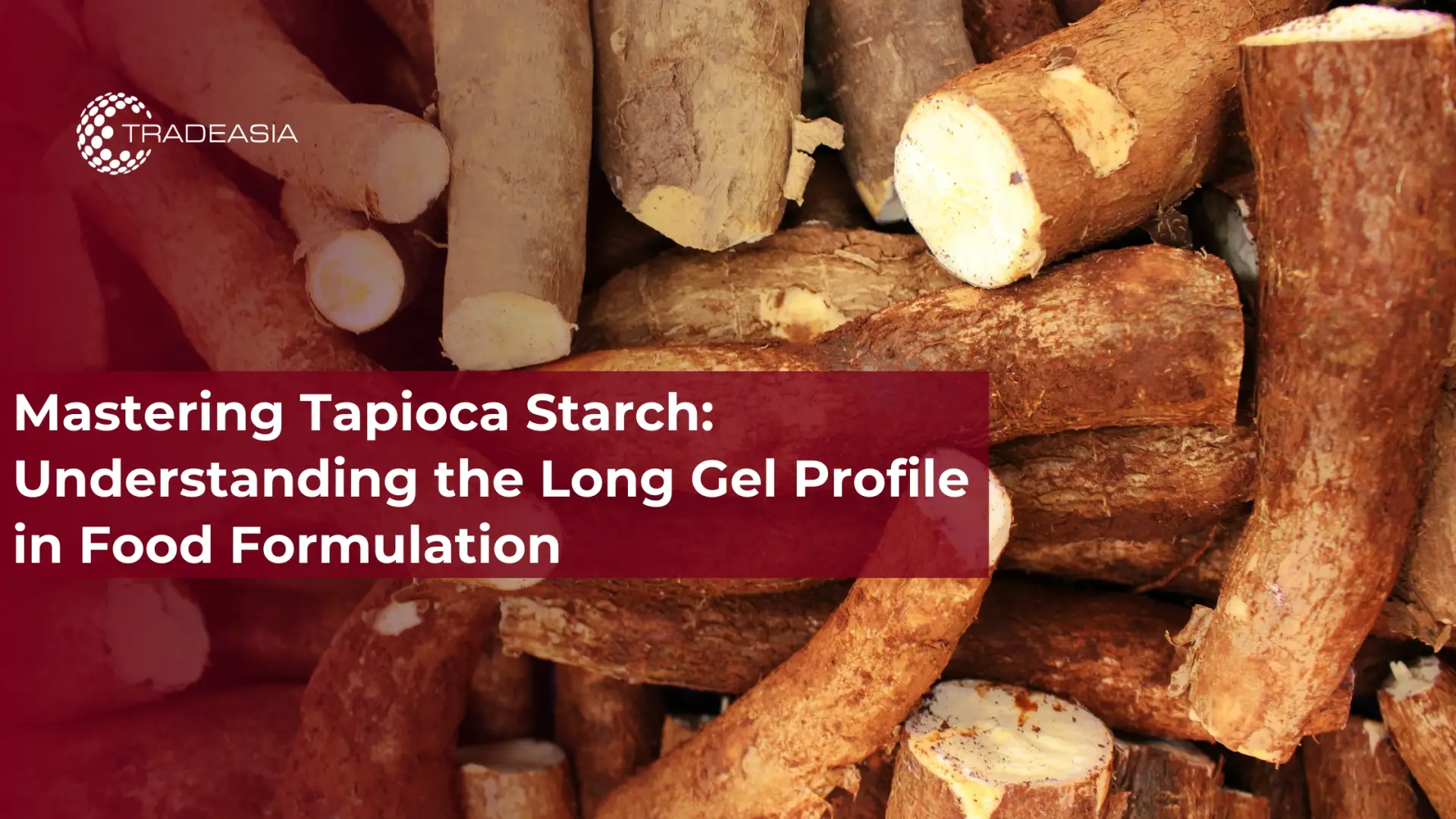
Tapioca starch, derived from the roots of cassava (Manihot esculenta), is widely used in global food manufacturing because of its distinctive rheological profile. One of its most notable functional characteristics is the formation of what food scientists often describe as a “long” or cohesive gel texture when cooked in water. This behavior differs significantly from the firmer and more brittle gel structures commonly produced by cereal starches such as corn or wheat. As a result, tapioca starch is frequently selected for formulations that require elasticity, smooth viscosity, and visual clarity.
Understanding the molecular composition behind this long gel profile helps manufacturers determine when tapioca starch is the most appropriate ingredient choice. By recognizing how it differs from cereal starches and how it behaves during industrial processing, product developers can better design textures that meet specific functional and sensory targets.
The Biophysics of the Long Gel: Amylose vs. Amylopectin
The functional behavior of starch during cooking is largely determined by the ratio and molecular structure of its two primary polysaccharides: amylose and amylopectin. These polymers are both composed of glucose units, but they differ significantly in their structural arrangement and physical behavior in aqueous systems.
Amylose is primarily a linear molecule consisting of long chains of glucose units connected by α-1,4 glycosidic bonds. Because of its relatively straight structure, amylose molecules tend to align with one another during cooling and form hydrogen bonds that contribute to gel firmness and retrogradation. Starches with higher amylose content therefore often produce gels that are more rigid and opaque.
Amylopectin, by contrast, has a highly branched molecular structure with multiple α-1,6 linkages that create a large and complex three-dimensional architecture. This branching pattern allows amylopectin molecules to interact with water differently during gelatinization. Instead of forming tightly packed networks, amylopectin-rich systems tend to produce more elastic and cohesive textures.
Tapioca starch is characterized by a relatively high proportion of amylopectin and a lower amylose content compared with many cereal starches. This composition contributes to several of its distinctive properties, including high paste clarity, smooth viscosity, and a cohesive gel structure. When heated in water, tapioca starch granules absorb moisture, swell, and eventually lose their crystalline structure in a process known as gelatinization.
As gelatinization progresses, the swollen granules and dissolved polymers interact within the surrounding aqueous environment. Because amylopectin molecules dominate the system, the resulting paste tends to display strong cohesiveness rather than forming a firm, brittle gel network. When mechanical force is applied—such as stirring, pouring, or stretching—the paste may exhibit a flowing or elongated texture that is commonly described as a “long gel” characteristic.
Another important feature of tapioca starch is the visual clarity of the gel it forms. Compared with many cereal starches, tapioca pastes often appear more translucent and glossy after cooking. This characteristic makes the starch particularly useful in applications where visual appearance and smooth texture are important quality attributes.
Textural Engineering: Applications of Cohesive Starch Systems
Because of its cohesive gel behavior and smooth mouthfeel, tapioca starch plays an important role in many modern food formulations. Product developers often use it in applications where elasticity, stretch, or chewiness is desirable. Its ability to create stable and glossy pastes also makes it suitable for products that require a visually appealing finish.
One application where tapioca starch has gained particular attention is in plant-based dairy alternatives. In many vegan cheese formulations, achieving meltability and stretch comparable to traditional dairy products can be challenging. Tapioca starch helps provide elasticity and viscosity that support a softer, more cohesive texture during heating. While it does not replicate the functional properties of milk proteins directly, it can contribute to the structural behavior required in certain plant-based cheese systems.
In Asian food applications, tapioca starch is widely used to achieve specific textural qualities associated with regional culinary traditions. Products such as tapioca pearls for bubble tea, certain rice cakes, and extruded noodles often rely on the cohesive and elastic properties of tapioca starch. These foods are valued for their characteristic chewiness and resilience during cooking, attributes that are supported by the starch’s amylopectin-rich composition.
Tapioca starch is also commonly used in sauces, fruit preparations, pie fillings, and glazes where clarity and smooth flow are important. The glossy appearance and relatively stable viscosity help improve product presentation while maintaining desirable mouthfeel. In some frozen or refrigerated products, tapioca starch may also be preferred because it can provide improved freeze-thaw stability compared with certain cereal starches.
By selecting starches based on their structural behavior rather than simply their thickening power, food manufacturers can better control the sensory profile of their products. Tapioca starch therefore serves as a valuable functional ingredient in applications where smoothness, elasticity, and visual clarity are key formulation goals.
The Corn Starch Contrast: Short Gels and Structural Differences
To better understand the role of tapioca starch in food formulation, it is useful to compare its behavior with that of common cereal starches such as corn starch. Corn starch, extracted from the endosperm of maize kernels, contains a higher proportion of amylose than tapioca starch. This compositional difference significantly influences the structure of the gels formed during cooking and cooling.
When corn starch is heated in water, the granules swell and release amylose into the surrounding liquid. During cooling, these linear amylose molecules gradually align and form hydrogen-bonded networks. This process contributes to the formation of firmer gels that may appear opaque and less elastic than those produced by tapioca starch.
As a result, corn starch pastes tend to exhibit what food technologists often describe as a “short” texture. Instead of stretching or flowing cohesively, the gel may break more cleanly when mechanical force is applied. This property can be advantageous in applications where a firm or sliceable structure is desired.
For example, products such as custards, pastry creams, and certain pudding formulations often rely on the structural firmness associated with cereal starches. In these cases, the gel network created by amylose contributes to a stable and spoonable consistency that holds its shape during serving.
The differences between long and short gel textures illustrate why starch selection is an important formulation decision. While tapioca starch offers elasticity and clarity, corn starch may provide firmness and structural rigidity. Product developers therefore evaluate the desired texture, processing conditions, and sensory characteristics when determining which starch source is most appropriate.
Industrial Processing Dynamics: Shear Stability and Hydration Control
In industrial food manufacturing, the functional performance of starch is closely linked to processing conditions. Factors such as temperature, shear intensity, pH, and processing time can all influence how starch granules behave during cooking and mixing.
Tapioca starch typically gelatinizes at relatively moderate temperatures compared with some cereal starches. This property can support efficient processing because thickening occurs without requiring excessively high heating conditions. However, once the granules have fully swollen, the paste may become sensitive to prolonged mechanical shear.
Under high-shear mixing or pumping conditions, the swollen granules can gradually break down, leading to a reduction in viscosity. This structural breakdown may affect product consistency if processing parameters are not carefully controlled. For this reason, some manufacturing processes introduce starch later in the production cycle or manage shear conditions during hydration.
In applications that require greater processing stability, manufacturers may use modified tapioca starches rather than native starch. Techniques such as cross-linking strengthen the internal structure of starch granules, improving their resistance to mechanical shear, heat, and acidic environments. These modified starches allow food processors to maintain viscosity and texture even under demanding industrial conditions.
Careful control of hydration, heating profiles, and mixing intensity therefore plays an important role in ensuring consistent starch functionality during large-scale production. Understanding these processing dynamics helps manufacturers optimize both product quality and manufacturing efficiency.
Procurement and Quality Assurance in Tapioca Starch Supply
Beyond formulation and processing considerations, the quality of the starch supply itself plays an important role in ensuring consistent product performance. For procurement teams and quality assurance departments, selecting reliable suppliers with strong quality control systems is essential for maintaining production stability.
Tapioca starch is typically produced in regions where cassava cultivation is widely established, including parts of Southeast Asia and South America. Modern starch processing facilities employ extensive washing, separation, and drying steps to produce refined starch powders suitable for food applications. Even so, buyers often evaluate suppliers based on their adherence to recognized food safety standards and their ability to provide consistent product specifications.
Quality documentation such as Technical Data Sheets (TDS) and Certificates of Analysis (CoA) allows manufacturers to verify important parameters including moisture content, particle size, microbiological limits, and viscosity characteristics. Analytical tools such as Rapid Visco Analyzer (RVA) profiles or Brabender curves may also be used to confirm the functional properties of the starch under controlled conditions.
Consistent supply quality is particularly important in large-scale manufacturing where small variations in ingredient performance can affect processing behavior or final product texture. By working with suppliers who maintain strong quality assurance systems and transparent documentation practices, manufacturers can reduce variability and support stable production operations.
Conclusion
Tapioca starch occupies an important position in modern food formulation due to its distinctive functional properties and wide range of applications. Its amylopectin-rich composition contributes to cohesive gel behavior, smooth viscosity, and attractive visual clarity, making it suitable for products that require elasticity, chewiness, or glossy appearance.
Understanding the structural differences between tapioca starch and cereal starches allows food technologists to make informed decisions when designing textures for specific applications. While cereal starches such as corn starch may provide firmer gel structures, tapioca starch offers flexibility and cohesiveness that can enhance many processed food systems.
Successful use of tapioca starch also depends on appropriate processing conditions and consistent ingredient quality. Factors such as hydration control, shear management, and supplier reliability all influence the performance of the starch during large-scale manufacturing. When these elements are carefully managed, tapioca starch can serve as a dependable functional ingredient in a wide range of food products.
Companies seeking reliable sources of food-grade tapioca starch may benefit from working with suppliers who provide transparent documentation, consistent product specifications, and stable international supply networks. For more information about tapioca starch sourcing, product specifications, and industrial applications, visit foodadditivesasia.com.