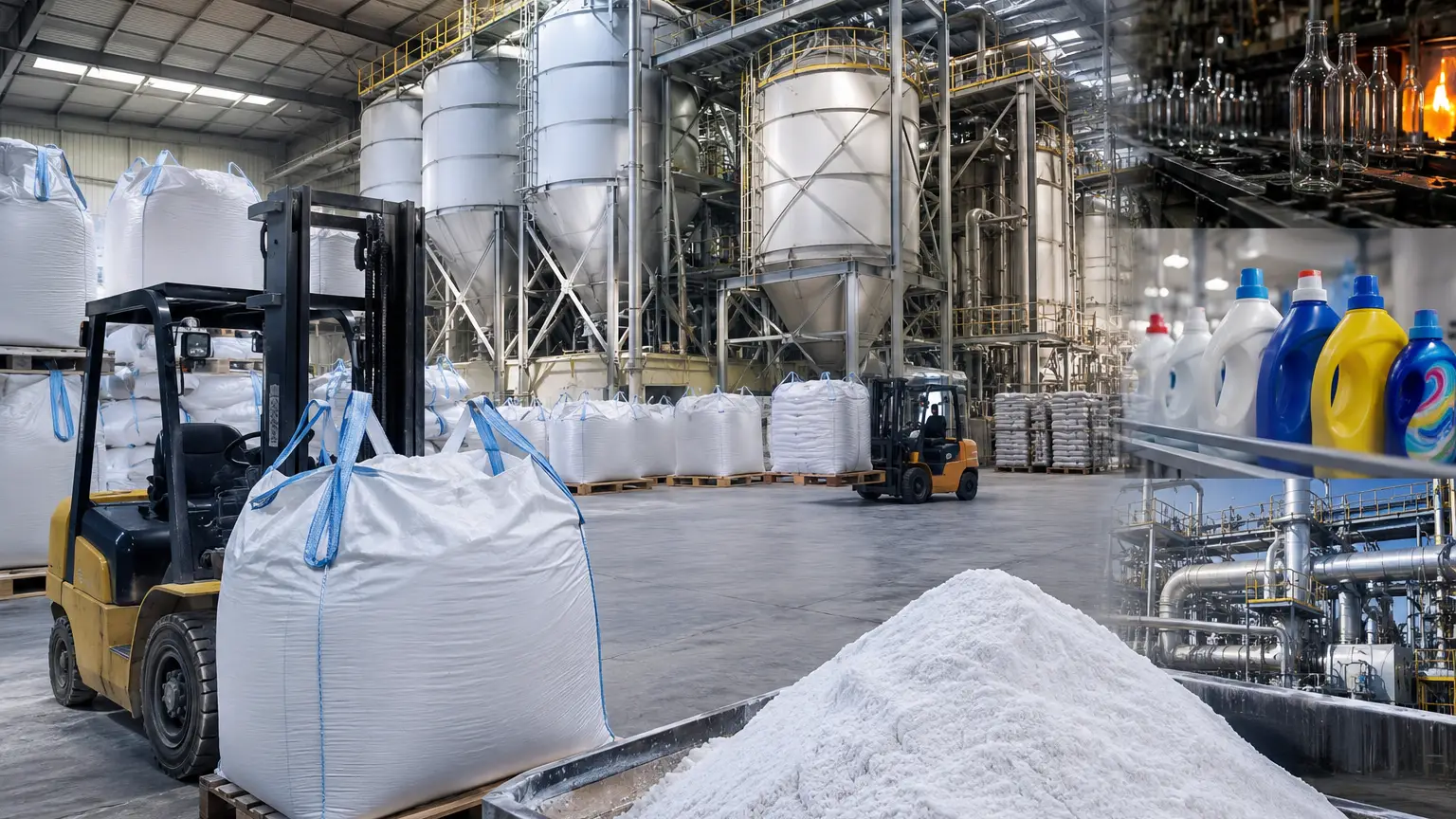
Sodium carbonate has been traded as a commodity industrial alkali for over 150 years, yet its buyer base has never been static. The industries consuming soda ash light today span construction-linked glass manufacturing, fast-moving consumer goods detergent production, municipal water infrastructure, chemical intermediates synthesis, pulp and paper processing, and an accelerating new category in solar energy and electric vehicle glass. The global soda ash light market was valued at USD 21.7 billion in 2024 and is projected to reach USD 32.4 billion by 2033, expanding at a CAGR of 4.6%. That growth is not evenly distributed across buyer categories: some segments are consolidating and professionalizing their procurement, others are growing faster than the headline market rate, and a few are beginning to substitute or restructure their soda ash demand in response to environmental mandates. For suppliers, distributors, and procurement teams trying to understand where the demand is, and where it is heading, a buyer-by-buyer analysis is more commercially useful than the aggregate market number.
What Soda Ash Light Is and Why Buyer Segments Matter
Soda ash light (sodium carbonate, Na2CO3) is a white, fine-grained anhydrous powder characterized by lower bulk density than dense soda ash — typically 500-600 kg/m³ compared to 900-1,000 kg/m³ for the dense grade. This physical characteristic is not incidental to its commercial role: the fine particle size and lower bulk density make soda ash light more reactive and faster-dissolving in aqueous processes than the dense grade, which is why it dominates in applications that require rapid dissolution, including detergent formulation, chemical synthesis, and water treatment dosing systems.
The distinction between light and dense soda ash matters commercially because the two grades do not serve interchangeable buyer bases. Dense soda ash is the dominant form for glass batch blending, where controlled particle size distribution in a dry batch is more important than dissolution speed. Light soda ash captures a disproportionate share of demand from detergent formulators, chemical producers, and water treatment operators, which is why the light category is anticipated to expand faster than dense during the forecast period, driven by increasing demand for soaps and detergents. Procurement teams and distributors positioning in soda ash light specifically are targeting a different, and in some respects faster-growing, end-use cluster than the aggregate soda ash market statistics suggest.
Primary Buyer Segments
Glass Manufacturers
Glass manufacturing remains the largest end-use segment for soda ash, accounting for approximately 51% of market share in 2025, including flat glass for construction and automotive industries, container glass for beverages and food packaging, and specialty glass such as borosilicate and solar glass. Within this segment, light soda ash plays a specific role: it is used in batch formulations for specialty glass and in facilities where rapid dissolution into the glass melt is prioritized over the dry-blend properties that make dense soda ash dominant in float glass lines.
The procurement profile of glass manufacturers is characterized by very high volume, long-term supply contracts, and price benchmarking against published spot indices for soda ash (CFR Asia, FCA Europe). Major producers often secure long-term supply contracts with glass manufacturers, ensuring predictable demand. For glass manufacturers, supply reliability and consistent particle size distribution are the primary qualification criteria, ahead of price. A single batch inconsistency in soda ash quality can disrupt a continuous glass melt process and cause expensive production downtime.
The fastest-growing sub-segment within glass is solar glass. Growth of energy-efficient buildings in Europe and increasing penetration of automotive glass in North America have contributed to steady demand, while Solvay supplies soda ash for flat glass production used in solar panels in Germany and India, aligning with renewable energy infrastructure growth. Solar panel glass manufacturing requires ultra-white, low-iron flat glass, which demands high-purity soda ash grades — a specification where synthetic light soda ash from the Solvay process has an advantage over natural trona-based material that may carry more trace mineral impurities.
Detergent and Soap Manufacturers
Detergent and soap manufacturers are the second-largest buyer segment globally and the fastest-growing by value. The detergents segment is the fastest-growing end-use category, supported by rising household and industrial cleaning product demand, particularly in Asia-Pacific and Latin America. Soda ash light functions as a builder in powder detergent formulations: its alkalinity activates surfactants, softens hard water by precipitating calcium and magnesium ions, and raises bath pH to improve cleaning performance in both household laundry and industrial cleaning applications.
Light soda ash is preferred over dense in this application specifically because of its superior dissolution speed in washing machine drum temperatures and its compatibility with continuous mixing processes in detergent powder spray-drying towers. Soda ash serves as an important builder in heavy-duty laundry detergents and soaps as it has strong alkalinity properties that activate surfactants imparting cleaning abilities to these products.
Procurement behavior in the detergent segment spans two distinct tiers. Large FMCG detergent companies — Henkel, Unilever, P&G, Nirma, and their contract manufacturing networks — purchase soda ash light on annual supply agreements with volume commitments, indexed pricing, and strict quality specifications covering bulk density, moisture content, sodium carbonate assay, and sodium chloride impurity limits. Mid-scale regional detergent manufacturers purchase on quarterly orders through chemical distributors, making this tier the most commercially accessible buyer cluster for distributors offering smaller lot sizes and flexible delivery terms. Approximately 3.2 million metric tons of soda ash were used in detergent formulations in 2023 across North America alone, according to the American Cleaning Institute.
Chemical Intermediates Producers
Chemical intermediates producers represent approximately 18% of global soda ash light demand and are the most technically diverse buyer segment. They consume soda ash light as a feedstock for the synthesis of sodium compounds including sodium silicate, sodium bicarbonate, sodium chromate, and sodium phosphate, each of which feeds further downstream into adhesives, food additives, water treatment chemicals, ceramics, and textile auxiliaries. Around 24% of domestic demand in the United States originates from chemical processing industries producing sodium compounds.
This buyer segment is less visible than glass or detergents in aggregate market statistics but is commercially important for two reasons: it tends to require higher-purity soda ash grades than industrial detergent production, and it often purchases on spot or short-term contracts rather than annual agreements, making it accessible to chemical distributors with flexible inventory positions. Chemical intermediates buyers qualify soda ash light on assay purity (typically minimum 99.2% Na2CO3), moisture content, heavy metals, and iron content, because trace impurities carry through into downstream specialty chemical products.
Water Treatment Operators
Municipal and industrial water treatment operators are a structurally growing buyer segment, particularly in markets with expanding urban water infrastructure. Soda ash light is used in water treatment for pH adjustment and alkalinity control — adding sodium carbonate raises pH in corrosive low-alkalinity water, protecting distribution pipework from corrosive attack and improving the effectiveness of disinfection processes. It is also used in ion exchange resin regeneration for water softening, and in flue gas desulfurization systems at coal-fired power plants where it neutralizes acidic combustion gases.
In 2025, the expansion of urban water supply networks, particularly in Asia and Africa, is driving growth in soda ash consumption, with governments investing heavily in infrastructure projects that prioritize clean and accessible drinking water. A concrete example of this procurement pattern came in October 2024, when the Public Utilities Corporation of Seychelles issued a tender for 105 metric tonnes of sodium carbonate for use in water treatment, inviting both local and international manufacturers and suppliers to submit bids. This kind of tender-based procurement — small to mid-scale volumes, open to international bidders, with defined delivery timelines — is structurally representative of how water utilities across Africa, the Middle East, and South and Southeast Asia procure soda ash light.
Water treatment buyers are more price-sensitive than pharmaceutical or specialty chemical buyers, but their demand is structurally stable and non-cyclical, making them attractive long-term customers for distributors serving emerging markets. For water treatment dosing applications, the key specification parameters are high assay purity, low heavy metals, and consistent bulk density for accurate dosing system calibration.
Pulp and Paper Manufacturers
Pulp and paper manufacturers consume soda ash light primarily in the kraft pulping process, where it contributes to the chemical recovery cycle by acting as a make-up alkali to compensate for sodium losses during pulping. It also functions in bleaching chemical preparation and in on-site causticizing systems that convert sodium carbonate back into caustic soda for process reuse. This application makes pulp and paper mills both buyers of soda ash light and producers of it as a recovery by-product, with the balance between bought-in and recovered soda ash varying by mill efficiency and capacity.
While pulp and paper represents a smaller share of total soda ash light demand than glass or detergents, it is a consistent long-term buyer base in regions with integrated forest products industries: Scandinavia, Canada, Brazil, Chile, Indonesia, and China. Procurement in this segment is typically through long-term mill supply contracts, with quality specifications emphasizing assay purity and moisture content.
Secondary and Niche Buyer Segments
Textile manufacturers use soda ash light as a fixative in reactive dyeing processes — sodium carbonate raises bath pH at the fixation stage, triggering the covalent bond formation between reactive dye and cellulose fiber. This application is significant in volume terms across South and Southeast Asian textile production clusters, particularly in Bangladesh, India, Pakistan, Vietnam, and Indonesia. Procurement is typically through local chemical traders who aggregate smaller volumes from multiple mills.
Beyond traditional sectors, the soda ash light market is witnessing growth in niche chemical applications such as catalysts, pharmaceuticals, and electronics, with the demand for ultra-pure, fine-grained soda ash in these sectors rising due to the need for precise chemical reactions and minimal impurities. Pharmaceutical-grade sodium carbonate is used as an excipient and pH modifier in drug formulation, requiring pharmacopeial compliance (USP/EP) and full impurity documentation. Electronics manufacturing uses ultra-high-purity soda ash in specialty glass for display panels and semiconductors, where trace metal contamination limits are exceptionally tight.
Pool and recreational water treatment represents a modest but growing retail-adjacent buyer category, particularly in markets with expanding residential and commercial swimming pool infrastructure across the Middle East, Southeast Asia, and Latin America. Soda ash light is marketed directly to pool operators and maintenance companies as a pH increaser (alkalinity raiser). This segment operates on very different procurement terms from industrial buyers — smaller packaging, distributor-led supply chains, and retail pricing rather than bulk chemical contract structures.
Regional Buyer Concentration
Asia-Pacific commands the largest share of the global soda ash light market, accounting for over 52% of total market value in 2024. China alone is the world's largest single consumer, driven by its massive glass production base, integrated detergent and chemical manufacturing, and domestic textile industry. India is the second-largest Asia-Pacific consumer and is growing faster than China in proportional terms, with the Alkali Manufacturers Association of India reporting installed soda ash capacity of 43.96 lakh MTPA as of March 2024 with production of 35.12 lakh MTPA — capacity utilization at 80% and investment continuing to expand.
Europe's buyer base is dominated by glass and specialty chemical manufacturers, with procurement concentrated among large industrial groups operating continuous production facilities. European buyers are the most specification-demanding globally, driven by regulatory requirements under REACH, sustainability reporting mandates, and quality standards imposed by brand-owner customers in automotive and construction glass supply chains. European soda ash light prices averaged USD 489-502 per metric ton in early 2025, reflecting the region's higher logistics costs and regulatory compliance burden compared to Asian market pricing.
The Middle East and Africa is projected to be the fastest-growing regional market for soda ash light, with a forecasted CAGR of 6.2% from 2025 to 2033, underpinned by significant investments in industrialization and government initiatives to improve water infrastructure. This is the commercially most dynamic region for distributors seeking new buyer relationships, as the industrial base is building out its consumption across all major soda ash light application categories simultaneously.
What Drives Buyer Purchasing Decisions
Price sensitivity varies systematically across buyer segments and should not be treated as uniform. Glass manufacturers are moderately price-sensitive and focus on volume-weighted annual pricing against benchmark indices. Detergent manufacturers are more price-sensitive, particularly mid-scale regional producers in Asia and Africa who compete in margin-compressed consumer goods markets. Chemical intermediates producers balance price sensitivity against stringent purity specifications that limit the supplier pool. Water utilities operate on tender-based procurement with defined budget cycles, making relationship continuity and bid compliance more important than spot-market price optimization.
Grade and specification compliance is the most consistent procurement criterion across all buyer segments. Soda ash light buyers uniformly require batch-specific certificates of analysis confirming sodium carbonate assay, moisture content, bulk density, sodium chloride impurity levels, and iron content. Buyers in regulated applications — food contact materials, pharmaceuticals, and drinking water treatment — require additional documentation including food safety compliance, heavy metals analysis, and where relevant, REACH registration confirmation for European market supply.
Contract structure preferences split broadly between the large industrial buyer tier, which negotiates annual or semi-annual supply agreements with indexed pricing and defined volume commitments, and the mid-scale and spot buyer tier, which purchases through distributors on quarterly or ad hoc terms. For procurement teams managing soda ash light supply across multiple buyer categories or geographies, working with a global chemical distributor that can consolidate supply, provide consistent documentation, and offer flexible lot sizes across market tiers reduces the coordination cost of managing a fragmented supplier base.
Tradeasia International, a Singapore-headquartered global chemical supplier and distributor with over two decades of supply chain experience, supplies soda ash light to industrial buyers across Asia, the Middle East, Africa, and beyond. Whether you are sourcing for detergent formulation, water treatment, chemical synthesis, or specialty glass production, Tradeasia International's procurement network offers grade-specific COA documentation, multi-origin sourcing, and logistics coordination tailored to your application requirements.
Outlook: How the Buyer Base Is Evolving
Three structural shifts are reshaping the soda ash light buyer landscape over the next five to seven years.
The solar energy transition is enlarging the glass segment's demand beyond what construction and automotive cycles alone would sustain. Solar panel manufacturing requires significant volumes of high-purity flat glass, and each gigawatt of solar panel capacity installed requires approximately 5,000 metric tons of flat glass, which in turn consumes soda ash as a primary raw material. As global solar installations continue to scale under national clean energy targets, this application adds a structurally growing demand increment to an already large glass buyer segment.
The detergent segment's geographic center of gravity is shifting southward and eastward. Growth in detergent consumption in Sub-Saharan Africa, South Asia, and Southeast Asia is outpacing mature market growth in Europe and North America, driving demand for soda ash light in markets where mid-scale and artisanal detergent manufacturers predominate. These buyers access soda ash light through regional distributors rather than direct producer relationships, making distribution network depth a competitive variable for suppliers serving this growth tier.
Sustainability pressures are introducing a new procurement criterion that did not exist at significant scale five years ago: low-carbon origin preference. Natural trona-based soda ash from the United States and Turkey carries a lower carbon footprint per tonne than synthetic Solvay-process material, and European buyers operating under corporate carbon reporting requirements are beginning to factor production route into supplier qualification, not just price and purity. Tradeasia International stands as a reliable supplier of soda ash light, offering high-quality and sustainable solutions to meet the diverse needs of industries worldwide, prioritizing customer satisfaction and aligning operations with global sustainability goals. For procurement teams navigating the intersection of supply reliability, cost efficiency, and emerging sustainability requirements, supplier selection in soda ash light is becoming a more multidimensional decision than it was a decade ago.
FAQ (Frequently Asked Questions)
What is soda ash light and how is it different from dense soda ash? Soda ash light and dense soda ash are both anhydrous sodium carbonate (Na2CO3) but differ in bulk density and particle size. Light soda ash has a lower bulk density (500-600 kg/m³) and finer particle size, making it faster-dissolving and more reactive in aqueous processes. Dense soda ash (900-1,000 kg/m³) is preferred in dry batch processes such as glass manufacturing where controlled flow and batch weight consistency matter more than dissolution speed.
What is soda ash light used for? Soda ash light is used across five primary industrial applications: glass manufacturing (especially specialty and solar glass), detergent and soap formulation (as an alkalinity builder and water softener), chemical intermediates production (feedstock for sodium silicates, bicarbonates, and phosphates), water treatment (pH adjustment and alkalinity control in municipal and industrial systems), and pulp and paper manufacturing (kraft process chemistry). Secondary applications include textile dyeing, pharmaceuticals, electronics-grade glass, and pool water treatment.
Which industry buys the most soda ash light globally? Glass manufacturing is the largest single buyer segment, accounting for approximately 51-58% of global soda ash consumption depending on the source. Detergents and soaps are the second-largest segment and the fastest-growing, supported by rising consumer goods demand in Asia-Pacific, Africa, and Latin America. Chemical intermediates represent approximately 18% of demand, and water treatment is a growing niche driven by urban infrastructure investment in emerging markets.
What specifications do buyers require when sourcing soda ash light? Standard procurement specifications include sodium carbonate assay (typically minimum 99.2%), moisture content (below 0.5% for most applications), bulk density, sodium chloride impurity limits, and iron content. Water treatment and food contact applications additionally require low heavy metals and compliance documentation. Pharmaceutical applications require USP or EP pharmacopeial compliance with full impurity profiles.
How do large industrial buyers structure their soda ash light procurement? Large glass manufacturers and FMCG detergent companies typically negotiate annual or semi-annual supply agreements with volume commitments and pricing indexed to published soda ash benchmark indices (CFR Asia, FCA Europe). Mid-scale regional detergent manufacturers and chemical processors buy on quarterly orders through distributors. Water utilities and smaller industrial buyers often procure via tender processes or spot purchases through established trading relationships.
Why is the Middle East and Africa the fastest-growing region for soda ash light demand? The Middle East and Africa's soda ash light demand is growing faster than global averages because the region is simultaneously expanding across all primary application categories: glass production is growing with construction and urban development investment, detergent consumption is rising with population growth and rising living standards, and water treatment infrastructure is expanding with government investment in clean water access. This multi-sector demand expansion from a lower consumption base produces above-average growth rates compared to more mature industrial markets in Europe and North America.
What is driving solar glass demand for soda ash light? Solar panel manufacturing requires high-purity, ultra-white flat glass to maximize light transmission into photovoltaic cells. Each gigawatt of solar panel capacity requires approximately 5,000 metric tons of flat glass, which consumes soda ash as a primary raw material input. As global solar installation targets under national clean energy policies continue to expand, solar glass adds a structural demand increment to the glass buyer segment that is independent of construction and automotive cycles.
Where can industrial buyers source soda ash light with full grade documentation? Tradeasia International supplies soda ash light globally to buyers across detergent manufacturing, water treatment, chemical processing, and specialty glass applications. With a Singapore headquarters, regional offices in China, India, and Indonesia, and over 20 years of global chemical distribution experience, Tradeasia International provides batch-specific COA documentation, multi-origin sourcing flexibility, and logistics coordination for buyers across Asia, the Middle East, Africa, and beyond. Contact our team for grade specifications and volume pricing.