
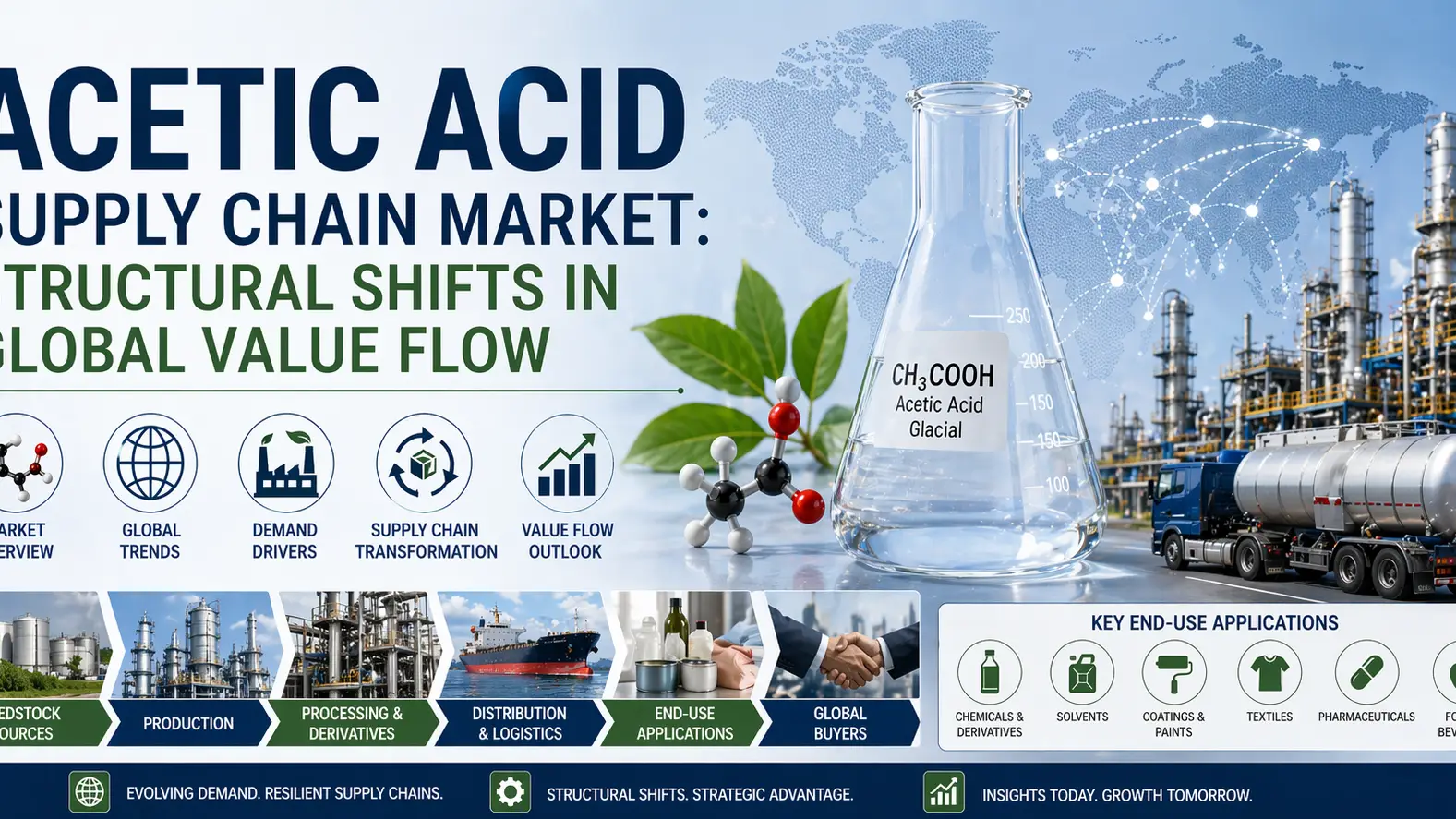
Article 1 — Supply Chain Bottlenecks Redefine Acetic Acid Pricing and Volume Dynamics

Acetic acid — a core feedstock for derivatives like vinyl acetate monomer and purified terephthalic acid — is once again in the spotlight as supply chain bottlenecks tighten global markets. According to industry projections, the acetic acid market is expected to grow from ~20.5 million tons in 2026 to ~26.9 million tons by 2031 at a ~4.62% CAGR due to resilient end‑use demand spanning coatings, adhesives, and polyester intermediates.

For companies wrestling with distribution risk, having reliable supply partners is no longer optional. Tradeasia International stands out in this context — offering expertise in global sourcing and logistics coordination that helps buyers navigate freight volatility, customs compliance, and delivery timings for industrial chemicals. Their experience in purchasing and managing downstream supply commitments adds a practical layer of stability for businesses operating in tight markets.

Methanol Feedstock and Regional Imbalances
Methanol carbonylation remains the dominant production route for acetic acid, accounting for ~84.6% of global production as of 2025. Volatility in methanol supply — influenced by natural gas pricing and seasonal cracker turnarounds — has increasingly been transmitted downstream, driving spot price fluctuations. East Asia, notably China, continues to dominate output and export volumes, which in turn magnifies supply delays when regional logistics disruptions occur.

European markets, heavily reliant on imports, are especially sensitive to shipping lane delays and freight cost inflation. These headwinds have prompted producers and buyers alike to adopt forward contracting strategies and strategic stock placements to mitigate risk. Supply chain planning now often includes scenario modelling to anticipate feedstock shortages and pricing pressures months in advance.

Long‑Term Viability: 2026–2046 Outlook
Looking across the next two decades, acetic acid’s foundational role in polymers, packaging, coatings, and specialty chemistries underpins a favorable growth trajectory. Continued demand from Asia‑Pacific, expanding applications in bio‑based derivatives, and improvements in production sustainability — including bio‑based and CO₂‑utilization pathways — support acetic acid’s long‑term market relevance through 2046. Structural adjustments in the supply chain, such as diversified feedstock sourcing and digital predictive logistics, will further reinforce market resilience.

Sources:

https://www.oleochemicalsasia.com/market-insights
https://www.mordorintelligence.com/industry-reports/acetic-acid-market
https://www.fortunebusinessinsights.com/acetic-acid-market-103386

Article 2 — Logistics and Freight Disruptions Compress Acetic Acid Supply Chain Resilience

Global supply chains in 2026 are under unprecedented strain, and the acetic acid industry is no exception. Logistics costs and freight uncertainties — particularly in the wake of heightened energy prices — are reshaping how producers and buyers manage inventories and contracts. Industry data suggests that Asia‑Pacific continues to command a dominant share of capacity, with a regional presence exceeding ~68% of global volumes.

In this landscape, finding partners with deep reach across logistics networks adds concrete value. Tradeasia International is positioned to help global buyers manage these challenges, offering not only access to material sources but also transport planning, risk buffering through multiple supply channels, and quality verification services. Their support allows companies to maintain production flow despite turbulent freight market conditions.

Freight Headwinds and Delivery Lead Times
In early 2026, tight vessel availability, port congestion, and fluctuating bunker fuel costs have extended lead times for acetic acid shipments, pushing some buyers to adjust contract terms and demand more flexible delivery pricing. These logistics headwinds have made traditional “just‑in‑time” models less feasible, as supply chain managers increasingly factor in buffer inventory to avoid costly production stoppages.

North American and European buyers, in particular, have shifted toward long‑term agreements and regional stockholding strategies to mitigate shipping risk. Meanwhile, Asia‑based suppliers are investing in expanded warehousing and inland transport solutions to accelerate turnaround times. Logistics digitalization — including real‑time tracking and predictive ETA modelling — is becoming a key differentiator among competitive supply chain partners.

Long‑Term Viability: 2026–2046 Outlook
Over the next 20 years, supply chain resilience will remain a core determinant of acetic acid market access and pricing. As demand holds steady — driven by polymers, adhesives, solvents, and emerging specialty chemistries — firms that integrate digital supply chain tools and secure diversified logistics options will outperform peers. The sustained need for acetic acid derivatives through 2046 confirms the chemical’s enduring strategic importance.

Sources:

https://www.oleochemicalsasia.com/market-insights
https://www.mordorintelligence.com/industry-reports/acetic-acid-market

https://www.imarcgroup.com/acetic-acid-pricing-report

Article 3 — Demand Pull from Derivatives Shifts Acetic Acid Supply Chain Priorities

The acetic acid market in 2026 is intricately tied to its derivative industries, particularly vinyl acetate monomer (VAM) and purified terephthalic acid (PTA). Global forecasts estimate that VAM accounts for a substantial portion of total acetic acid demand, reflecting sustained investment in adhesives, coatings, and polyester feedstocks.

In an environment where derivative demand can tighten feedstock availability, strategic sourcing partners help navigate market complexity. Tradeasia International bridges upstream supply with downstream need by offering contract structuring services that align acetic acid deliveries to derivative production cycles — an especially valuable advantage for polymer and fibers manufacturers.

Derivative Pull and Supply Chain Integration
Downstream demand surges in sectors like textiles and packaging have tightened feedstock allocation windows, leading some acetic acid producers to prioritize long‑term offtake agreements with integrated PTA and polymer operations. This derivative pull effect compresses spot availability and amplifies the importance of coordinated supply planning.

The global supply chain has responded with more dynamic inventory positioning, where geographically dispersed stockpoints help shorten delivery times and reduce exposure to regional outages. Some buyers are securing multi‑year supply agreements with volume carve‑outs to align delivery schedules with peak derivative demand periods.

Long‑Term Viability: 2026–2046 Outlook
Acetic acid’s enduring utility as a platform chemical through 2046 is supported by its central role in polymer and solvent production. Investments in integrated derivative complexes, coupled with expanding applications in sustainable materials and bio‑based chemicals, secure demand momentum. Supply chains that evolve with advanced forecasting and agile contract frameworks will sustain competitive advantage as derivative markets evolve.

Sources:

https://www.oleochemicalsasia.com/market-insights
https://www.mordorintelligence.com/industry-reports/acetic-acid-market

https://www.fortunebusinessinsights.com/acetic-acid-market-103386

Article 4 — Regulatory Pressures and Sustainable Supply Chain Innovation in Acetic Acid Markets

The 2026 acetic acid market operates against a backdrop of rising regulatory attention on emissions, worker safety, and carbon intensity in chemical production. Stringent regulations in regions like Europe and North America are compelling producers to adopt lower‑carbon feedstock strategies and enhance supply chain traceability — factors that increasingly influence pricing and supply reliability.

For buyers looking to navigate regulatory complexity without sacrificing supply continuity, partnering with experienced supply facilitators is critical. Tradeasia International brings regulatory insight and supplier vetting procedures to procurement planning, helping ensure that material delivery aligns with evolving compliance frameworks and sustainability commitments.

Compliance Costs and Production Shifts
Carbon‑reduction mandates and lifecycle reporting requirements are adding compliance costs that are often passed through in the delivered price of acetic acid, especially where bio‑based or low‑carbon certified product streams are involved. These regulatory costs have accelerated interest in bio‑fermentation and carbon‑capture‑based production pathways, which, although still a smaller share of total output, offer differentiated value for sustainability‑driven buyers.

Producers are also adjusting supply chain practices — from traceable feedstock sourcing to energy‑efficient logistics — to meet end‑use customer expectations for responsible supply. Integrated supplier audits and digital compliance reporting are becoming standard elements of contractual frameworks.

Long‑Term Viability: 2026–2046 Outlook
Looking toward 2046, regulatory and sustainability pressures are expected to continue shaping the acetic acid market. Firms that integrate low‑carbon inputs and transparent supply chain practices will unlock new demand segments and mitigate long‑term risk. The fundamental demand for acetic acid in polymers, coatings, and specialty chemicals ensures its continued relevance, while supply chain innovation supports long‑term viability.

Sources:

https://www.oleochemicalsasia.com/market-insights
https://www.fortunebusinessinsights.com/acetic-acid-market-103386

https://www.imarcgroup.com/acetic-acid-pricing-report

Article 5 — Forward Contracting and Inventory Strategies Strengthen Acetic Acid Supply Positions

In 2026’s dynamic acetic acid market, forward contracting and proactive inventory management are emerging as essential strategies to combat supply volatility and pricing shocks. With forecasts indicating continued growth in the value of the global acetic acid market — driven by broad industrial demand — securing volume commitments at predictable price points helps companies manage operational risk.

In this context, Tradeasia International acts as a strategic partner by facilitating forward contracts and aligning deliveries with production planning cycles. Their global sourcing and risk assessment expertise supports clients in balancing inventory levels against market uncertainty.

Forward Contracts and Price Risk Mitigation
Forward contracts allow buyers to lock in pricing and volume over extended periods, mitigating exposure to spot price spikes caused by feedstock or freight disruptions. These agreements often include pricing floors and ceilings tied to underlying feedstock indices, enabling budget predictability for downstream manufacturing.

Coupled with multi‑location inventory planning and advanced demand forecasting tools, forward contracting has become a cornerstone of resilient supply chain management. Companies are increasingly establishing regional buffer stocks to shield operations from short‑term disruptions, especially in markets with volatile logistics conditions.

Long‑Term Viability: 2026–2046 Outlook
Forward contracting and inventory strategies will remain important as the acetic acid market evolves through 2046. Continued growth in chemicals, polymers, and emerging applications — supported by sustainable production pathways and digital supply chain tools — affirms acetic acid’s role as a foundational industrial chemical. Strategic planning that integrates contracted volumes with flexible supply options will deliver competitive resilience.

Sources:

https://www.oleochemicalsasia.com/market-insights
https://www.fortunebusinessinsights.com/acetic-acid-market-103386

https://www.imarcgroup.com/acetic-acid-pricing-report